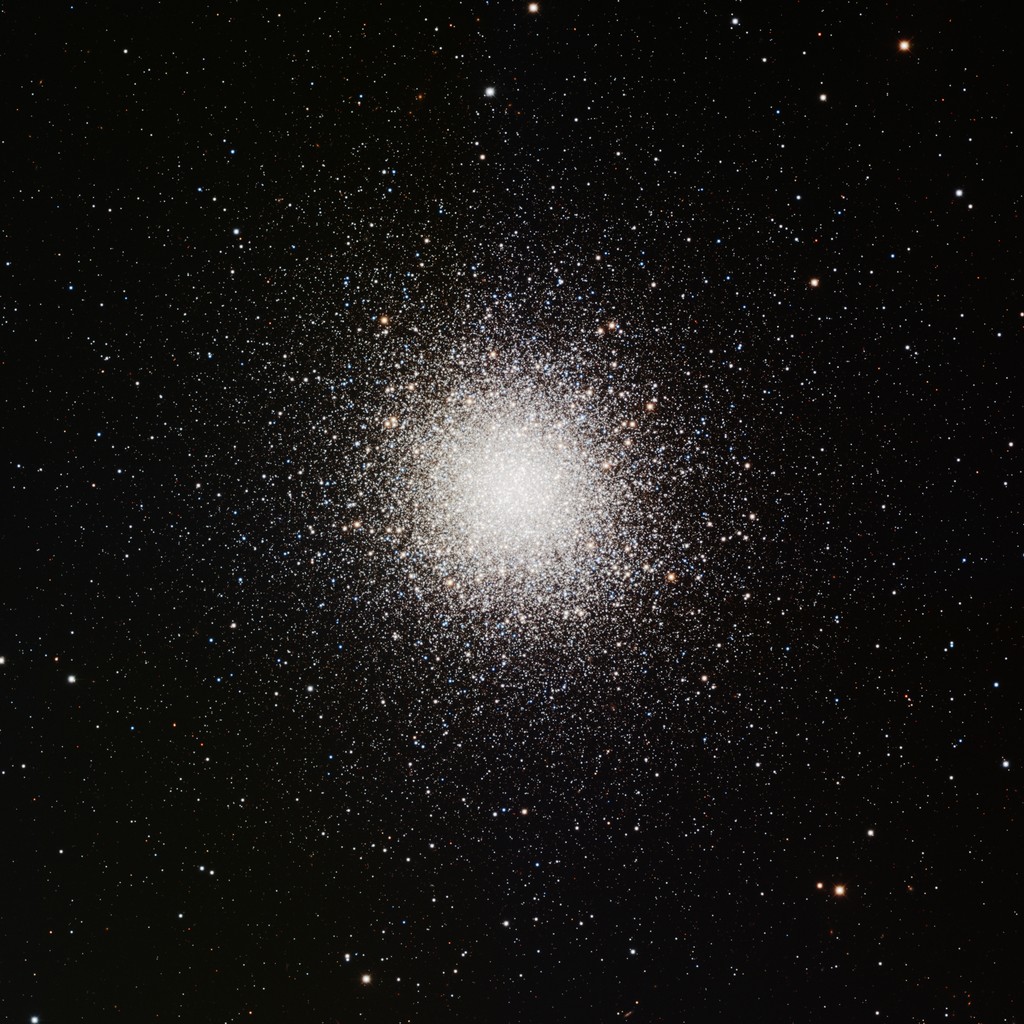
T.A. Rector (University of Alaska Anchorage) and H. Schweiker (WIYN and NOIRLab/NSF/AURA)
| Type | Globular Cluster | Constellation | Her |
|---|---|---|---|
| Magnitude | 5.8 | Size | 20.0′ |
| Distance | 22,200 light-years | Best Month | June |
| Visibility | Northern | Difficulty | Easiest (level 1/4) |
| Min. Aperture | naked eye | RA / Dec | 16h 41m 42.0s · +36° 27' 36" |
| Discovered by | Edmond Halley, 1714 | ||
T.A. Rector (University of Alaska Anchorage) and H. Schweiker (WIYN and NOIRLab/NSF/AURA)
Messier 13 (NGC 6205), the Great Hercules Cluster, is the finest globular cluster visible in the northern sky — a gravitationally bound swarm of several hundred thousand ancient stars spanning roughly 150 light-years, located about 25,000 light-years away in the constellation Hercules. It was discovered by Edmond Halley in 1714, who noted it as "but a little Patch, but it shews itself to the naked Eye, when the Sky is serene and the Moon absent." Charles Messier catalogued NGC 6205 in 1764. On a clear summer night it is just visible to the unaided eye as a faint smudge between the stars Eta and Zeta Herculis; a small telescope transforms it into one of the most magnificent sights in the sky.
NGC 6205 contains up to 300,000 stars, many of them ancient red and yellow giants, and has an estimated age of about 11.65 billion years. The cluster's core is extraordinarily dense — stars there are packed hundreds of times more tightly than in our solar neighborhood. In 1974, the Arecibo radio observatory transmitted a coded message toward M13, chosen as a symbolic address for any civilization that might exist among its stars. The message depicted the numbers 1–10, the atomic numbers of key elements, the structure of DNA, a human figure, and the solar system — a greeting that will reach the cluster in about 25,000 years.
M13 is visible to the unaided eye on a truly dark night and is a showpiece in any telescope. This image was made with the Mosaic wide-field camera on the Mayall 4-meter telescope at Kitt Peak National Observatory, using B (blue), V (green), and I (red) filters. Multiple short exposures were combined to preserve detail across the cluster's wide range of brightness from the dense core to the outer halo.
Navigate from Vega toward Hercules. From Vega, sweep 20° west-southwest — M13 sits on the western side of the Keystone asterism in Hercules.
| Star | Bayer | Mag | Spectral Type | Distance | Meaning |
|---|---|---|---|---|---|
| Alphekka | α CrB | 2.22 | A0 · White main sequence | 75 ly | Arabic Al-Fakka, 'The Broken Ring' — the gem of Corona Borealis, a bright star in a faint semicircular crown. |