NOIRLab/ NSF /AURA
| Type | Globular Cluster | Constellation | Oph |
|---|---|---|---|
| Magnitude | 7.6 | Size | 11.7′ |
| Distance | 30,300 light-years | Best Month | July |
| Visibility | Global | Difficulty | Moderate (level 3/4) |
| Min. Aperture | 3in | RA / Dec | 17h 37m 37.2s · -03° 15' 00" |
| Discovered by | Charles Messier, 1764 | ||
NOIRLab/ NSF /AURA
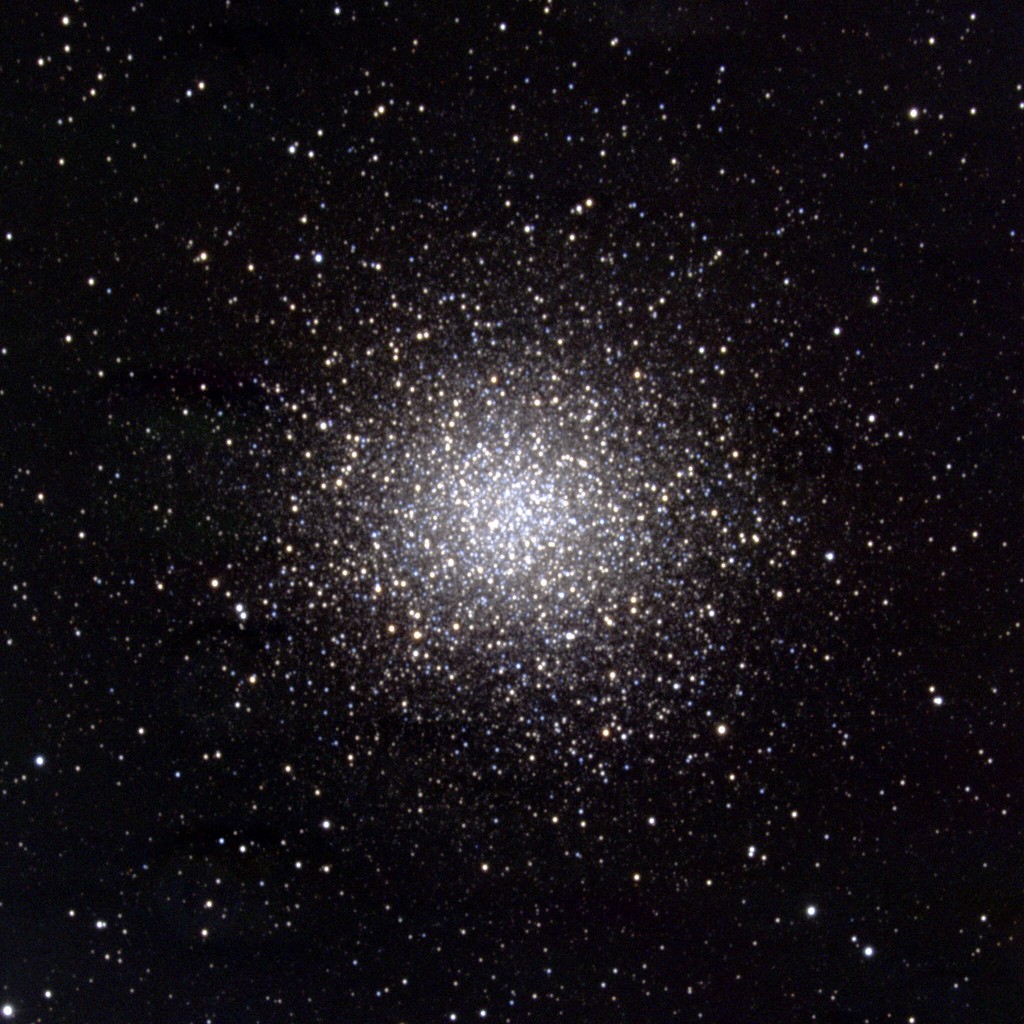
Messier 14 (NGC 6402) is a large globular cluster in the constellation Ophiuchus, lying approximately 29,000 light-years from Earth and spanning about 72 light-years across. It was discovered by Charles Messier on June 1, 1764. NGC 6402 is notable for its very slight ellipticity — barely deviating from a perfect circle — and for being one of the more loosely concentrated globulars in Messier's catalog, with a gradual falloff in star density from center to edge rather than a sharp, brilliant core. Despite its moderate appearance, M14 is a rich cluster containing around 150,000 stars with an estimated age of 13 billion years.
NGC 6402 made astronomical history in 1938 when a nova — a runaway thermonuclear explosion on the surface of a white dwarf — was detected within the cluster, one of the first novae observed in a globular cluster. It was only recognized from archival photographic plates 28 years after the fact. More recently, astronomers have catalogued hundreds of variable stars in M14, including RR Lyrae pulsators and W Virginis Cepheids — Population II variables useful for distance measurement. The cluster's relatively loose structure compared with similarly distant globulars makes it an interesting case study in globular cluster dynamics.
Through binoculars M14 appears as a faint, round glow; a 150 mm telescope shows a large, softly hazed sphere with a slightly brighter center, though individual stars require substantially larger apertures to resolve. This image was made from CCD exposures taken at the Kitt Peak National Observatory 0.9-meter telescope in April 1998.
Navigate from Vega toward Ophiuchus. In central Ophiuchus, roughly between M10 and M16.
| Star | Bayer | Mag | Spectral Type | Distance | Meaning |
|---|---|---|---|---|---|
| Cebalrai | γ Oph | 2.76 | K2 · Orange giant | 82 ly | Arabic Kalb al-Rā'ī, 'Heart of the Shepherd' — a quiet orange star marking the body of Ophiuchus the Serpent Bearer. |