NOIRLab/NSF/AURA
| Type | Globular Cluster | Constellation | Peg |
|---|---|---|---|
| Magnitude | 6.4 | Size | 18.0′ |
| Distance | 33,600 light-years | Best Month | September |
| Visibility | Northern | Difficulty | Easy (level 2/4) |
| Min. Aperture | binoculars | RA / Dec | 21h 30m 00.0s · +12° 10' 12" |
| Discovered by | Jean-Dominique Maraldi, 1746 | ||
NOIRLab/NSF/AURA
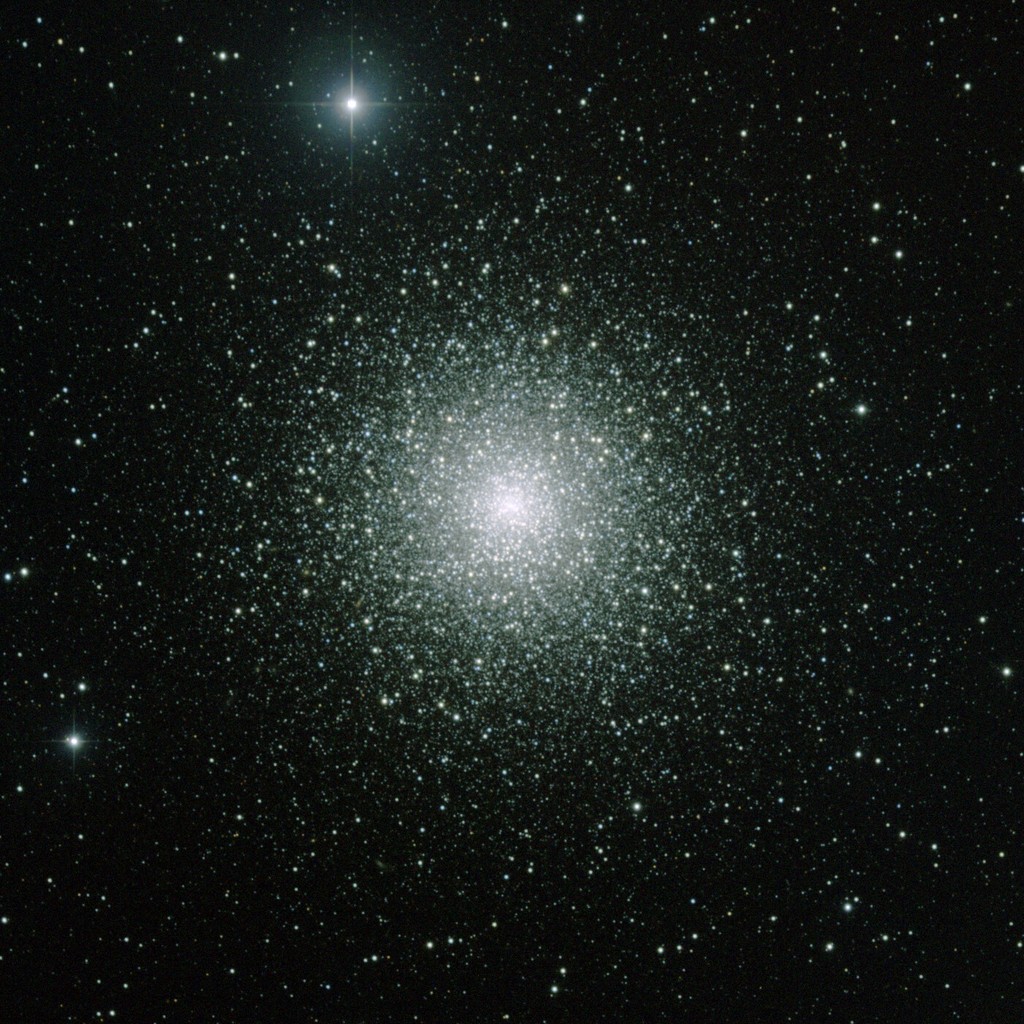
Messier 15 (NGC 7078) is one of the densest and most spectacular globular clusters in the Milky Way, lying approximately 33,000 light-years away in the constellation Pegasus and spanning roughly 120 light-years across. It was discovered by Jean-Dominique Maraldi in 1746 while tracking a comet; Charles Messier added it to his catalog in 1765. NGC 7078 is nearly visible to the naked eye on a clear night, and through any telescope it is a magnificent object — one of Messier's finest showpieces. Its surface brightness and high stellar density make it one of the most rewarding globulars to observe from the northern hemisphere.
NGC 7078 is remarkable among globular clusters for having undergone a process called core collapse: gravitational interactions between stars have funneled mass inward over billions of years, creating an extraordinarily dense, luminous core. Astronomers believe a central black hole or a concentration of stellar-mass black holes may sustain this ultra-dense nucleus. M15 also contains Pease 1, one of only four planetary nebulae ever found within a globular cluster — the glowing shell of gas expelled by a dying star, visible as a tiny blue dot in deep images. The cluster holds more than 100 known variable stars, including numerous RR Lyrae pulsators.
In binoculars M15 appears as a bright, concentrated haze west of the star Enif in Pegasus; a small telescope shows a noticeably bright core surrounded by a gradually fading halo, and larger apertures resolve a cascade of stars across the outer regions. This image was made from CCD exposures taken at the WIYN 0.9-meter telescope in July and September 1998; brightness was carefully compressed to reveal both the dazzling core and the faint outer halo simultaneously.
From Enif: From Enif (Epsilon Pegasi), move 4° northwest — M15 is easily found just northwest of this bright star.
| Star | Bayer | Mag | Spectral Type | Distance | Meaning |
|---|---|---|---|---|---|
| Enif | — | 2.38 | K2 · Orange supergiant | 690 ly | Arabic Al-Anf, 'The Nose' of the horse — marks the muzzle of Pegasus. A supergiant that varies irregularly in brightness. |
| Sadalmelik | β Aqr | 2.95 | G2 · Yellow supergiant | 520 ly | Arabic Sa'd al-Malik, 'Lucky Stars of the King' — one of several 'lucky star' names in Aquarius, associated with the spring rains in ancient Arabia. |