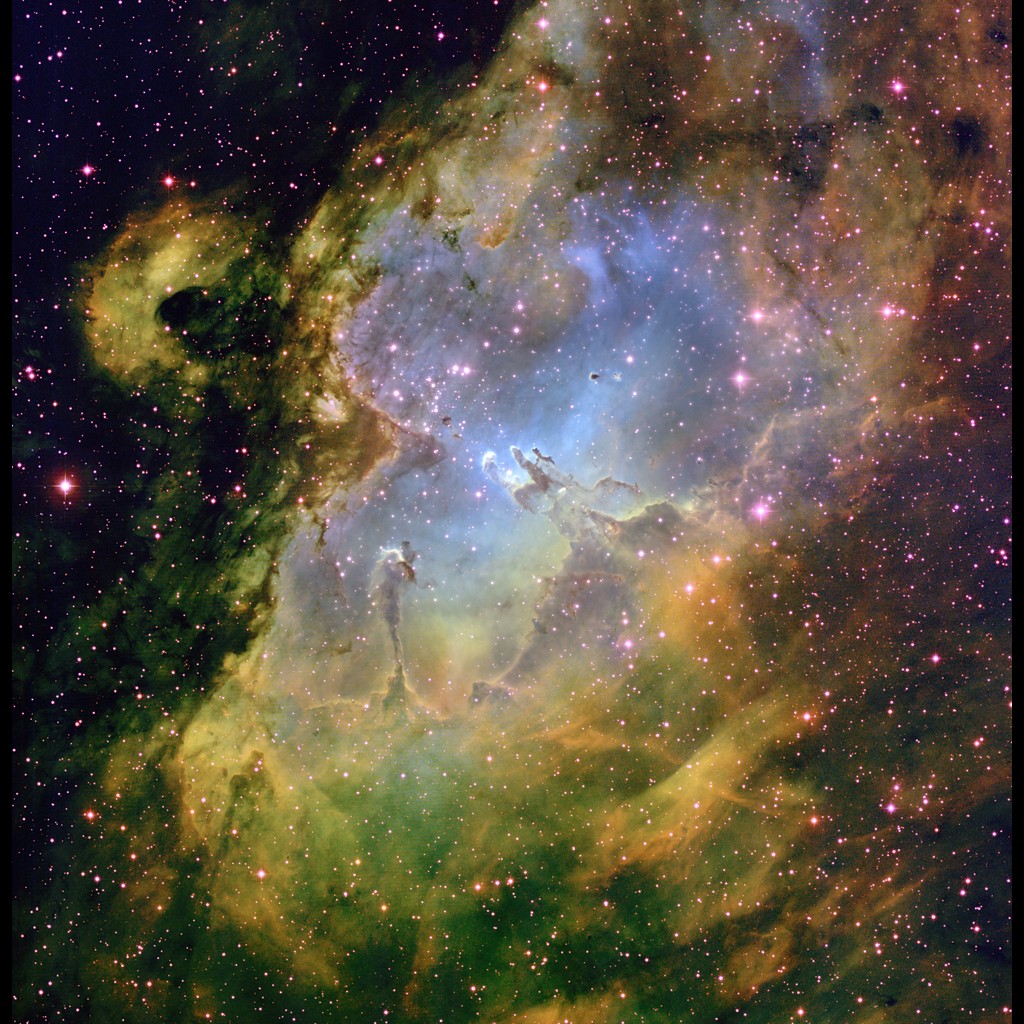
T.A.Rector (NRAO/AUI/NSF and NOIRLab/NSF/AURA) and B.A.Wolpa (NOIRLab/NSF/AURA)
| Type | Emission Nebula | Constellation | Ser |
|---|---|---|---|
| Magnitude | 6.4 | Size | 35.0′ |
| Distance | 7,000 light-years | Best Month | August |
| Visibility | Global | Difficulty | Easy (level 2/4) |
| Min. Aperture | binoculars | RA / Dec | 18h 18m 46.8s · -13° 46' 48" |
| Discovered by | Philippe Loys de Chéseaux, 1745 | ||
T.A.Rector (NRAO/AUI/NSF and NOIRLab/NSF/AURA) and B.A.Wolpa (NOIRLab/NSF/AURA)
Messier 16 (NGC 6611), the Eagle Nebula, is a luminous star-forming region in the constellation Serpens containing both a young open star cluster and the glowing cloud of gas and dust that gave birth to it. The embedded cluster was first recorded by Philippe Loys de Chéseaux in 1746, but the surrounding nebulosity was not noticed until Charles Messier catalogued the whole system in 1764. NGC 6611 lies approximately 7,000 light-years away in the Sagittarius-Carina spiral arm of the Milky Way — the same arm that contains the neighboring Omega Nebula, M17, just two degrees to the south. The nebula glows red with the light of ionized hydrogen energized by a cluster of brilliant O and B stars at its heart, stars only about two million years old yet already tens of times more massive than the Sun.
The Eagle Nebula is best known for its "Pillars of Creation," towering columns of cold gas and dust sculpted by the searing ultraviolet radiation of the hot young cluster stars. These elephant-trunk structures mark the leading edge of a retreating molecular cloud where new stars are still condensing inside compact globules of gas. The outward-flowing stellar winds have already cleared a cavity around the brightest members, leaving a complex of neutral lumps and bright-edged dark lanes that mark the boundary between newly ionized and still-protected material. Across the face of the nebula, dark knots and striations record the turbulent contest between radiation pressure and gravity playing out over millions of years.
M16 is a rewarding binocular object on a dark night, showing the combined glow of nebula and cluster; a telescope at moderate power reveals the pillars and the contrasting colors of the emission and dust regions. This image was taken at the Kitt Peak National Observatory 0.9-meter telescope with the Mosaic CCD camera, combining Hydrogen-alpha (green), Oxygen [O III] (blue), and Sulfur [S II] (red) emission-line exposures to highlight the nebula's structure.
Navigate from Vega toward Serpens. In Serpens Cauda, in the rich summer Milky Way — look for a bright star cluster with surrounding nebulosity.
| Star | Bayer | Mag | Spectral Type | Distance | Meaning |
|---|---|---|---|---|---|
| Nunki | ζ Sgr | 2.05 | B2 · Blue-white main sequence | 228 ly | Babylonian origin — one of the oldest known star names, from the Babylonian star catalogue. Associated with the sacred city of Eridu. |
| Kaus Borealis | — | 2.82 | K1 · Orange giant | 78 ly | Hybrid Arabic-Latin, 'Northern Bow' — marks the top of the Archer's bow in Sagittarius. Part of the Teapot asterism. |