A Gentle Guide to Deep-Sky Objects
Galaxies and Clusters and Nebulae — Oh My!
"In astronomy, amateurs have always played a major part, and they still do. Amateurs do things professional astronomers don't want to do, haven't time to do or can't do."
— Sir Patrick Moore, creator of the Caldwell CatalogLore & Science ↑ top
To the naked eye, the night sky appears to be a canvas of stars. But scattered among them — sometimes visible as faint smudges, sometimes only revealed through a telescope — are objects of an entirely different nature: deep-sky objects, or DSOs. These are nebulae, star clusters, and galaxies that exist far beyond our immediate stellar neighborhood — vast structures of gas, dust, and stars spanning light-years or thousands of light-years of space. Understanding what they are makes the act of finding them — at the eyepiece or through the camera — something more than a scavenger hunt; it transforms it into a journey through cosmic time and scale. Every DSO lives inside a constellation — if you're still finding your way around the night sky, our companion Constellation Guide is a good place to start.
Long before Messier compiled his catalog and long before any telescope existed, people around the world were recording deep-sky objects — without knowing what they were. The Pleiades appear in Homer, the Bible, and Aboriginal Australian oral tradition stretching back thousands of years. Hipparchus noted the Perseus Double Cluster around 150 BC; Ptolemy cataloged what we now call M7 in 130 AD; Arab astronomers described the Beehive (M44) as a "cloudy star" visible between Cancer's claws.
The most remarkable pre-telescopic record belongs to the Persian astronomer Abd al-Rahman al-Sufi, who in 964 AD described a "little cloud" in his Book of Fixed Stars at the position of what we now know as the Andromeda Galaxy — M31. He was recording a galaxy containing a trillion stars, 2.5 million light-years away, nearly seven centuries before Messier and a thousand years before anyone understood what a galaxy was. In the southern sky, the Large and Small Magellanic Clouds — satellite galaxies of the Milky Way — were known to peoples of the southern hemisphere for millennia before Europeans documented them after Magellan's 1519 voyage.
A galaxy is a vast, gravitationally bound system of stars, stellar remnants, gas, dust, and dark matter — an entire community of billions of suns held together around a common gravitational center, almost always a supermassive black hole. While a star cluster might contain tens of thousands of stars, a galaxy contains millions, or even trillions. They are the fundamental building blocks of the observable universe, and there are an estimated two trillion of them within range of our telescopes.
Astronomers classify galaxies using the Hubble sequence, often visualized as a tuning fork. The handle represents elliptical galaxies, grading from nearly spherical (E0) through intermediate forms (E3, E5) to strongly elongated (E7). Where the handle meets the fork sits the lenticular class (S0) — disc galaxies that have exhausted their gas and lost their spiral arms, occupying the transition between ellipticals and spirals. The fork then divides into two prongs: normal spirals running from tightly wound arms (Sa) through intermediate (Sb) to open, loosely trailing arms (Sc); and barred spirals following the same sequence (SBa, SBb, SBc) with a straight bar of stars driving the arms from the nucleus outward. Irregular galaxies — those that fit no branch — fall off the diagram entirely.
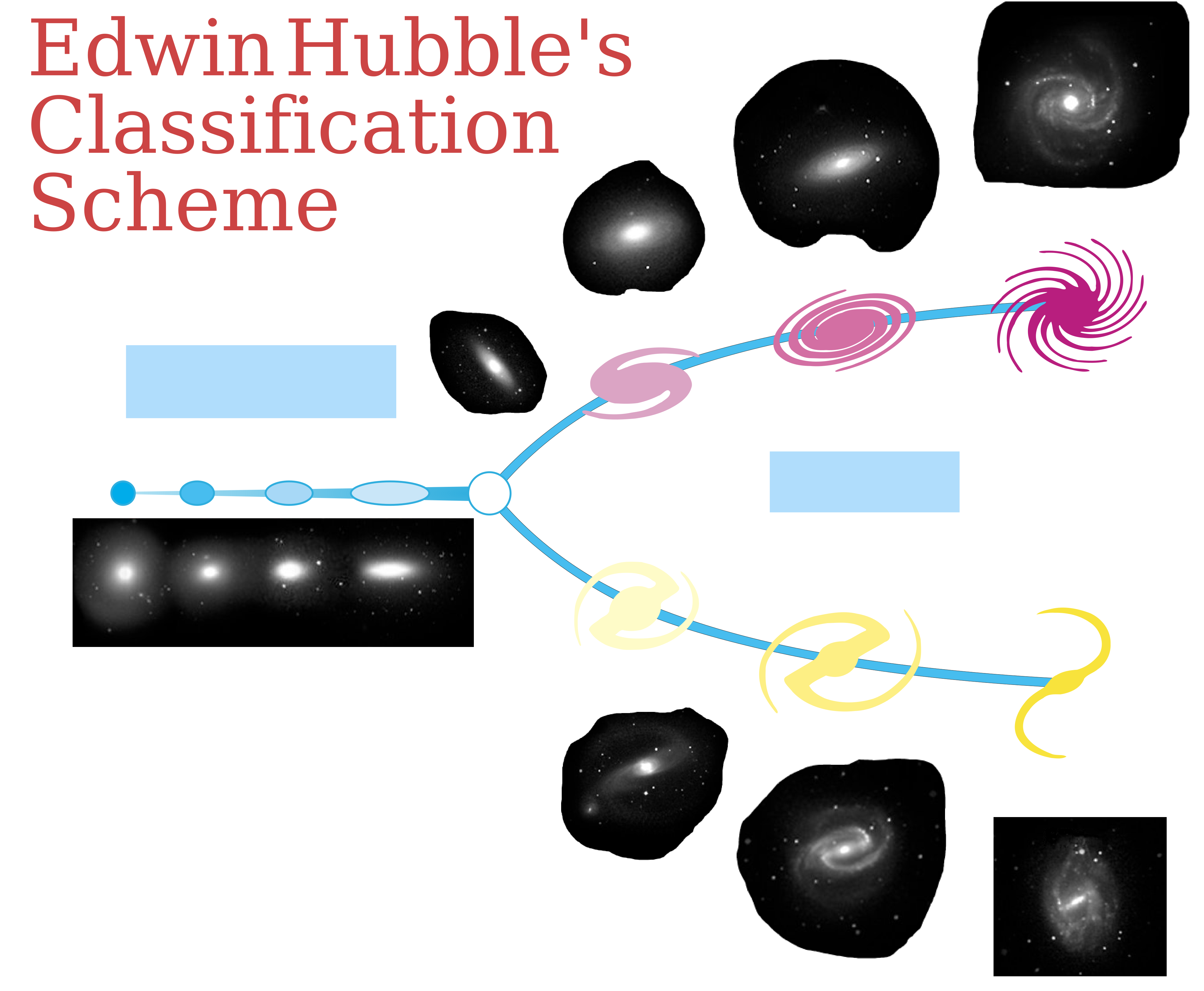
The Hubble Sequence — Edwin Hubble's "tuning fork" diagram organising galaxies by shape. Ellipticals (E0–E7) form the handle; at the fork: normal spirals (Sa–Sc) above, barred spirals (SBa–SBc) below.
Spiral galaxies (Sa–Sc) are the most familiar — flat, rotating discs with sweeping arms of stars, gas, and dust curling outward from a bright central bulge, with arm tightness decreasing from Sa through Sb to the open, fragmented arms of Sc. Barred spirals (SBa–SBc) follow the same sequence but sport a prominent straight bar of stars across the nucleus, from which the arms emerge at each end rather than winding directly from the center. Our own Milky Way is an SBb or SBc; the Andromeda Galaxy is an Sb. Elliptical galaxies (E0–E7), by contrast, are smooth and featureless — stretched spheres containing very little gas or dust, their star-forming days largely over. They are in many respects the "elderly" galaxies of the universe, composed mostly of older, cooler, redder stars. Lenticular galaxies (S0) sit at the crossroads: they have a disc like a spiral but no arms and little gas, halfway between the two extremes. Then there are irregular galaxies (Irr), which defy neat classification entirely: chaotic, asymmetric systems whose distorted shapes are usually the legacy of a gravitational encounter — a near-collision or outright merger with a neighboring galaxy that shredded their orderly structure. For most galaxies, shape is biography — the record of mergers survived, gas lost, and neighbors encountered.
The word nebula comes from the Latin for "cloud" or "mist," and that is precisely what these objects are: vast, diffuse regions of gas and dust drifting through the space between stars. If galaxies are the cities of the universe, nebulae are the nurseries and the graveyards — the raw material from which stars condense, and in many cases the material that stars leave behind when they die.
They come in several distinct varieties, classified by how they interact with light. Emission nebulae glow in their own right: nearby hot, young stars flood them with intense ultraviolet radiation, ionizing the surrounding gas and causing it to fluoresce in specific colors — the deep red of hydrogen, the blue-green of oxygen. The Orion Nebula (M42) is perhaps the most famous example. Reflection nebulae emit no light of their own; instead they scatter and reflect the light of nearby stars, much like fog around a streetlamp — and for the same reason that our daytime sky is blue, they tend to take on a cool, blue tint. Dark nebulae are invisible in the usual sense: so dense with dust that they block the light of everything behind them, appearing as voids or dark silhouettes against the glow of the Milky Way.
Two types of nebulae mark the deaths of stars. Planetary nebulae — despite the name, a historical accident from early observers who thought they resembled planets through small telescopes — have nothing to do with planets at all. They are the shed outer layers of dying, sun-like stars: as such a star exhausts its fuel, it puffs outward into a beautiful, expanding shell of glowing gas, leaving a tiny white dwarf at its center. When a far more massive star dies, the result is far more violent: a supernova explosion that scatters debris across light-years, creating a supernova remnant — a turbulent, energetic cloud that can remain visible for thousands of years. The Crab Nebula (M1), the first object in Messier's catalog, is exactly this: the still-expanding wreckage of a stellar explosion witnessed by Chinese astronomers in 1054 AD.
These types are not isolated phenomena — they are chapters in the same continuous cycle. A cold molecular cloud collapses under its own gravity, igniting stars and sculpting the surrounding gas into an emission nebula. Those stars grow, age, and eventually return their material to space — gently, as a planetary nebula, or violently, as a supernova remnant. That expelled gas and dust drifts through the galaxy, seeding the next generation of clouds, and the cycle begins again. When you look at a nebula through an eyepiece or a camera, you are watching stellar life in progress — either its beginning or its end.
A star cluster is a family of stars born together from the same nebula and held in each other's gravitational embrace. Open clusters are loose, young groupings of dozens to thousands of stars, typically found within the disc of the Milky Way — the Pleiades are the most famous example. Globular clusters are far older and far more spectacular: ancient, densely packed spheres of tens of thousands to millions of stars, orbiting the outskirts of our galaxy like attendant moons. Through a telescope, the core of a rich globular cluster — M13 in Hercules, or Omega Centauri — resolves into a breathtaking swarm of individual suns.
The difference in appearance between these two cluster types is not merely structural — it reflects their age, and astronomers can read that age directly from a cluster's stars. In a Hertzsprung-Russell diagram — a plot of stellar brightness against color — stars of a given cluster trace out a characteristic pattern. Young open clusters still have hot, blue, massive stars burning near the top; old globular clusters have long since exhausted those short-lived giants, and their brightest remaining stars are cooler, orange-red subgiants. The point where a cluster's stars begin to peel away from the main stellar sequence — the turnoff point — is a direct clock: the higher on the diagram, the younger the cluster. This technique of main-sequence fitting is how astronomers date clusters to within a few percent, no radioactive decay required.
Underlying this age difference is a distinction in stellar chemistry. Population I stars — like our Sun — are relatively young and metal-rich, forged from gas already enriched by earlier generations of stellar explosions. They populate the discs of spiral galaxies and are found in open clusters. Population II stars are ancient and metal-poor, born in the early universe when only hydrogen and helium were abundant. They inhabit galaxy halos and globular clusters. This is why globular clusters contain no nebulosity and no blue supergiants: their gas was consumed or dispersed billions of years ago, and the massive stars that would shine blue burned out long before recorded history. The reddish, uniform glow of a rich globular is the color of extreme old age.
Every object in this guide carries two brightness figures: magnitude and, for extended objects, surface brightness. Magnitude is a logarithmic scale inherited from ancient Greek astronomy — each step of one magnitude represents a brightness difference of about 2.5 times, so a magnitude 5 star is 100 times fainter than a magnitude 0 star. Confusingly, brighter objects have lower — even negative — numbers: the full Moon sits around magnitude −12, Venus peaks near −4, and the faintest stars visible to the naked eye from a dark site are around magnitude 6 or 7.
For deep-sky objects, the integrated magnitude tells you how bright the object would appear if all its light were concentrated into a single point — but most DSOs are not points. A galaxy or nebula spreads its light across an area of sky, and a large but faint object can be genuinely difficult to see even if its total magnitude looks promising on paper. Surface brightness corrects for this: it measures brightness per unit of sky area, and it is a far better predictor of how easy an object will actually be to detect. The Triangulum Galaxy (M33) is a classic example — magnitude 5.7 sounds bright, but its light is spread so thinly across nearly a degree of sky that it is one of the most challenging Messier objects to see with the naked eye, even from a dark site. The difficulty ratings in this guide are based on surface brightness and aperture requirements, not integrated magnitude alone.
Three catalogs define how astronomers organize these objects. The Messier Catalog (M1–M110) was compiled by French astronomer Charles Messier in the 18th century — not out of love for nebulae and galaxies, but as a list of objects to avoid while hunting comets. Paradoxically, his nuisance list became one of the most celebrated collections in observational astronomy. The Caldwell Catalog (C1–C109) was created in 1995 by British astronomer Sir Patrick Moore to complement Messier — adding spectacular objects Messier missed, especially in the southern sky. Where Messier's numbers follow roughly the order of discovery (M1 was first logged in 1758, M110 last), Moore ordered his catalog by declination — C1 near the north celestial pole, C109 deep in the southern sky — making the numbering a deliberate sweep of the entire sky from top to bottom. The New General Catalogue (NGC) is the master reference: nearly 8,000 objects compiled by John Louis Emil Dreyer in 1888, the backbone of professional and amateur astronomy alike. Dreyer ordered his entries by right ascension — west to east around the celestial equator — so NGC numbers climb steadily from NGC 1 in Pegasus near 0h through to the high numbers approaching 24h, then wrap around the sky.
The NGC was the product of over a century of purely visual observation — a technique astronomers called sweeping. An observer would fix their telescope at a set declination and let the Earth's rotation slowly drift the sky across the field of view, watching hour after hour for faint fuzzy patches among the stars. When one appeared, they stopped, measured its position with the telescope's graduated circles, and recorded its size, brightness, and shape entirely by eye. William Herschel perfected this method using enormous hand-built reflecting telescopes — his famous 48-inch "40-foot" instrument was the largest in the world. The human eye, especially with averted vision (looking slightly to one side to engage the more light-sensitive rod cells of the retina), was the only detector. It was physically gruelling work, prone to positional errors and occasional misidentifications, but it revealed thousands of objects previously unknown to science.
Photography changed everything almost the moment the NGC appeared. Long-exposure dry-plate photography could record objects far fainter than any human eye could see even through the largest telescopes. Astronomers such as Isaac Roberts and Max Wolf began sweeping the sky with cameras rather than eyes, rapidly discovering thousands of faint nebulae the visual era had entirely missed. The flood of new objects led Dreyer to publish two supplementary Index Catalogues — IC I in 1895 and IC II in 1908 — adding 5,386 objects and bringing the combined total to more than 13,000. Unlike the purely visual NGC, the IC catalogs are where astrophotography first enters the story: many of their entries were discovered specifically through photographic plates, and could not have been found any other way.
This guide is organized around the Messier and Caldwell catalogs, with NGC and IC numbers woven in throughout — because a great object is worth finding whatever name it goes by.

The Hunters ↑ top
Before photography, before computers, before electric light — a handful of astronomers changed the way humanity understands the universe. Armed with handmade telescopes, photographic plates, and an inexhaustible patience for darkness, they cataloged the deep sky object by object, night after night.
Charles Messier was obsessed with comets — he discovered thirteen and was known at the French court as the "Ferret of Comets." But his greatest frustration was the fuzzy objects that mimicked comets in his telescope: nebulae and star clusters that never moved. In 1758, he mistook the Crab Nebula (M1) for a comet and began keeping a list of objects to ignore. That list grew to 110 entries — several co-discovered with his colleague Pierre Méchain — and became the most-observed collection in amateur astronomy. Today, dedicated observers attempt the "Messier Marathon": viewing all 110 objects in a single night each spring, when geometry briefly makes it possible. Messier's nuisance catalog is now his greatest legacy.
Caroline Herschel was the first professional woman astronomer — paid a royal salary by King George III, she discovered eight comets and cataloged hundreds of deep-sky objects her brother William had missed. Born in Hanover and initially kept as a household servant by her own family, she was brought to England by William to assist his work — a role she quickly outgrew, becoming a formidable independent observer in her own right. Her discovery of NGC 253, the Sculptor Galaxy, in 1783 was among her finest: a massive spiral galaxy visible to the naked eye from dark skies, later ranked among the most productive star-forming galaxies known. She lived to 97 and received the Gold Medal of the Royal Astronomical Society — an honour not given to another woman for 168 years.
William Herschel built the largest telescopes of his age and used them to conduct the first systematic survey of the deep sky, cataloging over 2,500 nebulae and star clusters. He was the first to argue that the Milky Way was a disk-shaped system of stars — and that the fuzzy "nebulae" might be island universes as vast as the Milky Way itself. His intuition was correct, but the technology to prove it would not arrive for another century. A professional musician by training, he taught himself astronomy and telescope-making, ultimately constructing more than 400 instruments and grinding mirrors by hand with his sister Caroline at his side. In 1781, during one of his methodical sweeps of the sky, he discovered Uranus — the first planet found in the modern era, a moment that instantly doubled the known boundaries of the solar system. His catalogs, merged with his son John's southern-sky surveys, formed the foundation of Dreyer's NGC.
John Dreyer was a meticulous Danish-Irish astronomer who took on an almost impossible editorial task: making sense of the dozens of contradictory, overlapping catalogs that had accumulated over a century of visual observation. Dreyer was not primarily a discoverer — he was a compiler and reconciler. By the 1880s, astronomers were drowning in duplicates and conflicting coordinates from the Herschels, d'Arrest, Bigourdan, Lord Rosse, and many others. Dreyer spent years cross-referencing every observation, eliminating duplicates, and recalculating positions. The result — 7,840 objects published by the Royal Astronomical Society in 1888 — was the final, crowning achievement of the visual era. Almost immediately, photography began revealing thousands more objects invisible to the eye. Dreyer responded with two supplementary Index Catalogues in 1895 (IC I) and 1908 (IC II), adding 5,386 photographic discoveries and bringing the total to 13,226. NGC and IC numbers remain the universal reference system in professional astronomy to this day.
When dry-plate photography arrived in the 1880s, it exposed a stark limitation of the human eye: even through William Herschel's enormous telescopes, visual observers could only see a fraction of what the sky contained. Isaac Roberts in Britain and Max Wolf in Germany were among the first to systematically photograph the sky with long exposures, allowing the glass plate to accumulate light over hours. Roberts produced iconic early photographs of the Andromeda Nebula, revealing its spiral structure for the first time. Wolf alone discovered hundreds of new nebulae and asteroids. Their work, and that of their contemporaries, provided the flood of photographic discoveries that populated Dreyer's Index Catalogues — and inaugurated an era in which the camera, not the eye, became astronomy's primary instrument.
Henrietta Swan Leavitt never received the recognition she deserved in her lifetime. Hired as a "computer" at the Harvard College Observatory — one of dozens of women employed to measure photographic plates for low wages — she was assigned to study variable stars in the Magellanic Clouds. In 1912 she published a discovery of profound consequence: Cepheid variable stars follow a strict relationship between their pulsation period and their true luminosity. Measure the period and you know the true brightness; compare that to apparent brightness and you have its distance — a cosmic ruler of extraordinary reach. Hubble used her method to measure Andromeda and prove that galaxies exist far beyond the Milky Way. Without Leavitt's period-luminosity law, the scale of the universe would have remained unmeasured for decades more.
Edwin Hubble transformed humanity's understanding of the cosmos in a single decade. Working at Mount Wilson Observatory, he used Leavitt's Cepheid ruler to prove in 1923 that the Andromeda Nebula lay far beyond the Milky Way — demolishing the prevailing assumption that our galaxy was the entire universe. Where others saw fuzzy smudges, Hubble saw island universes. He then systematically classified galaxies by shape, producing the tuning fork diagram shown in the section above — a framework still in everyday use. In 1929 he announced that the universe was expanding: every galaxy receding from every other, the most distant ones fastest of all. That single observation became the foundation of modern cosmology and the Big Bang theory. The Hubble Space Telescope bears his name.
Sir Patrick Moore — broadcaster, author, and tireless champion of amateur astronomy — noticed that Messier's catalog, magnificent as it was, had a northern bias and left out many of the sky's most spectacular objects. In 1995, at the age of 72, he published the Caldwell Catalog: 109 objects selected to complement Messier, covering both hemispheres from the brilliant Double Cluster in Perseus to the Eta Carinae Nebula deep in the southern sky. He chose to identify his catalog with the letter "C" — for Caldwell, his middle name — since "M" was already Messier's, and using "Mo" for Moore would have been awkward. Beyond the catalog, Moore presented the BBC's The Sky at Night for 55 consecutive years — the world's longest-running television programme with the same host — remaining an ardent advocate for keeping astronomy accessible to everyone until his death in 2012.
Harvard College Observatory, c. 1890
(Public Domain)
Between 1885 and 1927, the Harvard College Observatory employed roughly 80 women to work through a vast archive of glass photographic plates — the raw data of the deep sky. Hired as "computers" by director Edward Charles Pickering, they were paid less than unskilled male laborers and largely denied academic credit, yet their painstaking classification of nebulae, star clusters, and stellar spectra became the backbone of modern astronomy's catalog of the universe. More than forty years before women could vote in the United States, these women were doing the foundational science.
Their contributions to deep-sky astronomy were direct and permanent. Williamina Fleming — originally hired as Pickering's housemaid — discovered 59 gaseous nebulae from the plates, including the Horsehead Nebula (IC 434) in 1888, one of the most photographed objects in the sky today; Dreyer's first Index Catalogue attributed her discoveries not to her, but simply to "Pickering." Henrietta Swan Leavitt, whose card appears above, discovered the Cepheid period-luminosity law that gave astronomy its first reliable ruler for measuring the distance to nebulae and galaxies. The plates these women analyzed fed directly into Dreyer's Index Catalogues of 1895 and 1908 — the thousands of newly discovered objects that carry IC numbers to this day. By the time the second catalog appeared, Fleming and her colleagues were famous enough to receive proper credit; the omissions of the first catalog were never corrected.
"In these days of great trouble and unrest, it is good to have something outside our own planet, something fine and distant and comforting to troubled minds."
— Annie Jump Cannon, Harvard Computer & astronomer (1863–1941)What's Inside ↑ top
This is an introduction to the dark sky — not a professional reference. It is designed to educate, inform, and inspire: to explain what the different types of deep-sky objects actually are, show you where to find them in the night sky, and give you a sense of the ancient universe you are looking at. Light from some of these objects left its source long before life existed on Earth.
Our guide is built for observers at every level — from first-time binocular users to seasoned telescope operators. Every object in the Messier and Caldwell catalogs is documented, cross-referenced, and mapped.
Browse and filter all 110 Messier objects and 109 Caldwell objects by type, constellation, difficulty, hemisphere, and best viewing month. Cross-referenced to NGC numbers throughout.
Every object includes discovery history, scientific data — distance, magnitude, angular size — and observing notes covering what to expect at the eyepiece or through the camera.
A four-level difficulty rating guides you from naked-eye showpieces to targets requiring dark skies and serious aperture — match each object to your equipment and conditions before you step outside.
Programmatic finder charts show you how to star-hop from a bright naked-eye anchor to your target, overlaid on the host constellation's stick figure. These are not a real-time mobile sky guide — they are intended to give you context and a general sense of where to look before you step outside.
Both catalogs use NGC or IC numbers as their common language — M1 is NGC 1952, C49 is NGC 2237. Every object page shows these cross-references, so whether you know a target by catalog name, NGC number, or popular name, you can find it. Each object also links to its host constellation in the companion guide.
Ground-based and amateur deep-sky imagery — intentionally chosen over space telescope images to stay approachable. Long-exposure photographs reveal structure and color invisible at the eyepiece, and show what patient astrophotography from Earth can achieve.
How much you can see depends as much on your sky as your telescope. The Bortle scale — a nine-point measure of sky darkness — is the most useful single number for predicting what is visible. A Class 1 sky is a pristine dark site where the zodiacal light casts shadows; a Class 9 is a bright city centre where only the Moon, planets, and the brightest stars are visible. Most suburban observers live under Class 5–7 skies, where the Milky Way is faint or absent and only the brightest DSOs can be found without optical aid. The difficulty ratings in this guide assume a Class 4–5 sky — dark enough to be rewarding, realistic enough to be honest.
Two techniques that cost nothing significantly improve what you can detect. Dark adaptation is the process by which your eyes adjust to darkness — the pupils dilate and the retina switches from cone cells to the more light-sensitive rod cells, a chemical process that takes 20 to 30 minutes and is destroyed in seconds by white light. Even a brief glance at a phone screen can set your adaptation back significantly; red lights are used at observatories because red wavelengths affect rod cells far less. Averted vision exploits the anatomy of the retina directly: the center of your visual field is dominated by cone cells optimised for color and detail, while the edges are rod-rich and far more sensitive to faint light. Looking slightly to one side of a dim object — so its light falls on the peripheral retina rather than the center — can reveal objects that are genuinely invisible when stared at directly. Both techniques were known to visual observers a century before electric light existed, and both remain essential today.
"The cosmos is within us. We are made of star-stuff. We are a way for the universe to know itself."
— Carl Sagan, Cosmos, 1980Explore the Guide ↑ top
Choose where you'd like to begin — browse the full catalog, dive into a single object, or cross over to the constellation guide to orient yourself in the night sky first.
Every object detail page includes ground-based imagery — sourced from land-based observatories and amateur astronomers wherever possible — alongside programmatic finder charts, so you can study the object at home before taking it to the eyepiece. These are real photons from objects millions or even billions of light-years away; the light arriving at your eye tonight left its source long before humans existed.
Browse and filter all 110 Messier objects and 109 Caldwell objects — with NGC cross-references — by type, hemisphere, difficulty, constellation, and more.
Browse the catalog →Deep-dive into any object — images, finder chart, discovery story, scientific data, and observing notes. Start with M13, the magnificent Hercules Globular Cluster.
Example: M13 (C45) →Every deep-sky object lives inside a constellation. If you're not sure how to find your way around the night sky, start with our constellation guide — learn the star patterns and star-hop your way to the right region before hunting for faint DSOs within it.
Go to the Constellation Guide →About & Credits ↑ top
This app was created by Andy Felong, a mostly retired software engineer with more than 40 years of experience spanning development, IT, quality assurance, operations, and management. Andy's passion for astronomy began long before his career, but was profoundly deepened by his early work writing real-time imaging software for Voyager spacecraft at the Jet Propulsion Laboratory. He has since held senior technology leadership roles at Apple Computer, Oracle Corporation, and Walmart.com, and most recently served as Vice President of Engineering at Agile Mind, a STEM oriented educational software company. Andy is an active contributor to the Open Source community and maintains a personal website at andyfelong.com. He is currently a member of the Martz-Kohl Observatory, where he serves on the Media and Public Relations team, and is exploring the new generation of “smart” telescopes.
This app is free to use for personal, educational, and non-commercial purposes. Please do not reproduce or redistribute without permission.
Deep-sky imagery in this guide is selected with a deliberate philosophy: wherever possible, images come from ground-based observatories and amateur astronomers rather than space telescopes. The goal is approachability — photographs taken from Earth that show these objects as a skilled observer with a serious instrument might see them, rather than the hyper-processed composites produced by Hubble or Webb. Space telescope imagery, however stunning, can make deep-sky objects feel alien and unreachable; ground-based and amateur images keep them connected to the night sky above you.
Primary image sources are NOIRLab (National Optical-Infrared Astronomy Research Laboratory, CC BY 4.0; credit: NOIRLab/NSF/AURA) and ESO (European Southern Observatory, CC BY 4.0; credit: ESO). For a small number of objects where no suitable ground-based image is available, archival NASA/ESA Hubble images are used (CC BY 4.0; credit: NASA, ESA, and the Hubble Heritage Team). Amateur images are used where licensing permits; individual credits appear on the relevant object pages. Finder charts are generated programmatically from the HYG Star Database v4.2 (David Nash, CC BY-SA 4.0). IAU constellation boundaries courtesy of the International Astronomical Union.
The historical and scientific content on this site draws on the following primary and secondary sources. Summaries are editorial in nature — written as accessible introductions rather than academic treatments — and are intended for educational and non-commercial use only.
Images are sourced almost entirely from ground-based observatories and individual photographers — consistent with the philosophy of keeping this guide approachable. The dominant source is NOIRLab / Kitt Peak National Observatory (Arizona), which supplies the majority of images across the catalog, often with individual astronomers and REU (Research Experiences for Undergraduates) program participants credited alongside the facility. A meaningful number of images come from amateur and independent photographers — people credited by name, shooting with their own equipment or through public access programs at professional observatories such as Adam Block's program at Kitt Peak and Mount Lemmon. A smaller set draws on digital sky surveys — Pan-STARRS, the Sloan Digital Sky Survey, and the Digitized Sky Survey — all ground-based. Space telescope imagery is essentially absent: two objects carry credits tied to Hubble or the Euclid mission, where no ground-based alternative was available.
If you want to explore further, NOIRLab's public image gallery is one of the finest freely licensed collections of professional astronomical photography on the web. Every image is released under Creative Commons and covers the full range of deep-sky objects — many of the same objects in this guide, often in higher resolution than shown here.
Wikimedia Commons is a broad, community-curated repository of freely licensed media that includes a large and varied collection of astronomical images — professional survey data, ESO and NASA releases, and amateur astrophotography. It is particularly useful for finding images of objects that fall outside the Messier and Caldwell catalogs, and is where many of the survey-based images in this guide (DSS, Pan-STARRS) can be traced back to.
Development Tools — This application was developed with assistance from Claude (Anthropic), an AI assistant used for code review, content organization, and testing support. All editorial decisions, design, data selection, and final implementation are the work of Andy Felong.
Historical summaries and observing descriptions are editorial in nature and intended as introductions only. Scientific data (distance, magnitude, size) is drawn from current catalog sources and may differ from older published values as measurements are refined.
Version 1.1.0