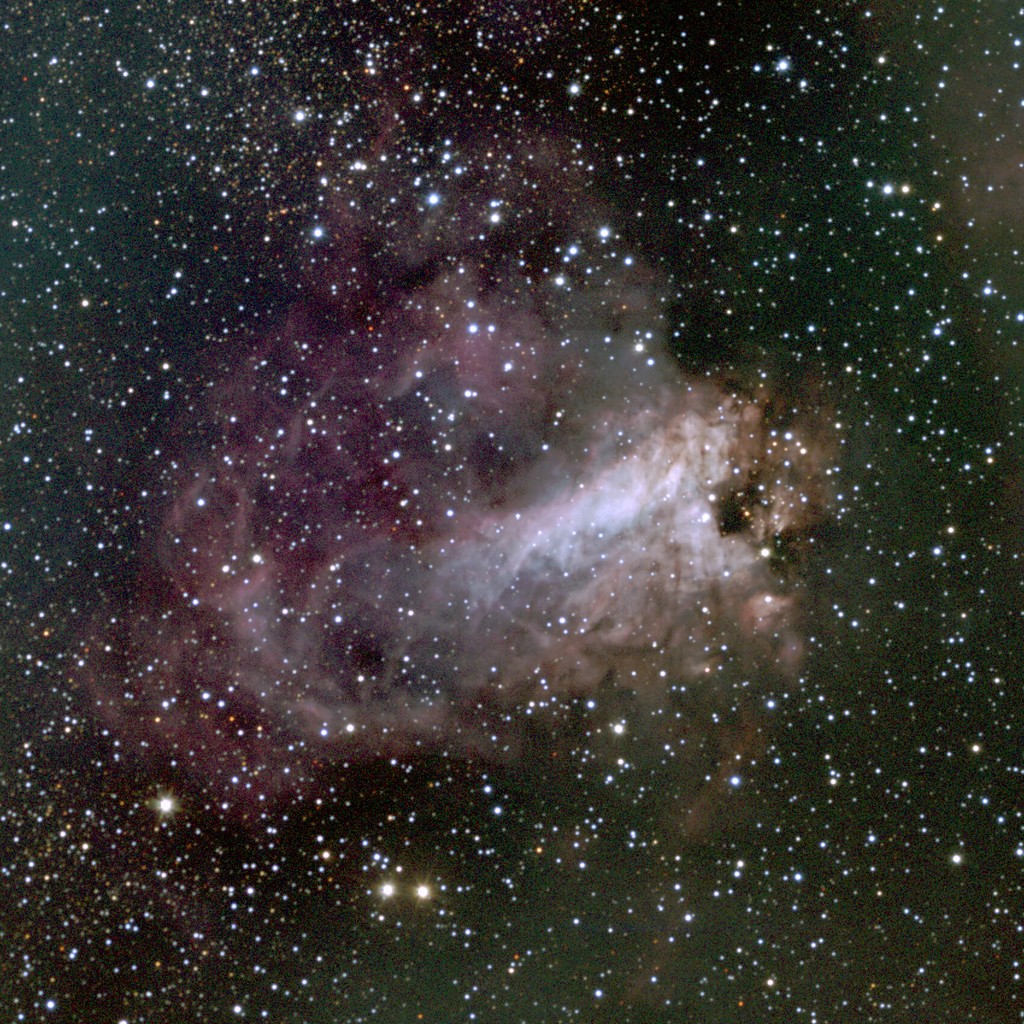
Hillary Mathis, N.A.Sharp, REU program/NOIRLab/ NSF /AURA
| Type | Emission Nebula | Constellation | Sgr |
|---|---|---|---|
| Magnitude | 6.0 | Size | 46.0′ |
| Distance | 5,500 light-years | Best Month | August |
| Visibility | Global | Difficulty | Easiest (level 1/4) |
| Min. Aperture | naked eye | RA / Dec | 18h 20m 49.2s · -16° 10' 48" |
| Discovered by | Philippe Loys de Chéseaux, 1745 | ||
Hillary Mathis, N.A.Sharp, REU program/NOIRLab/ NSF /AURA
Messier 17 (NGC 6618), known variously as the Omega Nebula, the Swan Nebula, and the Horseshoe Nebula, is one of the brightest and most massive star-forming regions in the Milky Way, located approximately 5,700 light-years away in the constellation Sagittarius. It was discovered by Philippe Loys de Chéseaux around 1745–46 and independently found by Charles Messier in 1764. NGC 6618 lies in the Sagittarius-Carina spiral arm alongside its famous neighbor, the Eagle Nebula (M16), just two degrees to the north. The nebula spans about 17 light-years and contains roughly 800 solar masses of gas and dust — raw material for future star formation — while also being a source of radio emission detectable by radio telescopes.
The Omega Nebula glows with the red light of ionized hydrogen excited by a cluster of young, hot stars embedded within it. Winding through the glowing gas are prominent dark lanes of opaque dust that create the distinctive curved, omega-like silhouette that gives the nebula one of its names — though many observers find the resemblance to a swan with an arched neck more compelling. The nebula's interior is a maelstrom of stellar winds, shock waves, and ultraviolet radiation where new stars are actively condensing. The embedded cluster contains dozens of O and B stars, and thousands of lower-mass stars are believed to be forming within the shielded dust regions.
M17 is visible to the naked eye under good conditions; binoculars reveal the characteristic curved arc of luminous gas, and a telescope shows the dark lanes threading through the bright emission regions. This image was assembled from 21 exposures taken in May 1995 and June 1996 at the Burrell Schmidt telescope of Case Western Reserve University's Warner and Swasey Observatory on Kitt Peak, as part of the Research Experiences for Undergraduates (REU) program supported by the National Science Foundation.
Navigate from Vega toward Sagittarius. In Sagittarius, about 2.5° south of M16 (Eagle Nebula) — both visible in the same binocular field.
| Star | Bayer | Mag | Spectral Type | Distance | Meaning |
|---|---|---|---|---|---|
| Nunki | ζ Sgr | 2.05 | B2 · Blue-white main sequence | 228 ly | Babylonian origin — one of the oldest known star names, from the Babylonian star catalogue. Associated with the sacred city of Eridu. |
| Kaus Borealis | — | 2.82 | K1 · Orange giant | 78 ly | Hybrid Arabic-Latin, 'Northern Bow' — marks the top of the Archer's bow in Sagittarius. Part of the Teapot asterism. |