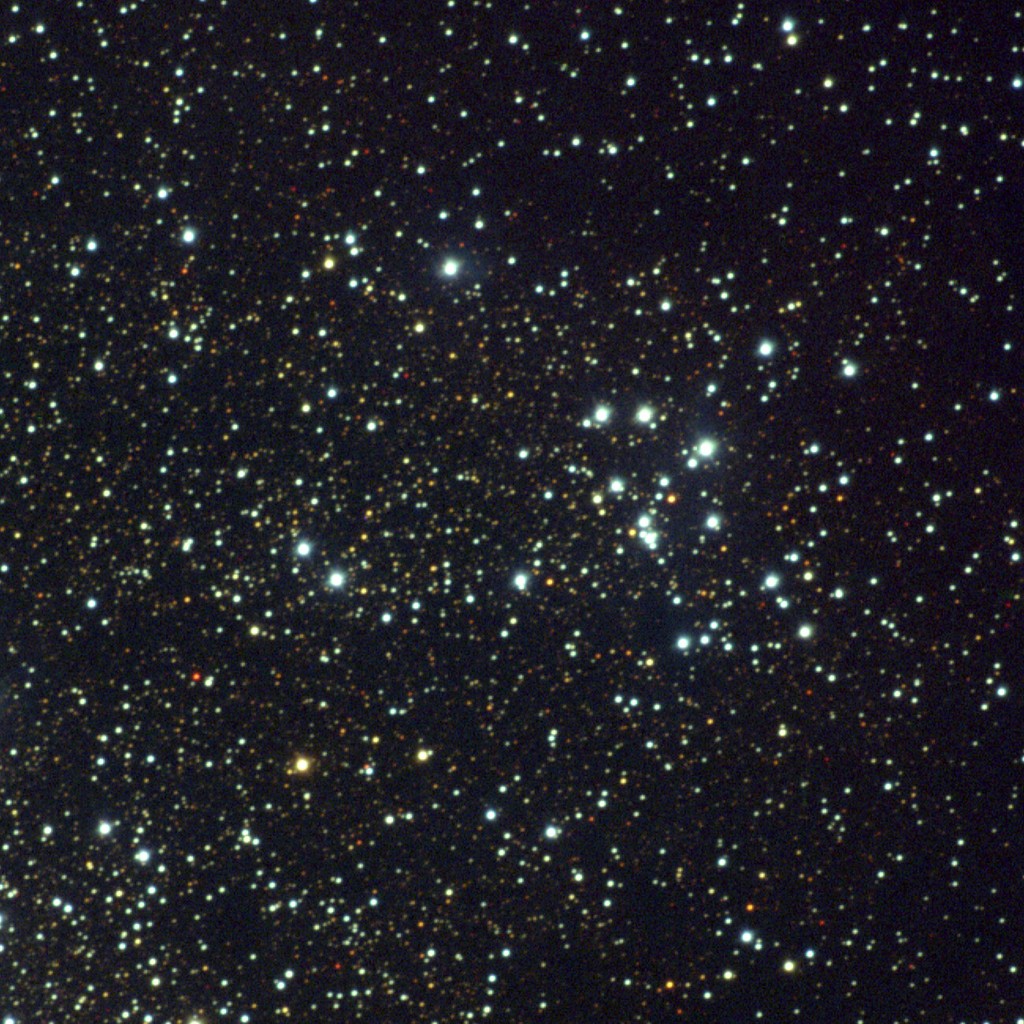
Hillary Mathis, REU program/NOIRLab/ NSF /AURA
| Type | Open Cluster | Constellation | Sgr |
|---|---|---|---|
| Magnitude | 7.5 | Size | 9.0′ |
| Distance | 4,900 light-years | Best Month | August |
| Visibility | Global | Difficulty | Easy (level 2/4) |
| Min. Aperture | binoculars | RA / Dec | 18h 19m 55.2s · -17° 07' 48" |
| Discovered by | Charles Messier, 1764 | ||
Hillary Mathis, REU program/NOIRLab/ NSF /AURA
Messier 18 (NGC 6613) is a sparse open star cluster in the constellation Sagittarius, lying approximately 5,000 light-years from Earth. It was discovered by Charles Messier on June 3, 1764, during a sweep through the rich Sagittarius star fields that also netted M17, M21, and M24. NGC 6613 is a relatively poor cluster — it contains fewer than two dozen confirmed members — and its brightest stars are hot blue-white types, indicating the cluster's youth. At an estimated age of only about 30 million years, M18 is considerably younger than the Sun and its stars have not yet evolved significantly from the main sequence.
Unlike the grand showpieces elsewhere in Sagittarius, M18 is a modest object: a loose scattering of bright blue stars with no dense nucleus or impressive concentration. It is included in Messier's catalog partly because it lies in a field so rich with nebulosity and neighboring clusters that a small telescope observer of Messier's era could easily mistake it for a comet. The surrounding Milky Way background in Sagittarius is so dense with background stars that distinguishing cluster members from field stars is genuinely challenging. For visual observers, the cluster is best identified by sweeping southward from the Omega Nebula (M17), which lies about 1 degree to the north.
In a small telescope M18 appears as a loose gathering of a dozen or so stars in a rich Milky Way field; it is best appreciated in a wide-field eyepiece that lets the surrounding star clouds provide context. This approximately true-color image was assembled from BVR exposures taken in June 1996 at the Burrell Schmidt telescope of Case Western Reserve University's Warner and Swasey Observatory on Kitt Peak, as part of the Research Experiences for Undergraduates (REU) program supported by the National Science Foundation.
Navigate from Vega toward Sagittarius. In Sagittarius between M17 and M24 — sweep south from M17 about 1°.
| Star | Bayer | Mag | Spectral Type | Distance | Meaning |
|---|---|---|---|---|---|
| Nunki | ζ Sgr | 2.05 | B2 · Blue-white main sequence | 228 ly | Babylonian origin — one of the oldest known star names, from the Babylonian star catalogue. Associated with the sacred city of Eridu. |
| Kaus Meridionalis | δ Sgr | 2.72 | K3 · Orange giant | 306 ly | Hybrid Arabic-Latin, 'Middle of the Bow' — the central bow star of Sagittarius, part of the famous Teapot asterism. |
| Kaus Borealis | — | 2.82 | K1 · Orange giant | 78 ly | Hybrid Arabic-Latin, 'Northern Bow' — marks the top of the Archer's bow in Sagittarius. Part of the Teapot asterism. |