Doug Williams, REU Program/NOIRLab/ NSF /AURA
| Type | Globular Cluster | Constellation | Oph |
|---|---|---|---|
| Magnitude | 6.8 | Size | 13.5′ |
| Distance | 28,000 light-years | Best Month | July |
| Visibility | Global | Difficulty | Easy (level 2/4) |
| Min. Aperture | binoculars | RA / Dec | 17h 02m 34.8s · -26° 16' 12" |
| Discovered by | Charles Messier, 1764 | ||
Doug Williams, REU Program/NOIRLab/ NSF /AURA
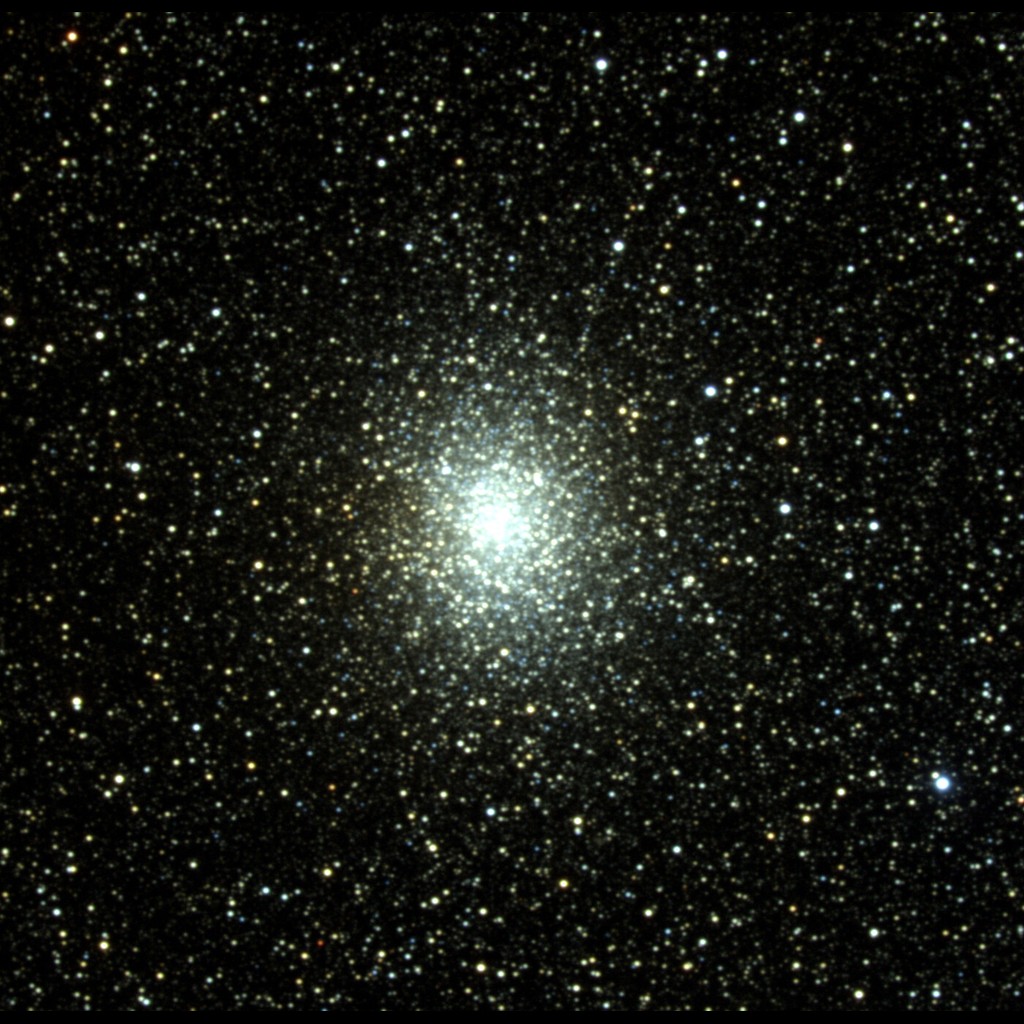
Messier 19 (NGC 6273) is a rich globular cluster in the constellation Ophiuchus, located approximately 28,000 light-years from Earth but only about 5,000 light-years from the Milky Way's galactic center — making it one of the Messier globulars that sits closest to the heart of our galaxy. It was discovered by Charles Messier on June 5, 1764. The gravitational influence of the galactic core has made NGC 6273 one of the most noticeably flattened globular clusters in the sky: its outline is distinctly elongated along its major axis, spanning roughly 65 light-years, while its minor axis is noticeably shorter. This oblateness is believed to result from the tidal forces exerted by the galactic bulge over billions of years.
NGC 6273 is a dense, fairly concentrated cluster containing hundreds of thousands of stars with an estimated age of about 13 billion years. Its apparent brightness is magnitude 6.8 — just at the limit of naked-eye visibility — though its position near the galactic plane means that dust between us and the cluster dims and reddens its light somewhat. The cluster is receding from us at about 146 kilometers per second. Only four RR Lyrae variable stars have been identified in M19, a modest number compared with richer globulars. Because of its location nine degrees above the galactic plane and near the center, M19 is seen against a dense background of Milky Way stars and traces of dust.
Binoculars show M19 as a round, moderately bright haze; a 150 mm telescope begins to resolve a granular texture at the edges. This image was assembled from six exposures taken in July 1997 at the Kitt Peak National Observatory 0.9-meter telescope during the Research Experiences for Undergraduates (REU) program supported by the National Science Foundation.
Navigate from Rigel toward Ophiuchus. In southern Ophiuchus near the Scorpius border.
| Star | Bayer | Mag | Spectral Type | Distance | Meaning |
|---|---|---|---|---|---|
| Antares | α Sco | 1.06 | M1 · Red supergiant | 550 ly | Greek Antares, 'Rival of Mars' — its fiery red color rivals the planet Mars. The blazing heart of Scorpius and one of the largest stars known. |
| Shaula | — | 1.62 | B1 · Blue-white subgiant | 700 ly | Arabic Al-Shawlā', 'The Raised Tail' — the stinger of Scorpius, one of the brightest stars in the southern sky and a navigation star. |
| Kaus Australis | ε Sgr | 1.79 | B9 · Blue-white giant | 143 ly | Hybrid Arabic-Latin, 'Southern Bow' — the brightest star in Sagittarius, at the base of the Archer's bow. Part of the Teapot asterism. |
| Dschubba | λ Sco | 2.29 | B0 · Blue subgiant | 400 ly | Arabic Al-Jabhah, 'The Forehead' — marks the head of Scorpius. A rapidly rotating blue star that has shed a disk of material. |
| Graffias | — | 2.56 | B0 · Blue-white binary | 530 ly | Greek origin meaning 'Claws' — one of several names for the head of Scorpius. A fine double star in small telescopes. |
| Kaus Meridionalis | δ Sgr | 2.72 | K3 · Orange giant | 306 ly | Hybrid Arabic-Latin, 'Middle of the Bow' — the central bow star of Sagittarius, part of the famous Teapot asterism. |
| Nash | — | 2.98 | K0 · Orange giant | 97 ly | Arabic Al-Nasl, 'The Arrowhead' or 'The Point' — marks the tip of the Archer's arrow aimed at the heart of Scorpius. |