Todd Boroson/NOIRLab/ NSF /AURA
| Type | Emission Nebula | Constellation | Sgr |
|---|---|---|---|
| Magnitude | 6.3 | Size | 28.0′ |
| Distance | 5,200 light-years | Best Month | August |
| Visibility | Global | Difficulty | Easy (level 2/4) |
| Min. Aperture | binoculars | RA / Dec | 18h 02m 34.8s · -23° 01' 48" |
| Discovered by | Charles Messier, 1764 | ||
Todd Boroson/NOIRLab/ NSF /AURA
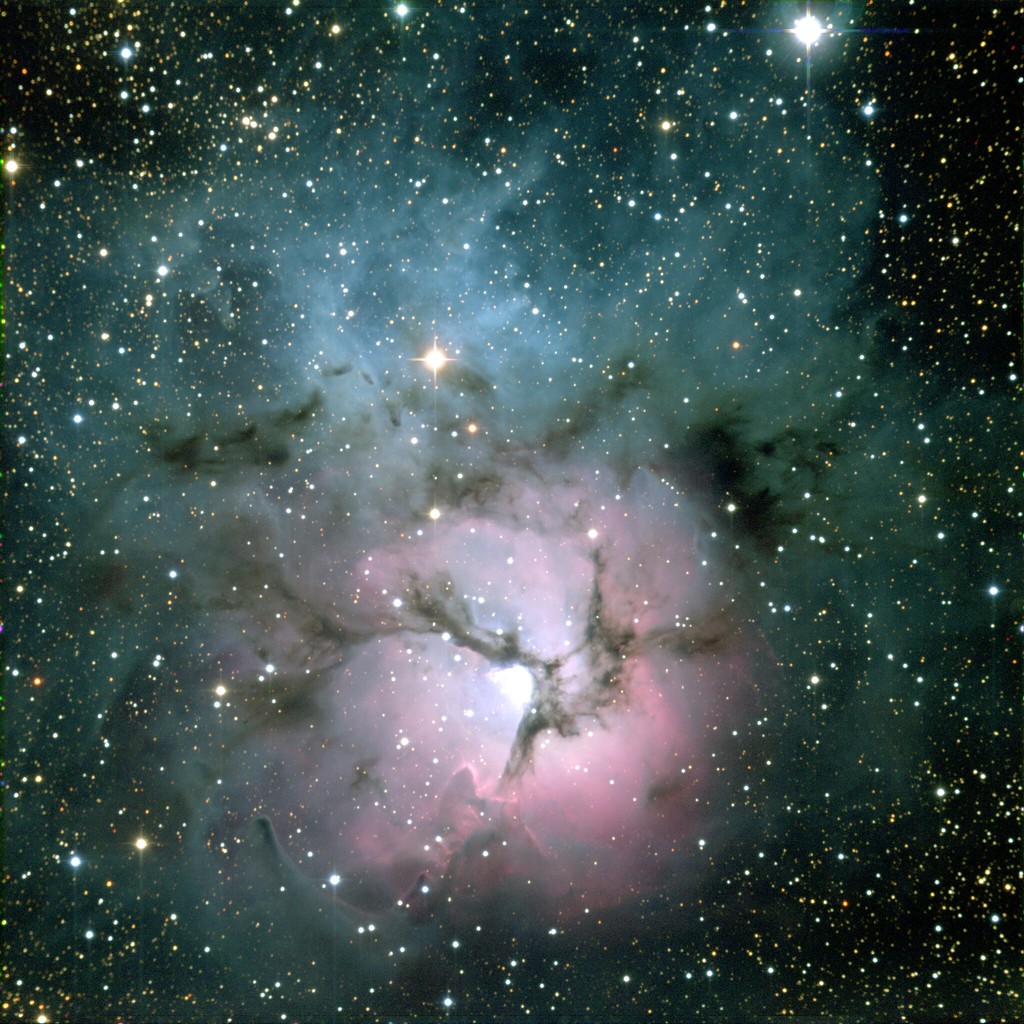
Messier 20 (NGC 6514), the Trifid Nebula, is one of the most visually striking nebulae in the sky — a rare single object that displays emission nebula, reflection nebula, and dark nebula side by side, all in one compact field. It lies in the constellation Sagittarius, close to the Lagoon Nebula (M8). The Trifid's distance is poorly determined, with estimates ranging from about 2,200 to 7,600 light-years. Charles Messier catalogued it in 1764, and its common name comes from the three lobes visible in telescopes, carved out by dark lanes of dust that seem to divide the nebula into thirds. John Herschel coined the name "Trifid" in the nineteenth century.
The southern reddish glow of NGC 6514 is a classic HII emission region: ultraviolet radiation from a bright central star cluster ionizes the surrounding hydrogen gas, which then emits the characteristic red light of hydrogen-alpha recombination. Farther out, where that radiation becomes too weak to ionize hydrogen, a striking blue reflection nebula appears — the same starlight scattered off dust grains rather than absorbed and re-emitted. The dark lanes that trisect the emission region are cool molecular clouds silhouetted against the bright gas behind them, and careful examination reveals that they too are sites of active star formation, with young stellar objects embedded in their densest cores.
A small telescope shows the three-lobed emission region clearly against a rich Sagittarius starfield; the blue reflection nebula to the north requires a dark sky and a moderate aperture to appreciate fully. This image was made at Kitt Peak National Observatory.
Navigate from Vega toward Sagittarius. In Sagittarius, about 1.5° north of the Lagoon Nebula M8 — often visible in the same binocular field.
| Star | Bayer | Mag | Spectral Type | Distance | Meaning |
|---|---|---|---|---|---|
| Kaus Australis | ε Sgr | 1.79 | B9 · Blue-white giant | 143 ly | Hybrid Arabic-Latin, 'Southern Bow' — the brightest star in Sagittarius, at the base of the Archer's bow. Part of the Teapot asterism. |
| Nunki | ζ Sgr | 2.05 | B2 · Blue-white main sequence | 228 ly | Babylonian origin — one of the oldest known star names, from the Babylonian star catalogue. Associated with the sacred city of Eridu. |
| Kaus Meridionalis | δ Sgr | 2.72 | K3 · Orange giant | 306 ly | Hybrid Arabic-Latin, 'Middle of the Bow' — the central bow star of Sagittarius, part of the famous Teapot asterism. |
| Kaus Borealis | — | 2.82 | K1 · Orange giant | 78 ly | Hybrid Arabic-Latin, 'Northern Bow' — marks the top of the Archer's bow in Sagittarius. Part of the Teapot asterism. |
| Nash | — | 2.98 | K0 · Orange giant | 97 ly | Arabic Al-Nasl, 'The Arrowhead' or 'The Point' — marks the tip of the Archer's arrow aimed at the heart of Scorpius. |