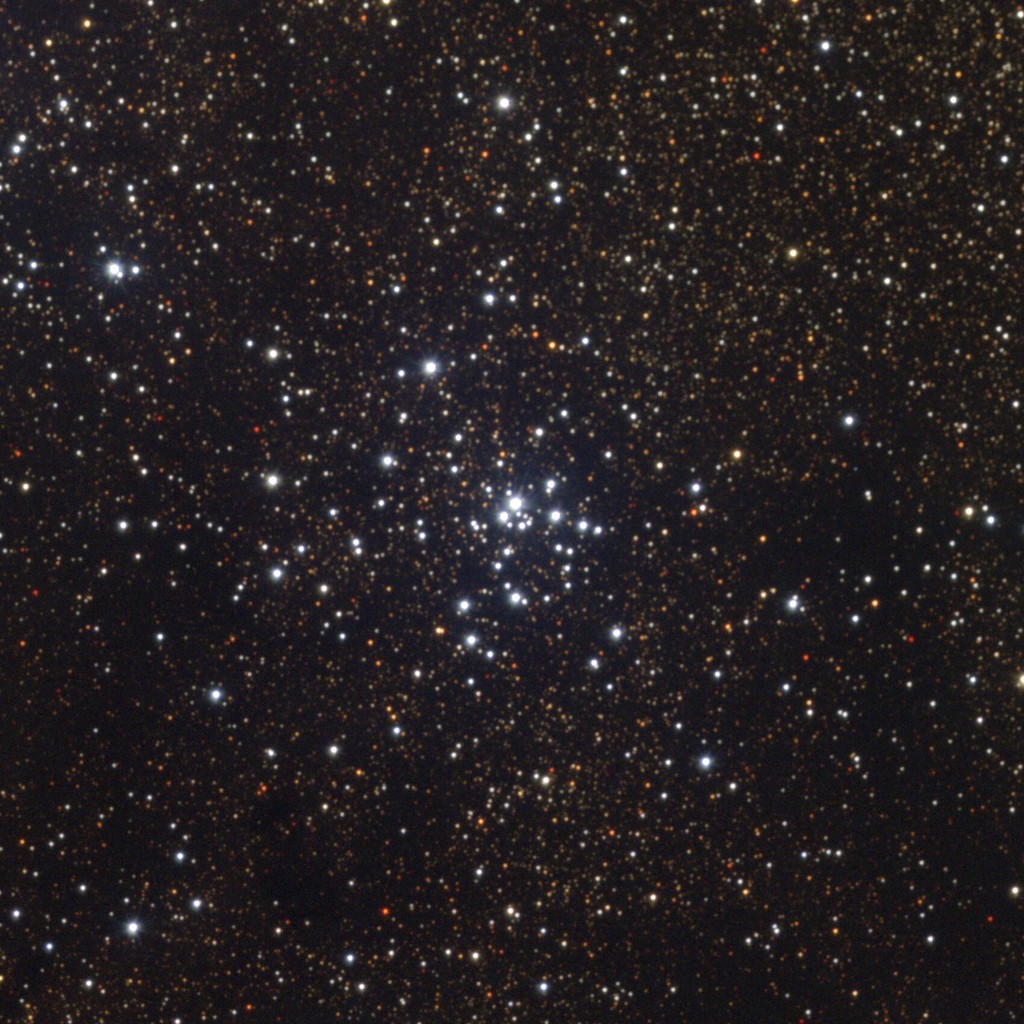
REU program/NOIRLab/ NSF /AURA
| Type | Open Cluster | Constellation | Sgr |
|---|---|---|---|
| Magnitude | 6.5 | Size | 13.0′ |
| Distance | 4,250 light-years | Best Month | August |
| Visibility | Global | Difficulty | Easy (level 2/4) |
| Min. Aperture | binoculars | RA / Dec | 18h 04m 37.2s · -22° 30' 00" |
| Discovered by | Charles Messier, 1764 | ||
REU program/NOIRLab/ NSF /AURA
Messier 21 (NGC 6531) is a young open star cluster in the constellation Sagittarius, located close on the sky to the Trifid Nebula (M20) — so close, in fact, that the two are sometimes captured together in a single wide-field view. Charles Messier discovered it on June 5, 1764, the same productive night he catalogued M20. NGC 6531 lies at an uncertain distance, roughly estimated at 4,250 light-years, and is probably only a few million years old — an infant by stellar standards. Despite a limited membership of perhaps 60 stars, the cluster displays a surprisingly strong central concentration and a wide range of star brightnesses, from hot blue-white members to fainter companions at the threshold of visibility.
NGC 6531's youthfulness is evident in the presence of several brilliant O and B-type stars, massive blue-white giants whose short lives of only tens of millions of years mean they have barely aged since forming together from the same molecular cloud. The cluster almost certainly formed in association with, or from the same material as, the star-forming activity visible in the nearby Trifid Nebula, though the spatial relationship between the two objects along the line of sight is not fully resolved. The surrounding Sagittarius starfields are extraordinarily rich, making M21 part of one of the most rewarding regions of the summer Milky Way.
In a wide-field binocular view, M21 appears as a compact knot of stars within half a degree of the glowing Trifid; a telescope shows a concentrated grouping with a few bright stars standing above a fainter haze of members. This approximately true-color image was assembled from eleven BVR exposures taken in July 1995 and June 1996 at the Burrell Schmidt telescope of Case Western Reserve University's Warner and Swasey Observatory on Kitt Peak, as part of the Research Experiences for Undergraduates (REU) program supported by the National Science Foundation.
Navigate from Vega toward Sagittarius. In Sagittarius, 0.7° northeast of M20 (Trifid Nebula) — easily found in the same binocular field.
| Star | Bayer | Mag | Spectral Type | Distance | Meaning |
|---|---|---|---|---|---|
| Kaus Australis | ε Sgr | 1.79 | B9 · Blue-white giant | 143 ly | Hybrid Arabic-Latin, 'Southern Bow' — the brightest star in Sagittarius, at the base of the Archer's bow. Part of the Teapot asterism. |
| Nunki | ζ Sgr | 2.05 | B2 · Blue-white main sequence | 228 ly | Babylonian origin — one of the oldest known star names, from the Babylonian star catalogue. Associated with the sacred city of Eridu. |
| Kaus Meridionalis | δ Sgr | 2.72 | K3 · Orange giant | 306 ly | Hybrid Arabic-Latin, 'Middle of the Bow' — the central bow star of Sagittarius, part of the famous Teapot asterism. |
| Kaus Borealis | — | 2.82 | K1 · Orange giant | 78 ly | Hybrid Arabic-Latin, 'Northern Bow' — marks the top of the Archer's bow in Sagittarius. Part of the Teapot asterism. |
| Nash | — | 2.98 | K0 · Orange giant | 97 ly | Arabic Al-Nasl, 'The Arrowhead' or 'The Point' — marks the tip of the Archer's arrow aimed at the heart of Scorpius. |