N.A.Sharp, REU program/NOIRLab/ NSF /AURA
| Type | Globular Cluster | Constellation | Sgr |
|---|---|---|---|
| Magnitude | 5.1 | Size | 24.0′ |
| Distance | 10,600 light-years | Best Month | August |
| Visibility | Global | Difficulty | Easiest (level 1/4) |
| Min. Aperture | naked eye | RA / Dec | 18h 36m 25.2s · -23° 53' 60" |
| Discovered by | Abraham Ihle, 1665 | ||
N.A.Sharp, REU program/NOIRLab/ NSF /AURA
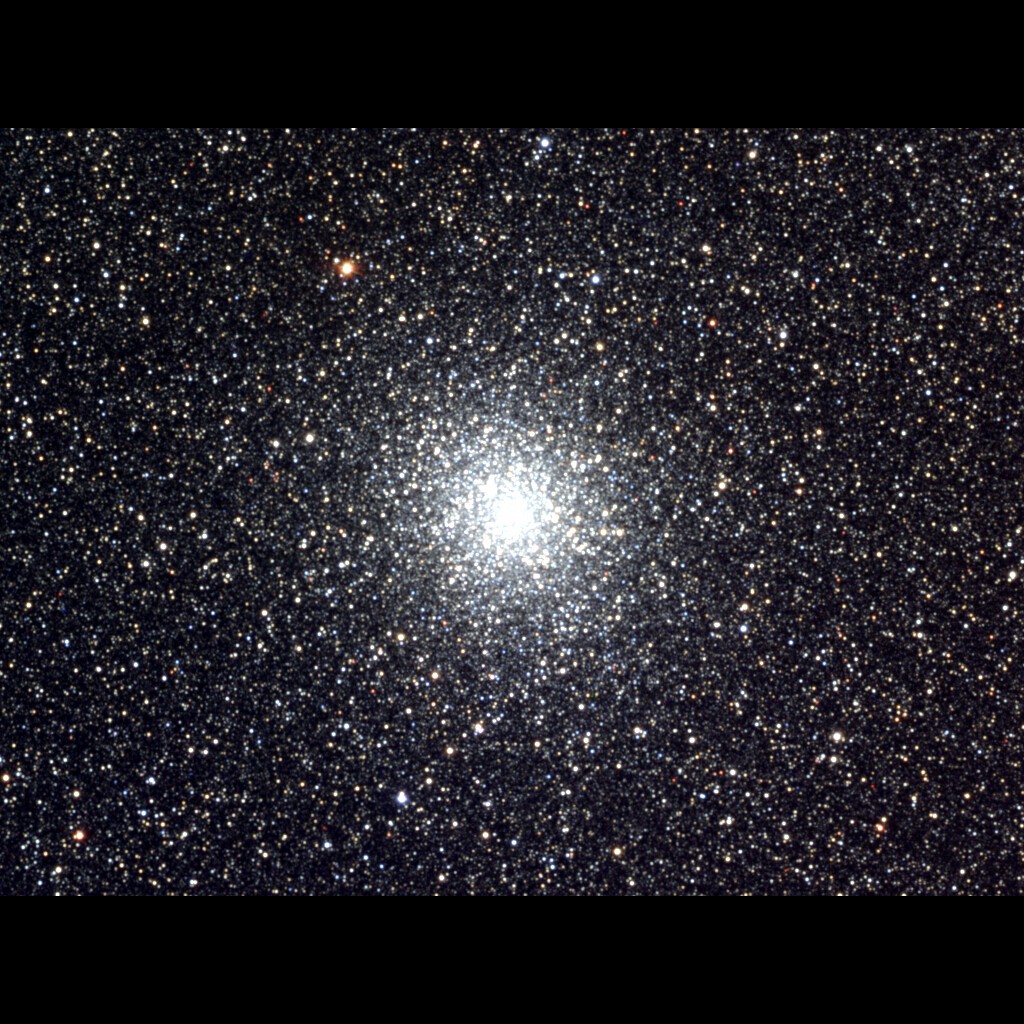
Messier 22 (NGC 6656) is the brightest globular cluster visible from the northern hemisphere and one of the closest, lying approximately 10,000 light-years away in the constellation Sagittarius. It spans roughly 65 light-years across and is a conspicuous naked-eye object in a dark sky, appearing as a fuzzy star in the rich Milky Way field just northeast of the bright star that marks the top of the Sagittarius "Teapot" asterism. Abraham Ihle first observed NGC 6656 in 1665, making it among the earliest-known globular clusters; it was later recorded by John Bevis and independently catalogued by Charles Messier in 1764. Johann Elert Bode resolved it into stars in 1777.
NGC 6656 is a notably rich cluster estimated to contain several hundred thousand stars with an age of around 12 billion years. It is slightly flattened — more obviously elongated than most globulars — possibly due to tidal interaction with the Milky Way's bulge, which lies relatively close in the same direction. M22 is one of only a handful of globular clusters known to contain a planetary nebula, and it harbors a small black hole at its core, inferred from radio observations of a compact radio source within the cluster. Because it lies close to the galactic plane, some of its light is dimmed by intervening dust, yet it still shines brilliantly enough to be visible well before full dark on a summer evening.
Binoculars reveal M22 as a large, bright, clearly non-stellar glow; a small telescope begins to sprinkle stars across the outer halo, and 150 mm aperture delivers a stunning, partially resolved view. This image was made from CCD exposures taken in June 1995 at the Burrell Schmidt telescope of Case Western Reserve University's Warner and Swasey Observatory on Kitt Peak, as part of the Research Experiences for Undergraduates (REU) program supported by the National Science Foundation.
Navigate from Vega toward Sagittarius. In Sagittarius, just 2.5° northeast of the top of the Teapot's lid (Lambda Sagittarii).
| Star | Bayer | Mag | Spectral Type | Distance | Meaning |
|---|---|---|---|---|---|
| Kaus Australis | ε Sgr | 1.79 | B9 · Blue-white giant | 143 ly | Hybrid Arabic-Latin, 'Southern Bow' — the brightest star in Sagittarius, at the base of the Archer's bow. Part of the Teapot asterism. |
| Nunki | ζ Sgr | 2.05 | B2 · Blue-white main sequence | 228 ly | Babylonian origin — one of the oldest known star names, from the Babylonian star catalogue. Associated with the sacred city of Eridu. |
| Kaus Meridionalis | δ Sgr | 2.72 | K3 · Orange giant | 306 ly | Hybrid Arabic-Latin, 'Middle of the Bow' — the central bow star of Sagittarius, part of the famous Teapot asterism. |
| Kaus Borealis | — | 2.82 | K1 · Orange giant | 78 ly | Hybrid Arabic-Latin, 'Northern Bow' — marks the top of the Archer's bow in Sagittarius. Part of the Teapot asterism. |
| Nash | — | 2.98 | K0 · Orange giant | 97 ly | Arabic Al-Nasl, 'The Arrowhead' or 'The Point' — marks the tip of the Archer's arrow aimed at the heart of Scorpius. |