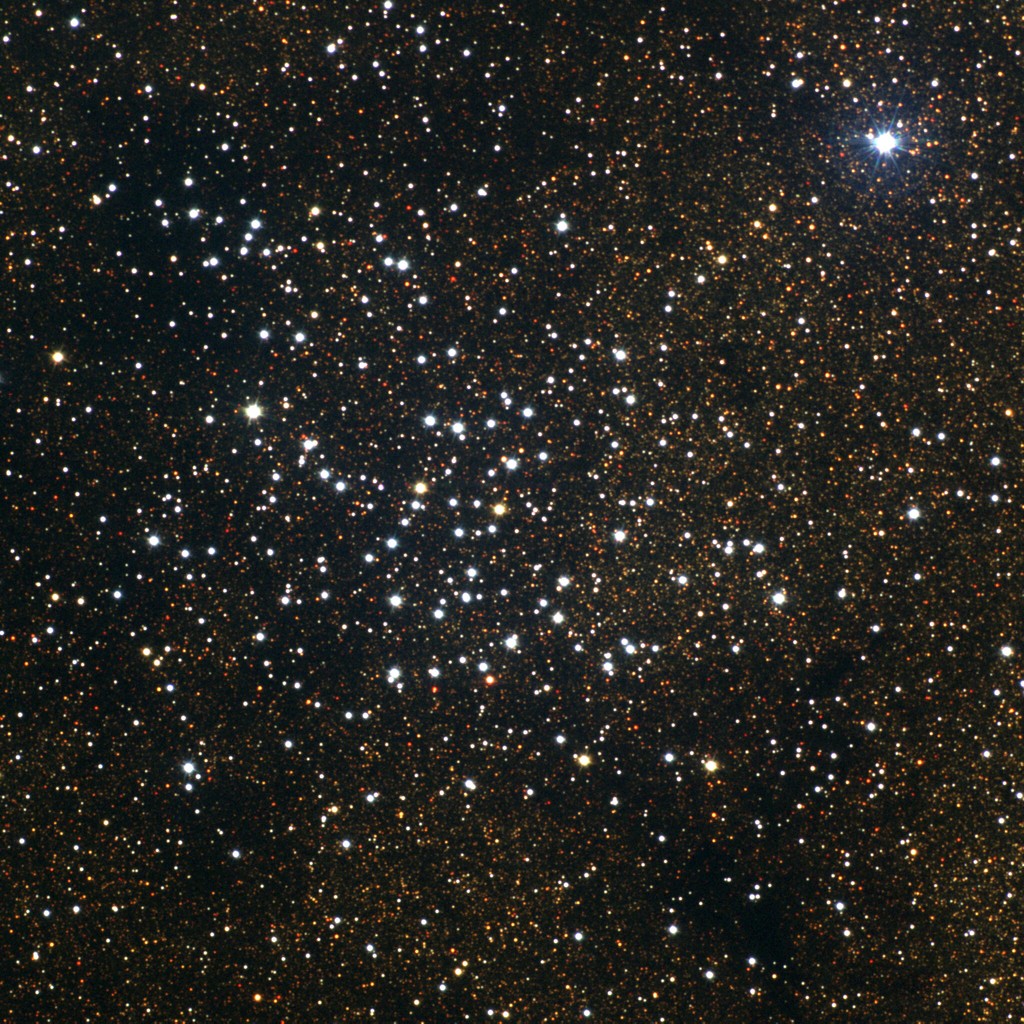
N.A.Sharp, REU program/NOIRLab/ NSF /AURA
| Type | Open Cluster | Constellation | Sgr |
|---|---|---|---|
| Magnitude | 6.9 | Size | 27.0′ |
| Distance | 2,150 light-years | Best Month | August |
| Visibility | Global | Difficulty | Easy (level 2/4) |
| Min. Aperture | binoculars | RA / Dec | 17h 56m 49.2s · -18° 58' 48" |
| Discovered by | Charles Messier, 1764 | ||
N.A.Sharp, REU program/NOIRLab/ NSF /AURA
Messier 23 (NGC 6494) is a large, rich open star cluster in the constellation Sagittarius, one of the more attractive and populous clusters in Messier's catalog. It lies approximately 2,200 light-years away, spans about 20 light-years, and presents an apparent diameter of roughly half a degree on the sky — comparable to the full Moon. Charles Messier discovered it on June 20, 1764. With an age estimated at over 200 million years, NGC 6494 is considerably more evolved than nearby young clusters like M21, and its main-sequence turnoff reveals that its most massive stars have already exhausted their fuel and departed the cluster's stellar roster.
Because M23 lies within the galactic plane, the background behind it is extraordinarily rich in Milky Way stars — though that richness comes at a cost: interstellar dust along the plane progressively reddens and dims the more distant background stars, producing a visibly brownish cast in color images and creating patches where dense dust clouds completely obscure the view behind them. The cluster itself contains 150–200 members of varying brightness, with no strong central concentration — stars are distributed relatively evenly across the cluster's face. A bright foreground star that appears to the northwest (upper right in this image) is not a cluster member but simply lies along the same line of sight.
Binoculars show M23 as a broad, rich glow with individual stars beginning to separate; a small telescope at low power resolves it into a lovely scattered field of stars of many brightnesses set against the dense Sagittarius Milky Way. This true-color image was assembled from six BVR exposures taken in July 1995 at the Burrell Schmidt telescope of Case Western Reserve University's Warner and Swasey Observatory on Kitt Peak, as part of the Research Experiences for Undergraduates (REU) program supported by the National Science Foundation.
Navigate from Vega toward Sagittarius. In northern Sagittarius, northwest of the main Teapot asterism.
| Star | Bayer | Mag | Spectral Type | Distance | Meaning |
|---|---|---|---|---|---|
| Nunki | ζ Sgr | 2.05 | B2 · Blue-white main sequence | 228 ly | Babylonian origin — one of the oldest known star names, from the Babylonian star catalogue. Associated with the sacred city of Eridu. |
| Kaus Meridionalis | δ Sgr | 2.72 | K3 · Orange giant | 306 ly | Hybrid Arabic-Latin, 'Middle of the Bow' — the central bow star of Sagittarius, part of the famous Teapot asterism. |
| Kaus Borealis | — | 2.82 | K1 · Orange giant | 78 ly | Hybrid Arabic-Latin, 'Northern Bow' — marks the top of the Archer's bow in Sagittarius. Part of the Teapot asterism. |
| Nash | — | 2.98 | K0 · Orange giant | 97 ly | Arabic Al-Nasl, 'The Arrowhead' or 'The Point' — marks the tip of the Archer's arrow aimed at the heart of Scorpius. |