Vanessa Harvey, REU program/NOIRLab/ NSF /AURA
| Type | Open Cluster | Constellation | Sgr |
|---|---|---|---|
| Magnitude | 4.6 | Size | 90.0′ |
| Distance | 10,000 light-years | Best Month | August |
| Visibility | Global | Difficulty | Easiest (level 1/4) |
| Min. Aperture | naked eye | RA / Dec | 18h 16m 58.8s · -18° 33' 00" |
| Discovered by | Charles Messier, 1764 | ||
Vanessa Harvey, REU program/NOIRLab/ NSF /AURA
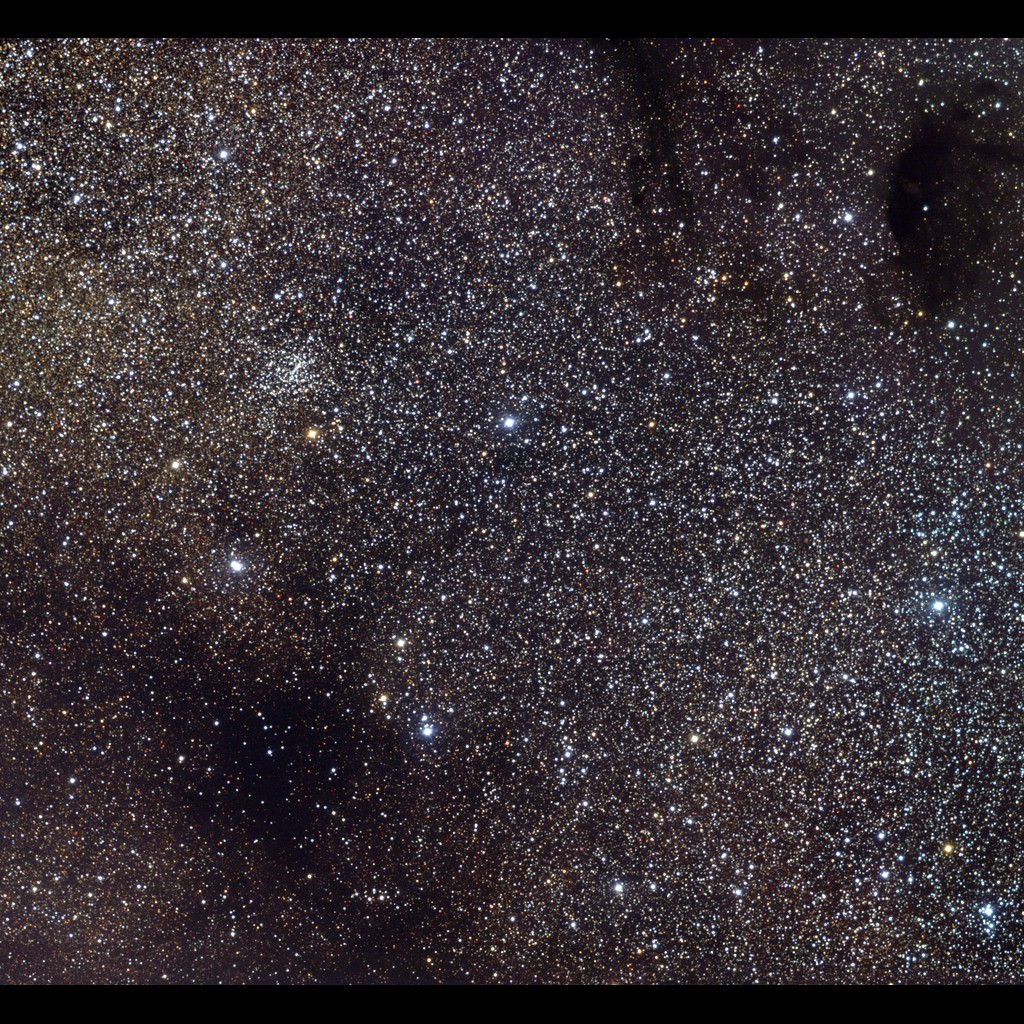
Messier 24, the Sagittarius Star Cloud, is unlike any other object in Messier's catalog — not a star cluster, nebula, or galaxy, but a vast window through the dust of the Milky Way into the Sagittarius spiral arm beyond. What Messier recorded on June 20, 1764, as a large "nebulosity" a degree and a half across is in fact a superposition of hundreds of thousands of stars lying at many different distances along our line of sight, visible to us because a gap in the intervening dust clouds allows an unusually deep view into the galactic interior. It carries only an Index Catalogue designation (IC 4715) since there is no single physical object to number.
Within the field of M24, a genuine compact open cluster — NGC 6603 — can be found in the upper left of this image, a dense knot of faint stars lying some 9,500 light-years away. To the northwest (upper right) lie two prominent dark nebulae, Barnard 92 and Barnard 93, inky patches of cold dense molecular gas that block the view of stars beyond them — a striking contrast against the surrounding sea of Milky Way light. The whole region is part of the Sagittarius spiral arm structure and lies roughly 10,000–16,000 light-years from Earth, with the stars visible spanning a wide range of actual distances.
In binoculars, M24 is a magnificent 2-degree-wide patch of condensed Milky Way, visibly richer than the surrounding sky; the dark nebulae Barnard 92 and 93 are clearly visible as star-free voids. This image is a mosaic of sixteen BVR frames — seven taken in June 1996 and nine in September 1997 — at the Burrell Schmidt telescope of Case Western Reserve University's Warner and Swasey Observatory on Kitt Peak, as part of the Research Experiences for Undergraduates (REU) program supported by the National Science Foundation.
Navigate from Vega toward Sagittarius. The brightest naked-eye patch in the Sagittarius Milky Way — unmissable on a clear dark night.
| Star | Bayer | Mag | Spectral Type | Distance | Meaning |
|---|---|---|---|---|---|
| Nunki | ζ Sgr | 2.05 | B2 · Blue-white main sequence | 228 ly | Babylonian origin — one of the oldest known star names, from the Babylonian star catalogue. Associated with the sacred city of Eridu. |
| Kaus Meridionalis | δ Sgr | 2.72 | K3 · Orange giant | 306 ly | Hybrid Arabic-Latin, 'Middle of the Bow' — the central bow star of Sagittarius, part of the famous Teapot asterism. |
| Kaus Borealis | — | 2.82 | K1 · Orange giant | 78 ly | Hybrid Arabic-Latin, 'Northern Bow' — marks the top of the Archer's bow in Sagittarius. Part of the Teapot asterism. |
| Nash | — | 2.98 | K0 · Orange giant | 97 ly | Arabic Al-Nasl, 'The Arrowhead' or 'The Point' — marks the tip of the Archer's arrow aimed at the heart of Scorpius. |