Hillary Mathis, Vanessa Harvey, REU program/NOIRLab/ NSF /AURA
| Type | Open Cluster | Constellation | Sgr |
|---|---|---|---|
| Magnitude | 4.6 | Size | 32.0′ |
| Distance | 2,000 light-years | Best Month | August |
| Visibility | Global | Difficulty | Easiest (level 1/4) |
| Min. Aperture | naked eye | RA / Dec | 18h 31m 37.2s · -19° 07' 12" |
| Discovered by | Philippe Loys de Chéseaux, 1745 | ||
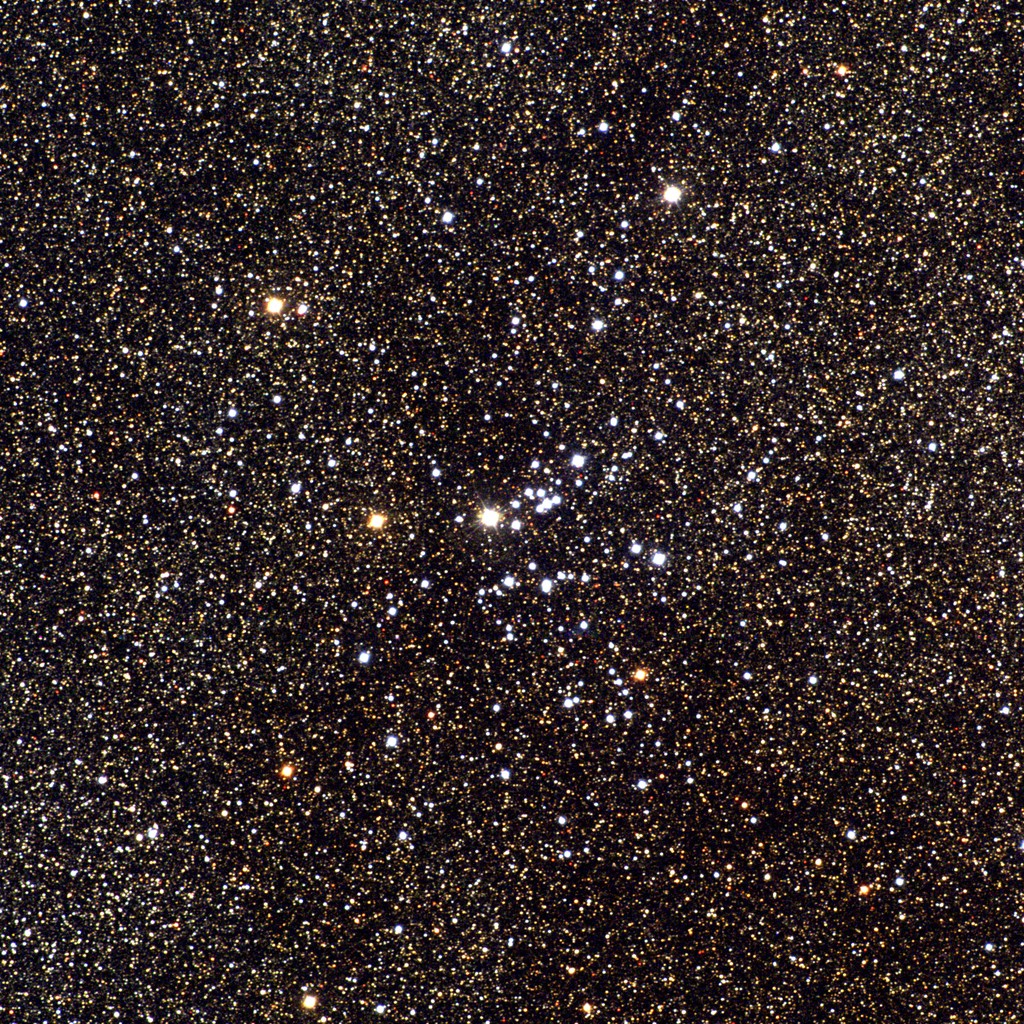
Hillary Mathis, Vanessa Harvey, REU program/NOIRLab/ NSF /AURA
Messier 25 (IC 4725) is a conspicuous open star cluster in the constellation Sagittarius, lying approximately 2,000 light-years from Earth and spanning about 20 light-years across. It was first recorded by Philippe Loys de Chéseaux around 1745 and independently found by Charles Messier on June 20, 1764. The cluster carries only an Index Catalogue number (IC 4725) rather than a New General Catalogue designation — an oversight in John Dreyer's 1888 compilation, since M25 is a plainly visible and well-populated cluster by any measure. It is a middle-aged cluster at roughly 90 million years old, old enough to have lost its hottest blue supergiants but still young enough to retain bright B-type stars.
IC 4725 contains around 60–80 confirmed members spanning a range of stellar types. Among them is U Sagittarii, a classical Cepheid variable — a pulsating star that expands and contracts with a period of about 6.7 days, brightening and dimming in a regular cycle. Cepheid variables are enormously important in astronomy because their pulsation period directly reveals their intrinsic luminosity, allowing their distances to be calculated; U Sgr played a small historical role in the development of this distance-ladder technique. The cluster's appearance in the rich Sagittarius starfields makes it a rewarding low-power binocular target.
Binoculars show M25 as a large, loosely scattered grouping of stars set in a richly populated Milky Way field; a small telescope resolves several dozen members spread across an area larger than the full Moon. This image was assembled from six BVR frames taken in June 1996 at the Burrell Schmidt telescope of Case Western Reserve University's Warner and Swasey Observatory on Kitt Peak, as part of the Research Experiences for Undergraduates (REU) program supported by the National Science Foundation.
Navigate from Vega toward Sagittarius. In Sagittarius, 3° northeast of M24 (Sagittarius Star Cloud).
| Star | Bayer | Mag | Spectral Type | Distance | Meaning |
|---|---|---|---|---|---|
| Nunki | ζ Sgr | 2.05 | B2 · Blue-white main sequence | 228 ly | Babylonian origin — one of the oldest known star names, from the Babylonian star catalogue. Associated with the sacred city of Eridu. |
| Kaus Meridionalis | δ Sgr | 2.72 | K3 · Orange giant | 306 ly | Hybrid Arabic-Latin, 'Middle of the Bow' — the central bow star of Sagittarius, part of the famous Teapot asterism. |
| Kaus Borealis | — | 2.82 | K1 · Orange giant | 78 ly | Hybrid Arabic-Latin, 'Northern Bow' — marks the top of the Archer's bow in Sagittarius. Part of the Teapot asterism. |
| Nash | — | 2.98 | K0 · Orange giant | 97 ly | Arabic Al-Nasl, 'The Arrowhead' or 'The Point' — marks the tip of the Archer's arrow aimed at the heart of Scorpius. |