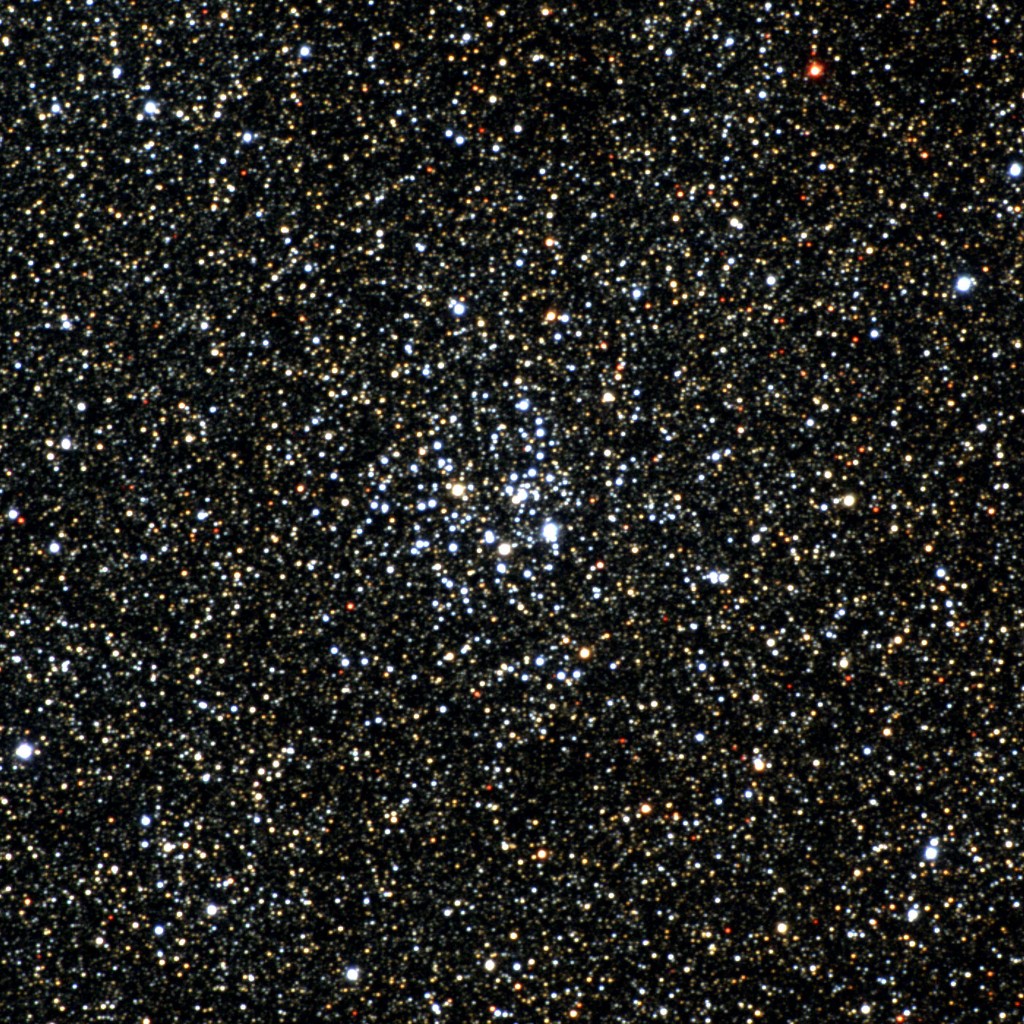
Hillary Mathis, Vanessa Harvey, REU program/NOIRLab/ NSF /AURA
| Type | Open Cluster | Constellation | Sct |
|---|---|---|---|
| Magnitude | 8.0 | Size | 15.0′ |
| Distance | 5,000 light-years | Best Month | August |
| Visibility | Global | Difficulty | Moderate (level 3/4) |
| Min. Aperture | 3in | RA / Dec | 18h 45m 18.0s · -09° 24' 00" |
| Discovered by | Charles Messier, 1764 | ||
Hillary Mathis, Vanessa Harvey, REU program/NOIRLab/ NSF /AURA
Messier 26 (NGC 6694) is an open star cluster in the constellation Scutum, approximately 5,000 light-years from Earth and about 90 million years old. Charles Messier discovered it on June 20, 1764, during the same productive sweep of Scutum and Sagittarius that yielded several other entries in his catalog. NGC 6694 is a fairly compact cluster — more concentrated toward its center than many Messier open clusters — though its moderate membership of around 90 stars is overshadowed in photographs by a spectacularly dense backdrop of Milky Way stars. Scutum lies in front of one of the Galaxy's richest star-cloud regions, and separating true cluster members from background field stars requires careful measurement of stellar motions.
NGC 6694's position in the galactic plane means significant intervening dust lies between us and the cluster, dimming its stars and giving the brighter members a slightly warm cast. Its age of roughly 90 million years places it between the youngest open clusters, which still glow with brilliant blue-white supergiants, and older ones in which only middle-aged stars remain. The brightest cluster members are hot B-type stars. The overall impression in deep images is of a cluttered, slightly concentrated knot of stars that must compete visually with one of the most populated regions of the Milky Way.
Through binoculars M26 appears as a faint, condensed haze among the dense Scutum starfields; a small telescope resolves a tight gathering of roughly two dozen stars, slightly concentrated at the center, against a glittering sea of background Milky Way stars. This approximately true-color image was assembled from BVR exposures taken in June 1996 at the Burrell Schmidt telescope of Case Western Reserve University's Warner and Swasey Observatory on Kitt Peak, as part of the Research Experiences for Undergraduates (REU) program supported by the National Science Foundation.
Navigate from Vega toward Scutum. In Scutum, southeast of the Wild Duck Cluster M11.