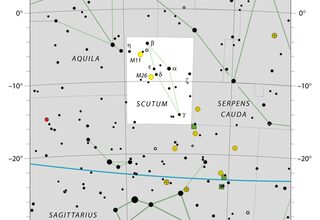
 IAU Chart
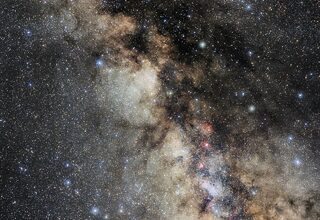 NOIRLab Images
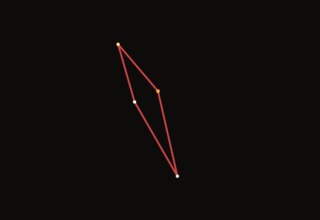 Stars and Sticks
| Abbreviation | Sct |
|---|---|
| Meaning | Shield |
| Pronunciation Guide is based on “Pronouncing Astronomical Names,” published in 1943 by the American Astronomical Society. | SCOOT-um |
| Genitive The genitive is the Latin possessive form used in star names. For example, Alpha Orionis means “the Alpha of Orion.” | SKOO-tye |
| Best Month | August |
| Visibility | Global |
| Origin | ModernAdded between the 17th and 18th centuries by astronomers like Hevelius or Plancius to define faint star clusters ignored by the ancients. |
| Author | HeveliusA Polish astronomer known as the "founder of lunar topography" who added several "filler" constellations using high-precision instruments. |
| Type | constellation |
| Difficulty | Challenging |
| Description | The Shield was created by Johannes Hevelius in 1684 to honor the Polish King Jan III Sobieski, who led the defense of Vienna against the Ottoman Empire in 1683 — one of the most decisive battles in European history. Despite its tiny size it lies in an extraordinarily rich region of the Milky Way and contains the Wild Duck Cluster (M11) — one of the richest and most compact open clusters known, containing roughly 2,900 stars packed so tightly that early observers thought they resembled wild ducks in flight. The Scutum Star Cloud — a dense patch of the Milky Way visible to the naked eye — lies within its borders. |
Click a thumbnail to view full-size. Plain and Annotated versions available on the image page.
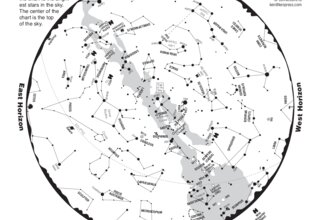
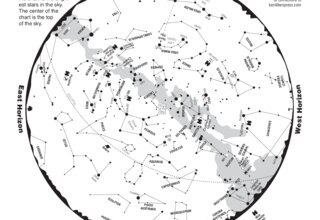
Monthly sky charts courtesy of What's Out Tonight? — Copyright ©2026 Ken Graun. Star charts are optimized for mid-latitudes of the Northern Hemisphere. Click a chart to view or download the PDF. For guidance on using the chart, or to purchase a planisphere and astronomy books, visit kenpress.com.
Images: NOIRLab/NSF/AURA/E. Slawik · IAU and Sky & Telescope · Stellarium — Full credits →