REU program/NOIRLab/ NSF /AURA
| Type | Planetary Nebula | Constellation | Vul |
|---|---|---|---|
| Magnitude | 7.5 | Size | 8.0′ |
| Distance | 1,360 light-years | Best Month | August |
| Visibility | Northern | Difficulty | Easy (level 2/4) |
| Min. Aperture | binoculars | RA / Dec | 19h 59m 34.8s · +22° 43' 12" |
| Discovered by | Charles Messier, 1764 | ||
REU program/NOIRLab/ NSF /AURA
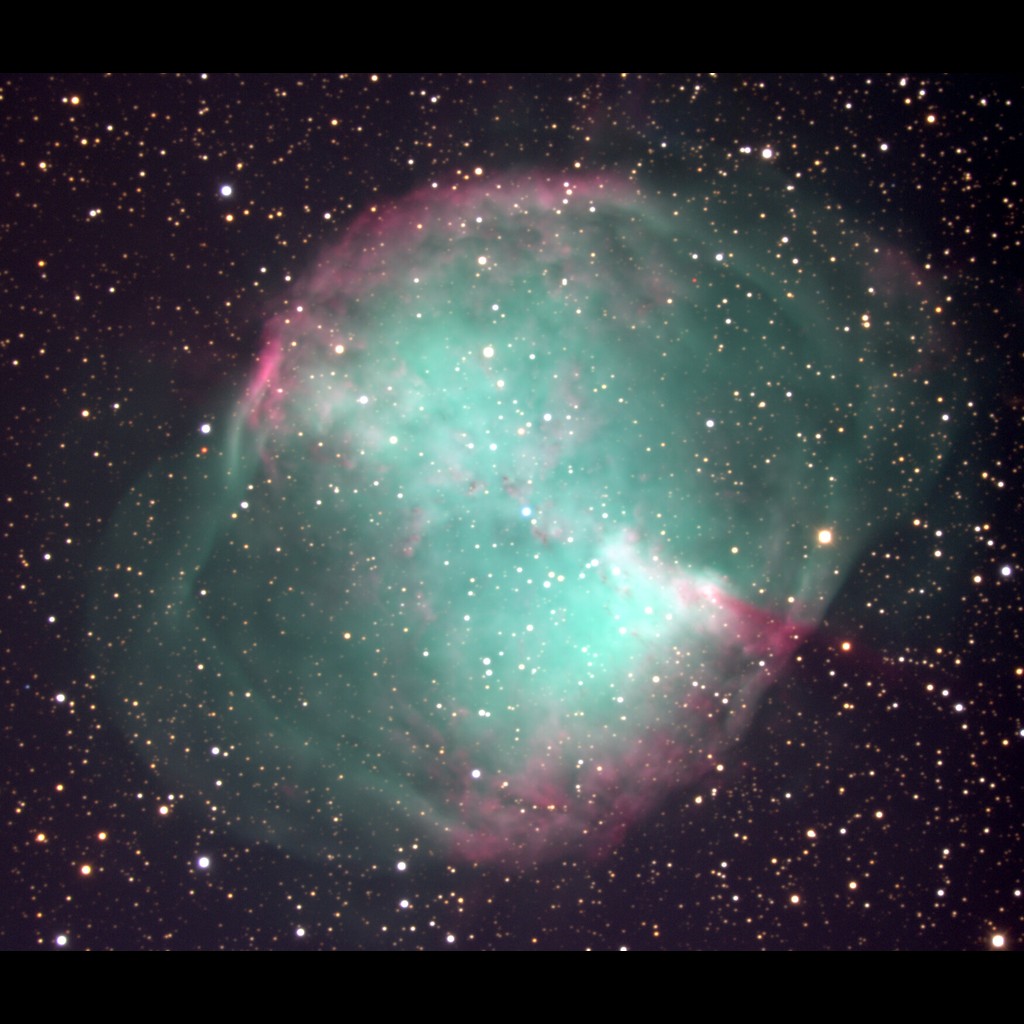
Messier 27 (NGC 6853), the Dumbbell Nebula, holds the distinction of being the first planetary nebula ever discovered. Charles Messier found it on July 12, 1764, and described it as an oval nebula without stars — puzzling, since planetary nebulae were not yet understood as a class. It was William Herschel who later gave them their misleading name, because in a small telescope their round, disk-like glow reminded him of the planets Uranus and Uranus. The Dumbbell lies approximately 1,360 light-years away in the small constellation Vulpecula, the Fox, and is the brightest planetary nebula in the sky, easily visible in binoculars.
NGC 6853 is the expanding shell of gas shed by a dying Sun-like star as it exhausted its nuclear fuel and collapsed into a white dwarf — the dense stellar remnant visible at the nebula's center. The white dwarf's intense ultraviolet radiation ionizes the surrounding gas, causing it to glow. The classic "dumbbell" shape — two lobes of brighter emission bridged by a fainter waist — is a product of the geometry of the ejection: material was shed preferentially along an equatorial belt, making the nebula appear lobed when viewed from our particular vantage point. The full extent of NGC 6853 is larger than its bright core suggests; long exposures reveal a much fainter outer envelope extending well beyond the familiar bright hourglass.
In binoculars the Dumbbell appears as a clearly non-stellar, oval glow; a small telescope at moderate power reveals the double-lobed silhouette that gives the nebula its name, and the central white dwarf becomes visible in a 200 mm aperture. This approximately true-color image was taken in July 2000 at the Kitt Peak National Observatory 2.1-meter telescope during the Research Experiences for Undergraduates (REU) program supported by the National Science Foundation; dynamic range was stretched to reveal the faint outer regions alongside the bright core.
From Sadr: From Sadr (Gamma Cygni), sweep 8° south into Vulpecula — M27 sits near the star 14 Vulpeculae.
| Star | Bayer | Mag | Spectral Type | Distance | Meaning |
|---|---|---|---|---|---|
| Vega | α Lyr | 0.03 | A0 · Blue-white main sequence | 25 ly | Arabic Wāqi', 'The Swooping Eagle' — the fifth brightest star and anchor of the Summer Triangle. Will become the North Star around 13,727 CE. |
| Altair | α Aql | 0.76 | A7 · White main sequence | 17 ly | Arabic Al-Nasr al-Tā'ir, 'The Flying Eagle.' One of the three stars of the Summer Triangle, it spins so fast it is noticeably flattened at the poles. |
| Sadr | γ Cyg | 2.23 | F8 · Yellow-white supergiant | 1800 ly | Arabic Al-Sadr, 'The Breast' — marks the center of Cygnus the Swan, where the Northern Cross intersects. Surrounded by the North America Nebula. |
| Gienah | — | 2.48 | K0 · Blue-white giant | 1520 ly | Arabic Al-Janāh, 'The Wing' — marks the wing of Cygnus the Swan, one of several stars sharing this name across different constellations. |
| Tarazed | γ Aql | 2.72 | K3 · Orange giant | 460 ly | Persian Tarāzad, possibly 'The Beam of the Scales' — flanks Altair in Aquila, the bright orange counterpart to the white eagle star. |
| Albireo | β Cyg | 3.05 | K3 · Orange giant + blue companion | 430 ly | Origin uncertain, possibly corrupted Latin or Arabic. Famous as one of the most beautiful double stars in the sky — gold and blue. |
| Sheliak | γ Lyr | 3.52 | A8 · Blue-white eclipsing binary | 960 ly | Arabic Al-Sheliak, 'The Tortoise' or 'The Lyre' — an eclipsing binary in Lyra that was one of the first variable stars discovered, in 1784. |
| Alshain | θ Aql | 3.71 | G8 · Yellow subgiant | 45 ly | Persian Shahīn, 'The Peregrine Falcon' — flanks Altair in Aquila, part of the trio of stars that make the eagle's body. |