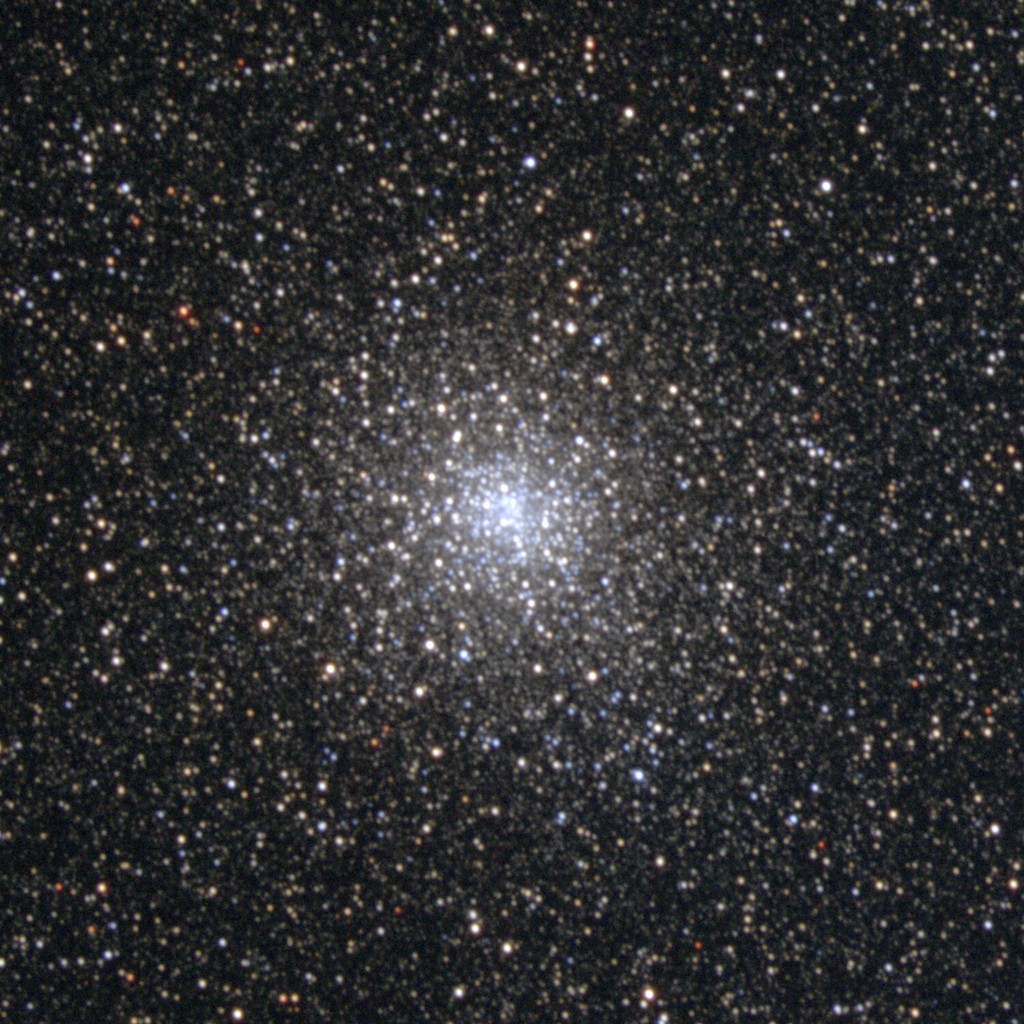
NOIRLab/ NSF /AURA
| Type | Globular Cluster | Constellation | Sgr |
|---|---|---|---|
| Magnitude | 6.8 | Size | 11.2′ |
| Distance | 18,300 light-years | Best Month | August |
| Visibility | Global | Difficulty | Easy (level 2/4) |
| Min. Aperture | binoculars | RA / Dec | 18h 24m 36.0s · -24° 52' 12" |
| Discovered by | Charles Messier, 1764 | ||
NOIRLab/ NSF /AURA
Messier 28 (NGC 6626) is a globular cluster in the constellation Sagittarius, approximately 18,000 light-years from Earth and spanning about 80 light-years across. It was discovered by Charles Messier on July 27, 1764. NGC 6626 is a moderately concentrated cluster, slightly elliptical in outline, and is one of the more densely populated globulars in Sagittarius — though it is somewhat overshadowed by its brighter and closer neighbor, M22. Its position near the galactic plane means interstellar dust dims and reddens it, making it less conspicuous to the naked eye than its true luminosity would suggest.
NGC 6626 made history in 1987 when it became the first globular cluster known to contain a millisecond pulsar — PSR B1821−24, a neutron star spinning 642 times per second. Millisecond pulsars in globular clusters are believed to be recycled pulsars, old neutron stars that have been "spun up" to extreme rotation rates by accreting mass from a binary companion. The discovery in M28 opened a new chapter in neutron star physics and prompted searches that have since found dozens of millisecond pulsars in other globulars. The cluster also contains a handful of RR Lyrae variable stars useful for refining its distance.
A small telescope shows M28 as a faint, compact, round glow next to the brighter M22; resolving individual stars at its edges requires a 200 mm aperture. This image was assembled from data taken in November 1998 at the Kitt Peak National Observatory 0.9-meter telescope, with brightness stretched to reveal the dense inner core without saturating it.
Navigate from Vega toward Sagittarius. In Sagittarius, about 1° northwest of Lambda Sagittarii (the Teapot lid star).
| Star | Bayer | Mag | Spectral Type | Distance | Meaning |
|---|---|---|---|---|---|
| Kaus Australis | ε Sgr | 1.79 | B9 · Blue-white giant | 143 ly | Hybrid Arabic-Latin, 'Southern Bow' — the brightest star in Sagittarius, at the base of the Archer's bow. Part of the Teapot asterism. |
| Nunki | ζ Sgr | 2.05 | B2 · Blue-white main sequence | 228 ly | Babylonian origin — one of the oldest known star names, from the Babylonian star catalogue. Associated with the sacred city of Eridu. |
| Kaus Meridionalis | δ Sgr | 2.72 | K3 · Orange giant | 306 ly | Hybrid Arabic-Latin, 'Middle of the Bow' — the central bow star of Sagittarius, part of the famous Teapot asterism. |
| Kaus Borealis | — | 2.82 | K1 · Orange giant | 78 ly | Hybrid Arabic-Latin, 'Northern Bow' — marks the top of the Archer's bow in Sagittarius. Part of the Teapot asterism. |
| Nash | — | 2.98 | K0 · Orange giant | 97 ly | Arabic Al-Nasl, 'The Arrowhead' or 'The Point' — marks the tip of the Archer's arrow aimed at the heart of Scorpius. |