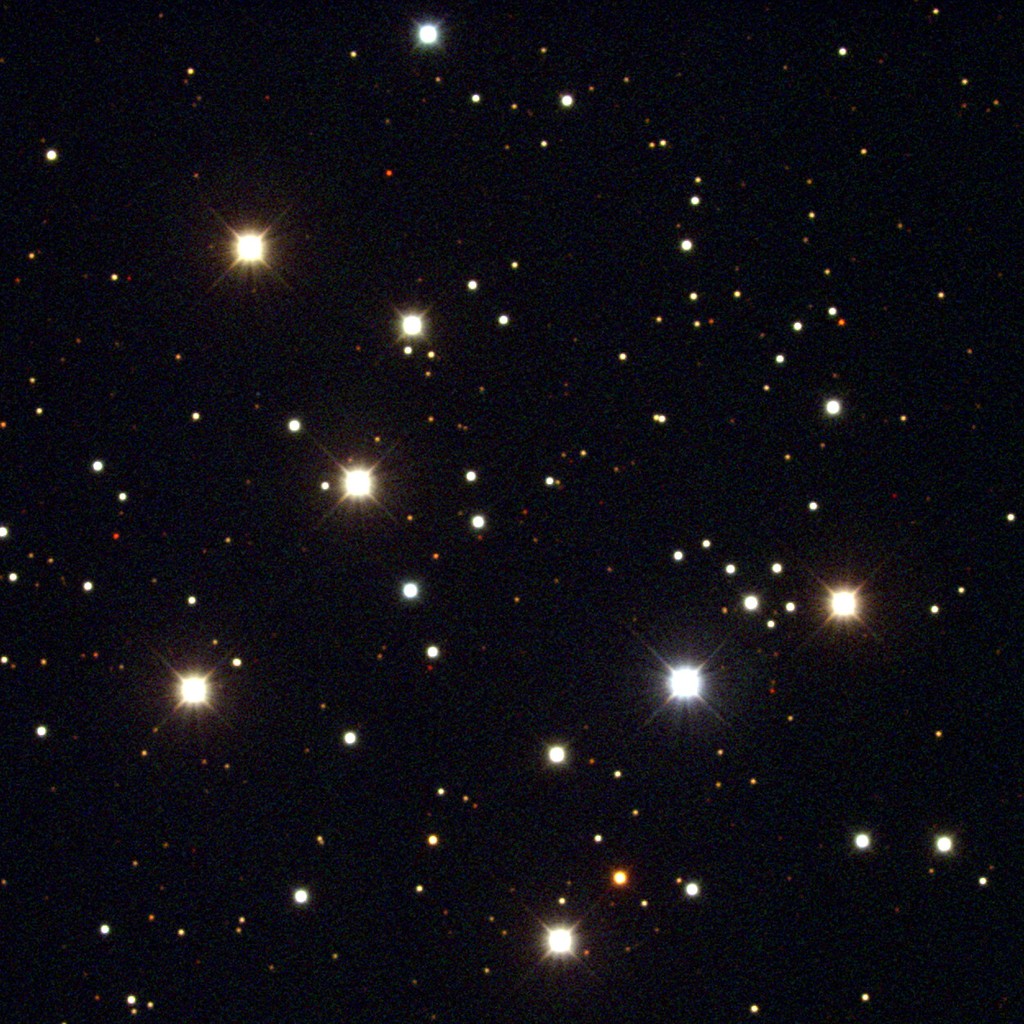
Hillary Mathis/NOIRLab/ NSF /AURA
| Type | Open Cluster | Constellation | Cyg |
|---|---|---|---|
| Magnitude | 7.1 | Size | 7.0′ |
| Distance | 4,000 light-years | Best Month | August |
| Visibility | Northern | Difficulty | Moderate (level 3/4) |
| Min. Aperture | binoculars | RA / Dec | 20h 23m 49.2s · +38° 31' 12" |
| Discovered by | Charles Messier, 1764 | ||
Hillary Mathis/NOIRLab/ NSF /AURA
Messier 29 (NGC 6913) is a small, sparse open star cluster in the constellation Cygnus, lying in a crowded stretch of the Milky Way in one of the richest regions of the northern sky. Charles Messier catalogued it on July 29, 1764. Its distance is uncertain — estimated somewhere between 4,000 and 6,000 light-years — because strong, poorly characterized interstellar dust absorption along this line of sight makes it difficult to determine the intrinsic brightness of the cluster's stars. That same dust dims NGC 6913 significantly; without it, the cluster would appear several times brighter than it does.
NGC 6913 contains about 50 confirmed members, of which roughly half a dozen bright blue-white stars form the small, distinctive grouping that is recognizable at the telescope. These hot O and B-type stars identify the cluster as young — likely less than 10 million years old — meaning M29 has barely aged since bursting into existence from a now-dispersed molecular cloud. The cluster is coarser and less impressive than many Messier showpieces, and its true membership is difficult to determine because the dense Cygnus Milky Way background makes foreground and background contamination significant. It is best appreciated as one jewel in a spectacular region of the summer sky.
In binoculars M29 is visible as a small knot of brighter stars set in a dazzling Milky Way field; a small telescope reveals five or six bright blue stars in a compact box-like pattern against a rich background. This approximately true-color image was assembled from sixteen frames taken at the Kitt Peak National Observatory 2.1-meter telescope on the night of June 18–19, 2003.
From Sadr: From Sadr (Gamma Cygni, centre of the Northern Cross), sweep 2° south.
| Star | Bayer | Mag | Spectral Type | Distance | Meaning |
|---|---|---|---|---|---|
| Deneb | α Cyg | 1.25 | A2 · Blue-white supergiant | 2600 ly | Arabic Dhanab al-Dajājah, 'Tail of the Hen' — the tail of Cygnus the Swan and one of the three stars of the Summer Triangle. |
| Sadr | γ Cyg | 2.23 | F8 · Yellow-white supergiant | 1800 ly | Arabic Al-Sadr, 'The Breast' — marks the center of Cygnus the Swan, where the Northern Cross intersects. Surrounded by the North America Nebula. |
| Gienah | — | 2.48 | K0 · Blue-white giant | 1520 ly | Arabic Al-Janāh, 'The Wing' — marks the wing of Cygnus the Swan, one of several stars sharing this name across different constellations. |
| Albireo | β Cyg | 3.05 | K3 · Orange giant + blue companion | 430 ly | Origin uncertain, possibly corrupted Latin or Arabic. Famous as one of the most beautiful double stars in the sky — gold and blue. |