REU program/NOIRLab/ NSF /AURA
| Type | Globular Cluster | Constellation | Cap |
|---|---|---|---|
| Magnitude | 7.5 | Size | 11.0′ |
| Distance | 28,000 light-years | Best Month | September |
| Visibility | Global | Difficulty | Moderate (level 3/4) |
| Min. Aperture | 3in | RA / Dec | 21h 40m 22.8s · -23° 10' 48" |
| Discovered by | Charles Messier, 1764 | ||
REU program/NOIRLab/ NSF /AURA
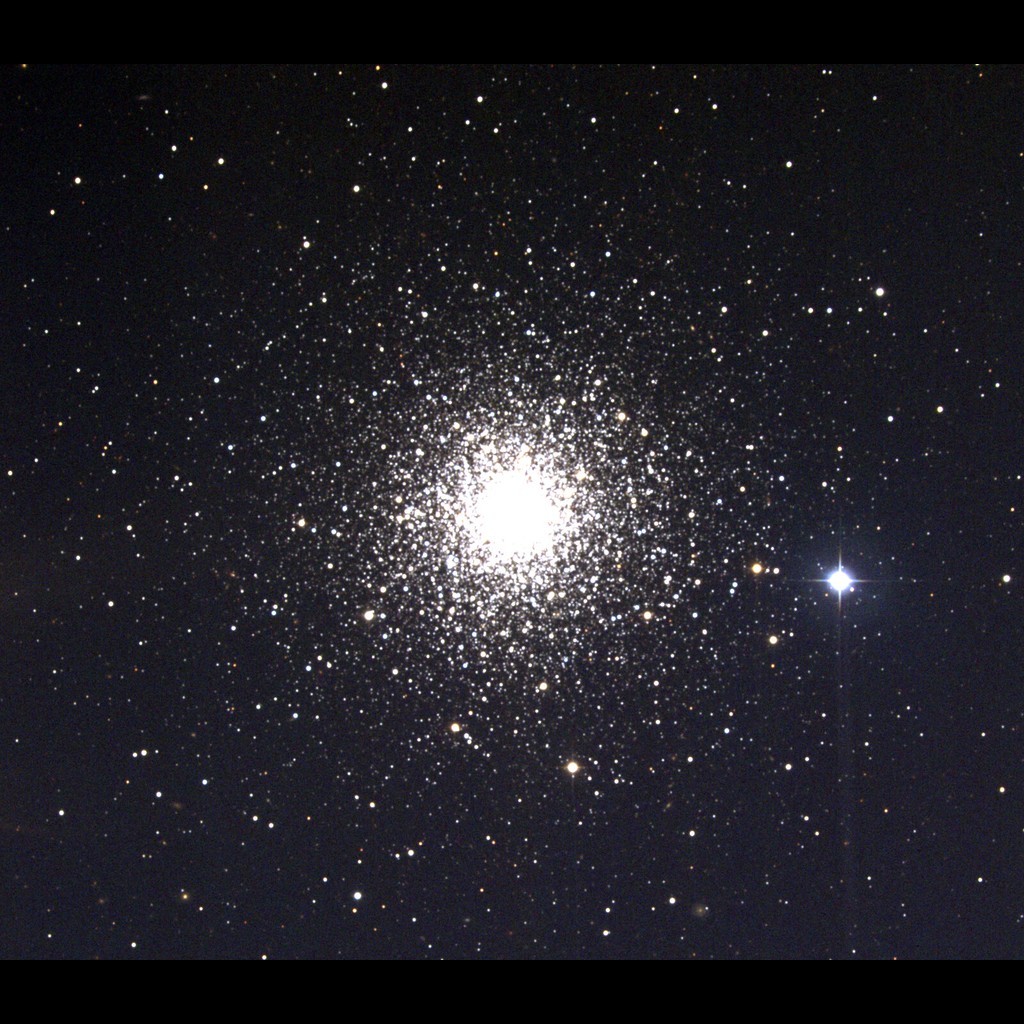
Messier 30 (NGC 7099) is a rich globular cluster in the constellation Capricornus, located approximately 26,000 light-years from Earth and spanning about 75 light-years across. Charles Messier discovered it on August 3, 1764, describing it as a "round nebula" with no stars. William Herschel later resolved NGC 7099 into its individual members. The cluster shines at apparent magnitude 7.2 — just below the naked-eye limit — and is among the dozen or so best Messier globulars for telescopic observing. Finding it requires a star-hop from the bright stars of Capricornus through a region of sky relatively poor in conspicuous landmarks.
NGC 7099 is classified as a core-collapsed globular cluster: over its 13-billion-year lifetime, gravitational interactions between stars have funneled mass progressively inward, compressing the core to extraordinary density. This process has given M30 one of the most striking structural profiles among all globulars — a steep central spike of light that falls away rapidly into a broader, more normal halo. Stars in the dense core interact frequently, exchanging energy in ways that can accelerate individual stars to escape velocity and eject them entirely. The cluster also contains a modest number of RR Lyrae variable stars and blue straggler stars, thought to be the products of stellar collisions or mass-transfer events in the crowded core.
A small telescope shows M30 as a concentrated round haze with an intensely bright center; a 150 mm aperture begins to resolve stars in the outer halo. This image was taken in July 1997 at the Kitt Peak National Observatory 0.9-meter telescope during the Research Experiences for Undergraduates (REU) program supported by the National Science Foundation.
Navigate from Enif toward Capricornus. In Capricornus, near the star 41 Capricorni.
| Star | Bayer | Mag | Spectral Type | Distance | Meaning |
|---|---|---|---|---|---|
| Fomalhaut | — | 1.17 | A3 · White main sequence | 25 ly | Arabic Fam al-Hūt, 'Mouth of the Fish' — one of the four Royal Stars of antiquity. Has a visible debris disk containing a possible planet. |