T.A.Rector and B.A.Wolpa/NOIRLab/ NSF /AURA/
| Type | Galaxy | Constellation | And |
|---|---|---|---|
| Magnitude | 3.4 | Size | 185.0′ |
| Distance | 2.537 million light-years | Best Month | November |
| Visibility | Northern | Difficulty | Easiest (level 1/4) |
| Min. Aperture | naked eye | RA / Dec | 00h 42m 43.2s · +41° 16' 12" |
| Discovered by | Abd al-Rahman al-Sufi, 964 | ||
T.A.Rector and B.A.Wolpa/NOIRLab/ NSF /AURA/
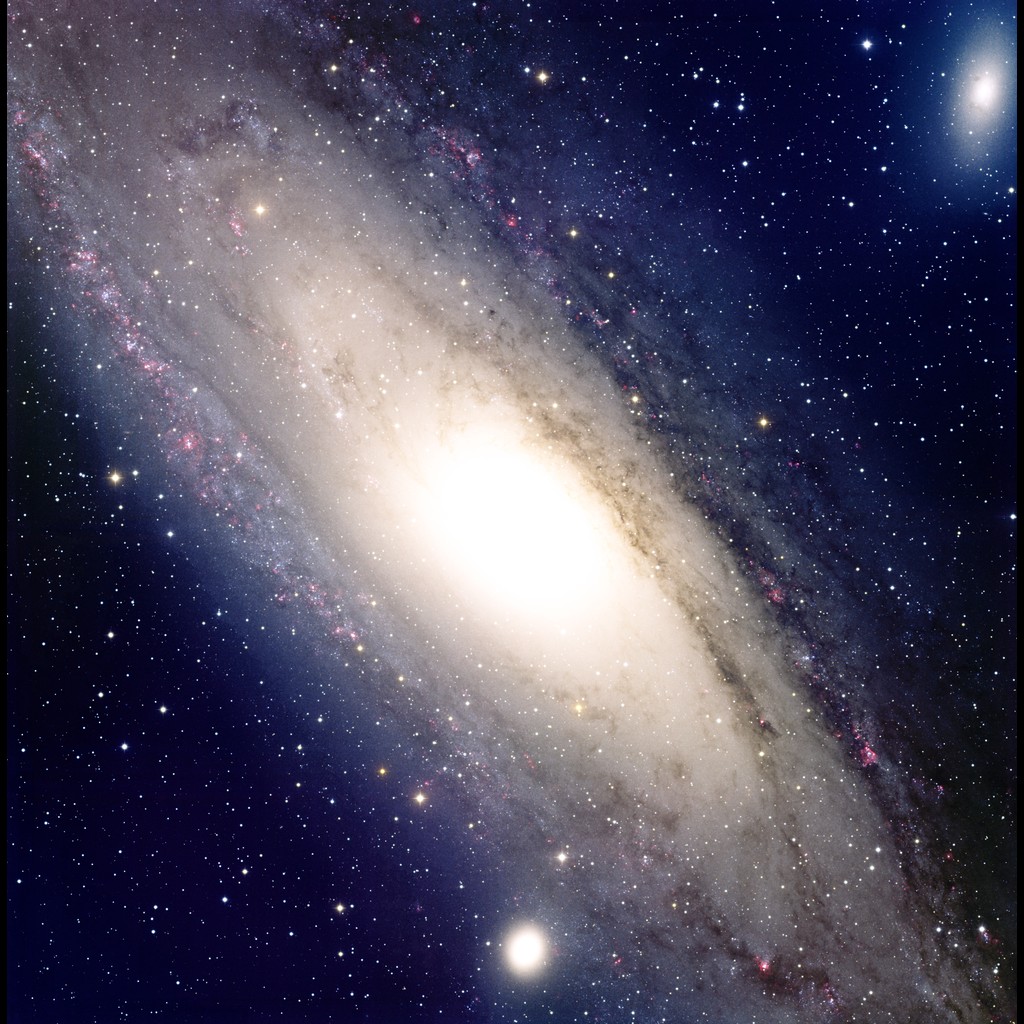
Messier 31 (NGC 224), the Andromeda Galaxy, is the closest large spiral galaxy to the Milky Way, lying approximately 2.2 million light-years away in the constellation Andromeda. It was first described in writing by Persian astronomer Abd al-Rahman al-Sufi in 964 AD as a "little cloud," and later observed telescopically by Simon Marius in 1612. Charles Messier catalogued it in 1764. On a clear, moonless night, NGC 224 is visible to the unaided eye as a large, elongated smudge of light — the most distant object routinely visible without optical aid. It spans more than 65,000 light-years in diameter, making it considerably larger in angular extent on the sky than five full Moons laid end to end.
Andromeda and the Milky Way are the two dominant members of the Local Group of galaxies, bound together gravitationally along with dozens of smaller satellite galaxies including M32 and M110. The two great spirals are approaching each other at roughly 110 kilometers per second and are expected to begin merging in approximately 4.5 billion years, ultimately forming a giant elliptical galaxy. NGC 224 contains an estimated trillion stars — roughly twice the number in the Milky Way — and harbors a double nucleus: two bright cores offset from each other, thought to be an eccentric disk of stars orbiting a supermassive black hole of roughly 100 million solar masses. Its spiral arms, star-forming regions, and satellite galaxies make it a perpetual target for professional and amateur astronomers alike.
From a dark site, M31 is the most spectacular naked-eye extragalactic object in the sky. This true-color image was made with the Mosaic CCD camera on the Kitt Peak National Observatory 0.9-meter telescope, combining exposures through seven filters — U, B, V, R, I, Hydrogen-alpha, and [O III] — to reveal both the stellar populations and the nebular emission regions within the galaxy.
From Alpheratz: From Alpheratz (Alpha Andromedae), the galaxy is easily found by star-hopping along the northern chain of Andromeda's stars.
| Star | Bayer | Mag | Spectral Type | Distance | Meaning |
|---|---|---|---|---|---|
| Mirach | β And | 2.07 | M0 · Red giant | 197 ly | Arabic Al-Mirāq, 'The Girdle' or 'The Loin' — marks the hip of Andromeda. Nearby sits M31, the Andromeda Galaxy, visible to the naked eye. |
| Alpheratz | α And | 2.07 | B9 · Blue-white subgiant | 97 ly | Arabic Surrat al-Faras, 'Navel of the Mare' — once shared between Andromeda and Pegasus, forming a corner of the Great Square. |
| Alpheratz | α And | 2.07 | B9 · Blue-white subgiant | 97 ly | Arabic Surrat al-Faras, 'Navel of the Mare' — the upper-left corner of the Great Square of Pegasus, now officially assigned to Andromeda. |
| Almaak | γ And | 2.10 | B8 · Orange giant + blue companion | 355 ly | Arabic Al-'Anāq al-Ard, 'The Desert Lynx.' One of the finest double stars in the sky — vivid gold and blue-green pair. |
| Shedir | γ Cas | 2.24 | K0 · Orange giant | 229 ly | Arabic Al-Sadr, 'The Breast' — marks the heart of Cassiopeia the Queen on her throne. A slowly varying orange giant. |