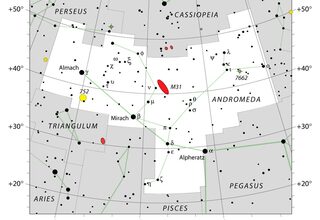
 IAU Chart
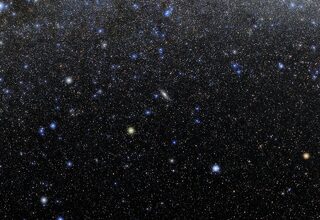 NOIRLab Images
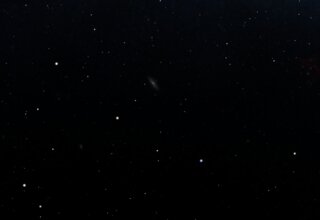 Stellarium Images
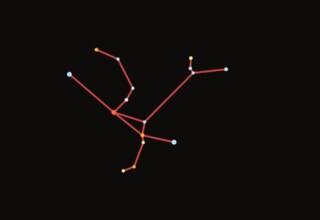 Stars and Sticks
| Abbreviation | And |
|---|---|
| Meaning | Princess of Ethiopia |
| Pronunciation Guide is based on “Pronouncing Astronomical Names,” published in 1943 by the American Astronomical Society. | an-DRAH-mih-duh |
| Genitive The genitive is the Latin possessive form used in star names. For example, Alpha Orionis means “the Alpha of Orion.” | an-DROM-ih-dee |
| Best Month | November |
| Visibility | Northern |
| Origin | AncientThese figures are rooted in the classical Greek and Mesopotamian traditions cataloged by Ptolemy in the 2nd century AD. |
| Author | PtolemyPtolemy, a 2nd-century Greco-Egyptian astronomer, cataloged the 48 classical constellations in his landmark work, the Almagest. These form the core of the 88 modern constellations recognized today. |
| Type | constellation |
| Difficulty | Easy |
| Description | Daughter of Cassiopeia and Cepheus, Andromeda was chained to a coastal rock as a sacrifice to the sea monster Cetus — punishment for her mother's boast that she was more beautiful than the sea nymphs. Perseus, returning from slaying Medusa, spotted her from the sky and fell instantly in love, slaying the monster and claiming her as his bride. Their union produced a lineage of heroes that shaped Greek mythology. The constellation's brightest star, Alpheratz, forms the corner of the Great Square of Pegasus and is actually a binary system 97 light-years away whose primary component is an unusual mercury-manganese star 200 times more luminous than the Sun. The famous Andromeda Galaxy (M31), visible to the naked eye, lies within its borders — our nearest large galactic neighbor at 2.5 million light-years. |
Click a thumbnail to view full-size. Plain and Annotated versions available on the image page.
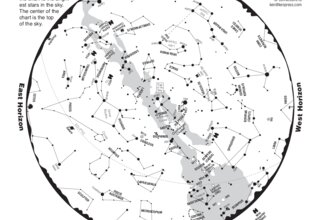
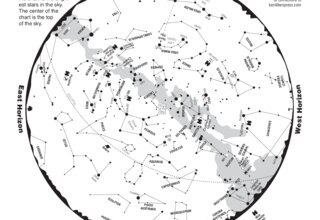
Monthly sky charts courtesy of What's Out Tonight? — Copyright ©2026 Ken Graun. Star charts are optimized for mid-latitudes of the Northern Hemisphere. Click a chart to view or download the PDF. For guidance on using the chart, or to purchase a planisphere and astronomy books, visit kenpress.com.
Images: NOIRLab/NSF/AURA/E. Slawik · IAU and Sky & Telescope · Stellarium — Full credits →