NOIRLab/NSF/AURA
| Type | Galaxy | Constellation | And |
|---|---|---|---|
| Magnitude | 8.7 | Size | 8.7′ |
| Distance | 2.49 million light-years | Best Month | November |
| Visibility | Northern | Difficulty | Easy (level 2/4) |
| Min. Aperture | binoculars | RA / Dec | 00h 42m 43.2s · +40° 52' 12" |
| Discovered by | Guillaume Le Gentil, 1749 | ||
NOIRLab/NSF/AURA
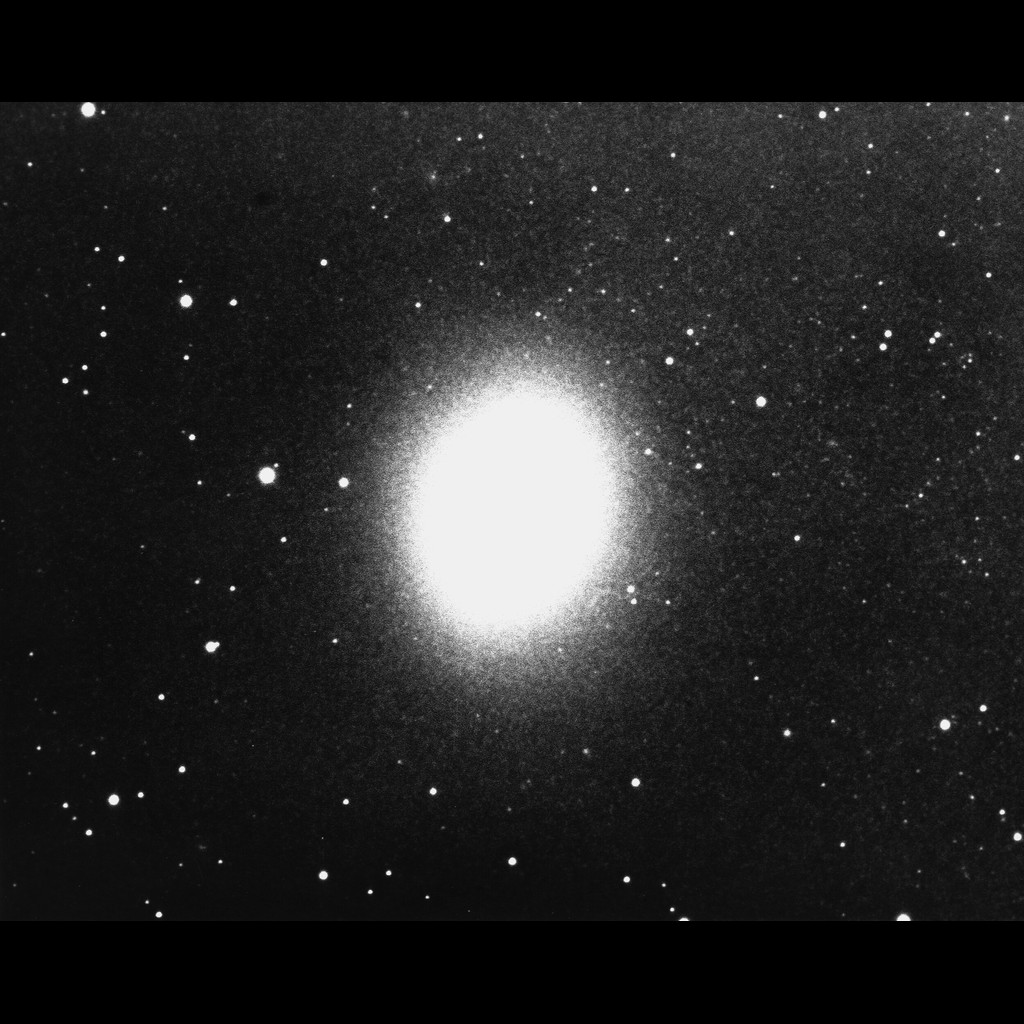
Messier 32 (NGC 221) is a compact dwarf elliptical galaxy and one of the two brightest satellite companions of the Andromeda Galaxy (M31), located approximately 2.2 million light-years from Earth in the constellation Andromeda. It was discovered by Guillaume Le Gentil in 1749 and catalogued by Charles Messier in 1764. Though classified as a dwarf by galactic standards — spanning only about 2,400 light-years, compared with M31's 65,000 — NGC 221 is a relatively massive dwarf elliptical and one of the closest external galaxies to our own. In photographs it appears as a small, intensely bright oval blur superimposed on the disk of M31 just to the south of the great galaxy's core.
NGC 221 is remarkable for its extremely dense, compact structure. Unlike many dwarf ellipticals that are loosely bound and low in surface brightness, M32 has a steeply peaked central brightness profile that signals a very high stellar density at its core. Astronomers have inferred the presence of a supermassive black hole at its center — with a mass of a few million solar masses — making it one of the smallest galaxies known to host such an object. It is thought that M32 may once have been a much larger spiral galaxy that was stripped of its outer disk and star-forming regions by gravitational interactions with M31 over billions of years, leaving behind its dense, compact remnant core.
Through binoculars M32 appears as a star-like point or tiny oval smudge alongside the great Andromeda Galaxy; a small telescope shows it as a compact, brightly condensed nucleus. This image was made at the Kitt Peak National Observatory 4-meter Mayall telescope in 1975.
From Alpheratz: Just 0.4° south of M31's centre — visible in the same binocular field as Andromeda.
| Star | Bayer | Mag | Spectral Type | Distance | Meaning |
|---|---|---|---|---|---|
| Mirach | β And | 2.07 | M0 · Red giant | 197 ly | Arabic Al-Mirāq, 'The Girdle' or 'The Loin' — marks the hip of Andromeda. Nearby sits M31, the Andromeda Galaxy, visible to the naked eye. |
| Alpheratz | α And | 2.07 | B9 · Blue-white subgiant | 97 ly | Arabic Surrat al-Faras, 'Navel of the Mare' — once shared between Andromeda and Pegasus, forming a corner of the Great Square. |
| Alpheratz | α And | 2.07 | B9 · Blue-white subgiant | 97 ly | Arabic Surrat al-Faras, 'Navel of the Mare' — the upper-left corner of the Great Square of Pegasus, now officially assigned to Andromeda. |
| Almaak | γ And | 2.10 | B8 · Orange giant + blue companion | 355 ly | Arabic Al-'Anāq al-Ard, 'The Desert Lynx.' One of the finest double stars in the sky — vivid gold and blue-green pair. |