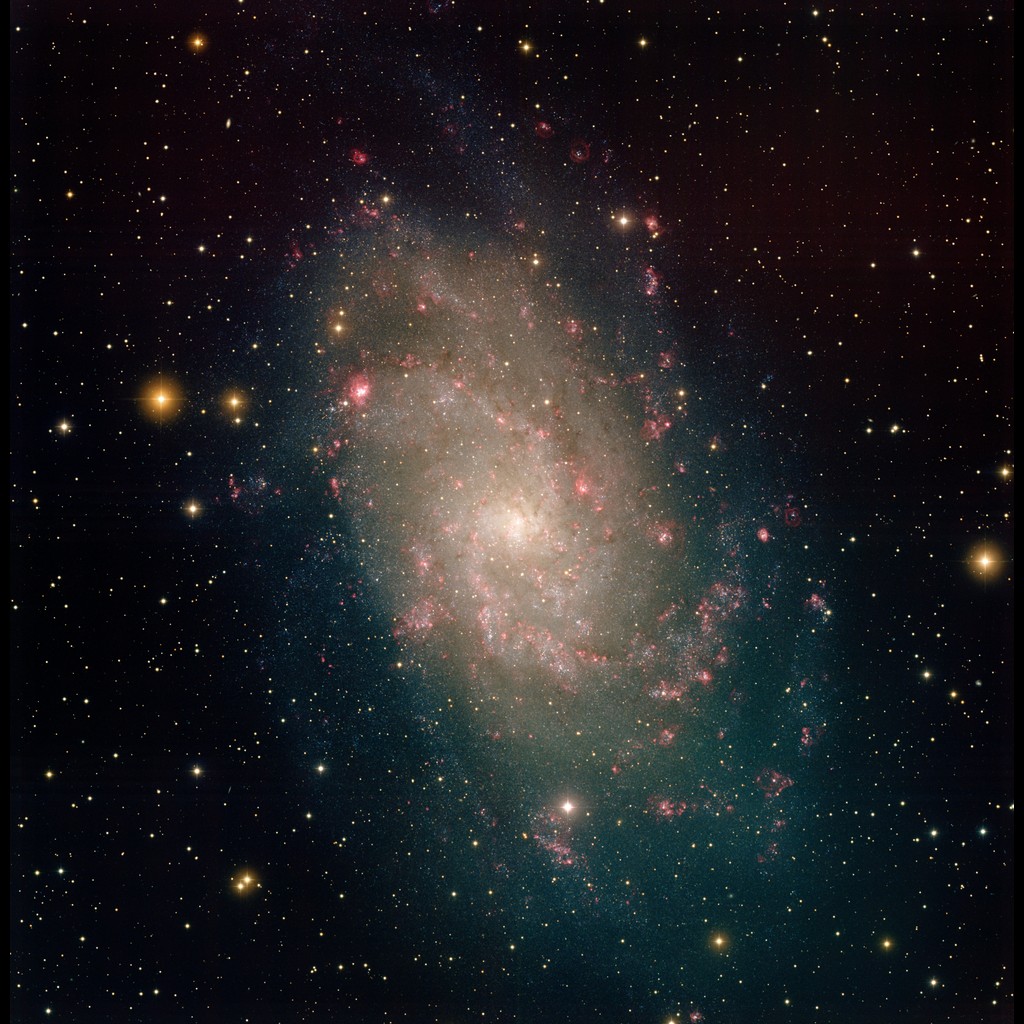
T.A.Rector (NRAO/AUI/NSF and NOIRLab/NSF/AURA) and M.Hanna (NOIRLab/NSF/AURA)
| Type | Galaxy | Constellation | Tri |
|---|---|---|---|
| Magnitude | 5.7 | Size | 70.0′ |
| Distance | 2.73 million light-years | Best Month | November |
| Visibility | Northern | Difficulty | Moderate (level 3/4) |
| Min. Aperture | binoculars | RA / Dec | 01h 33m 50.4s · +30° 39' 36" |
| Discovered by | Charles Messier, 1764 | ||
T.A.Rector (NRAO/AUI/NSF and NOIRLab/NSF/AURA) and M.Hanna (NOIRLab/NSF/AURA)
Messier 33 (NGC 598), the Triangulum Galaxy, is the third-largest member of the Local Group of galaxies and a near neighbor of the Milky Way and Andromeda Galaxy (M31), lying approximately 2.7 million light-years away in the constellation Triangulum. It may have been observed by Giovanni Battista Hodierna before 1654, and Charles Messier catalogued it in 1764. NGC 598 is a loosely wound face-on spiral more than 30,000 light-years across, oriented nearly perpendicular to our line of sight — a configuration that spreads its relatively modest total light across a large apparent area, making it one of the most challenging naked-eye objects in the sky despite its proximity. Under excellent dark conditions experienced observers can glimpse it; for most observers binoculars are needed.
The Triangulum Galaxy is actively star-forming, and its spiral arms blaze with pinkish-red HII emission regions — clouds of ionized hydrogen surrounding clusters of young hot stars. The largest of these, NGC 604, is a vast stellar nursery more than 1,300 light-years across, hundreds of times larger than the Orion Nebula and one of the biggest HII regions known in the Local Group. The blue tint of NGC 598's disk reflects the abundance of hot young stars scattered along its arms, while older redder populations concentrate toward the smaller central bulge. M33 is gravitationally linked to the Andromeda Galaxy and may be a satellite of M31 or a companion in a slow mutual orbit.
On the sky M33 covers an area comparable to two full Moons, but its low surface brightness makes it undetectable without darkness and a low-power wide-field view. This image was made with the Mosaic CCD camera on the Kitt Peak National Observatory 0.9-meter telescope, combining B, V, I, and Hydrogen-alpha filter data to highlight both the stellar content and the star-forming nebulae within the galaxy.
From Mirach: From Mirach (Beta Andromedae), move 7° northwest into Triangulum.
| Star | Bayer | Mag | Spectral Type | Distance | Meaning |
|---|---|---|---|---|---|
| Hamal | α Ari | 2.01 | K2 · Orange giant | 66 ly | Arabic Al-Hamal, 'The Head of the Ram' — the brightest star in Aries. Marked the vernal equinox around 2000 BCE. |
| Mirach | β And | 2.07 | M0 · Red giant | 197 ly | Arabic Al-Mirāq, 'The Girdle' or 'The Loin' — marks the hip of Andromeda. Nearby sits M31, the Andromeda Galaxy, visible to the naked eye. |
| Almaak | γ And | 2.10 | B8 · Orange giant + blue companion | 355 ly | Arabic Al-'Anāq al-Ard, 'The Desert Lynx.' One of the finest double stars in the sky — vivid gold and blue-green pair. |
| Sheratan | β Ari | 2.64 | A5 · White binary | 60 ly | Arabic Al-Sharatain, 'The Two Signs' — once marked the vernal equinox alongside Hamal. A spectroscopic binary star. |