REU program/NOIRLab/ NSF /AURA
| Type | Open Cluster | Constellation | Per |
|---|---|---|---|
| Magnitude | 5.5 | Size | 35.0′ |
| Distance | 1,400 light-years | Best Month | December |
| Visibility | Northern | Difficulty | Easiest (level 1/4) |
| Min. Aperture | naked eye | RA / Dec | 02h 42m 07.2s · +42° 43' 48" |
| Discovered by | Giovanni Batista Hodierna, 1654 | ||
REU program/NOIRLab/ NSF /AURA
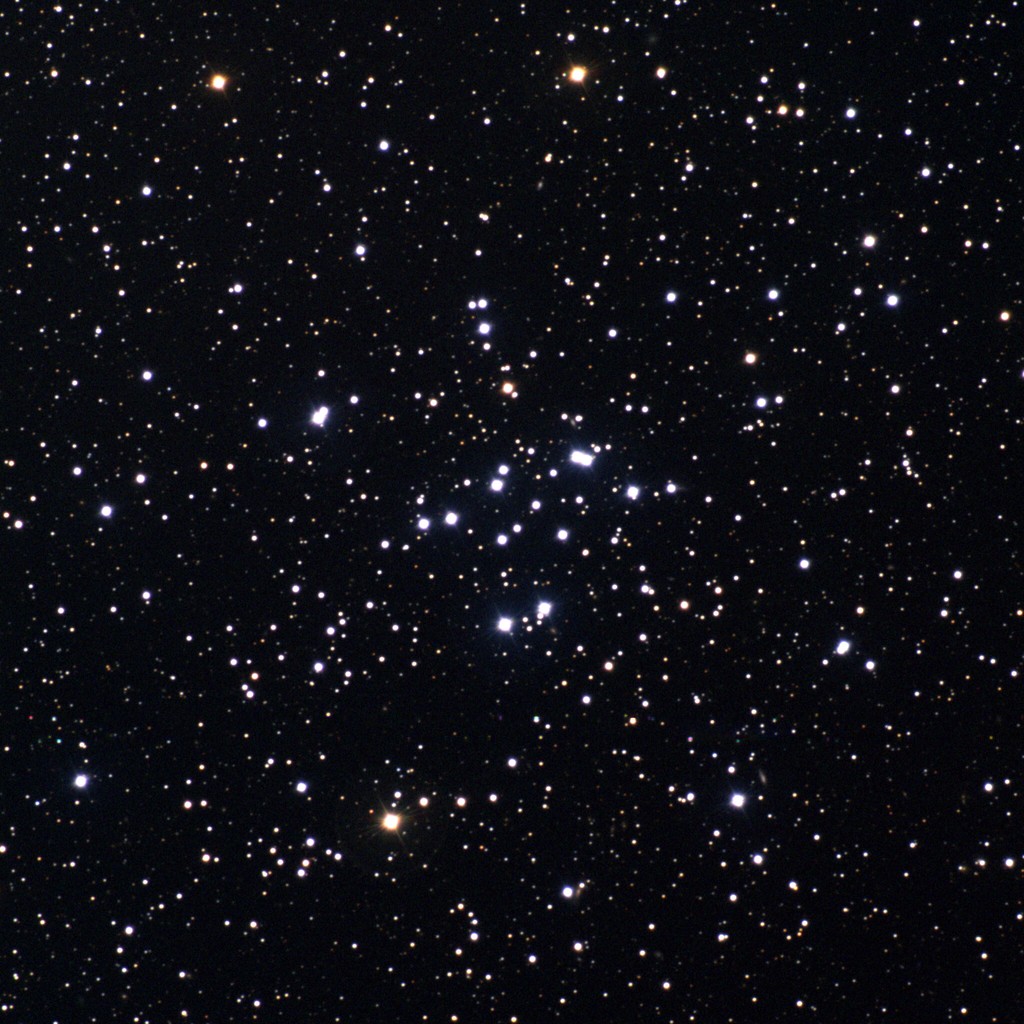
Messier 34 (NGC 1039) is a bright, loose open star cluster in the constellation Perseus, lying approximately 1,400 light-years from Earth and spanning about 12 light-years across. It may have been first recorded by Giovanni Battista Hodierna before 1654, and was catalogued by Charles Messier on August 25, 1764. NGC 1039 contains about 100 confirmed members and is just visible to the unaided eye under good conditions, sitting in a rich stretch of the Milky Way between Perseus and Andromeda. In binoculars or a wide-field telescope it is one of the more rewarding winter clusters — a broad, well-resolved gathering of stars with several obvious double and multiple star groupings among its membership.
NGC 1039 is estimated to be around 200–250 million years old, placing it in a middle age for open clusters. Most of its hottest original members have long since evolved off the main sequence, leaving a population dominated by blue-white A and F stars alongside a handful of brighter evolved giants. Several visual double stars are scattered through the cluster, making it a pleasing target for observers who enjoy splitting pairs with moderate apertures. M34 lies slightly above the galactic plane, so the star field background is rich but not the overwhelming profusion of the Sagittarius Milky Way; cluster members stand out clearly against the background.
In binoculars M34 appears as a large, loosely scattered group of stars; a small telescope at low power resolves perhaps 35–50 members spread across an area larger than the full Moon, with several attractive double stars visible. This approximately true-color image was assembled from BVR exposures taken in July 1996 at the Burrell Schmidt telescope of Case Western Reserve University's Warner and Swasey Observatory on Kitt Peak, as part of the Research Experiences for Undergraduates (REU) program supported by the National Science Foundation.
From Algol: From Algol (Beta Persei), move 5° northwest along the Perseus-Andromeda border.
| Star | Bayer | Mag | Spectral Type | Distance | Meaning |
|---|---|---|---|---|---|
| Mirphak | ε Per | 1.79 | F5 · Yellow-white supergiant | 590 ly | Arabic Mirfaq al-Thurayya, 'Elbow near the Pleiades' — the brightest star in Perseus, embedded in a beautiful star cluster visible in binoculars. |
| Algol | β Per | 2.09 | B8 · Eclipsing binary | 93 ly | Arabic Ra's al-Ghūl, 'Head of the Demon' — named for the severed Medusa head held by Perseus. It dims every 2.87 days as a companion eclipses it. |
| Almaak | γ And | 2.10 | B8 · Orange giant + blue companion | 355 ly | Arabic Al-'Anāq al-Ard, 'The Desert Lynx.' One of the finest double stars in the sky — vivid gold and blue-green pair. |