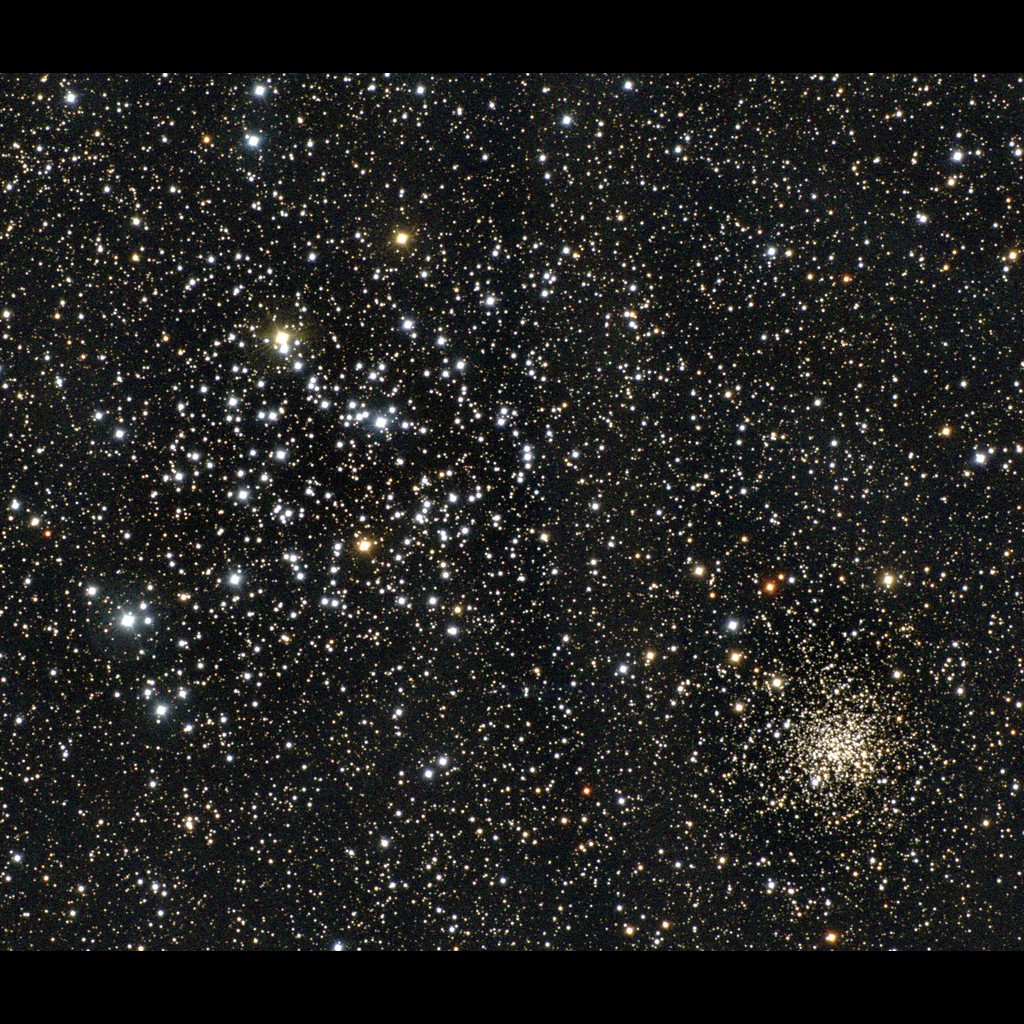
N.A.Sharp/NOIRLab/ NSF /AURA
| Type | Open Cluster | Constellation | Gem |
|---|---|---|---|
| Magnitude | 5.3 | Size | 28.0′ |
| Distance | 2,800 light-years | Best Month | February |
| Visibility | Northern | Difficulty | Easiest (level 1/4) |
| Min. Aperture | naked eye | RA / Dec | 06h 08m 52.8s · +24° 19' 48" |
| Discovered by | Philippe Loys de Chéseaux, 1745 | ||
N.A.Sharp/NOIRLab/ NSF /AURA
Messier 35 (NGC 2168) is a large, rich open star cluster in the constellation Gemini, approximately 2,800 light-years from Earth and just visible to the naked eye on a clear night near the foot of one of the celestial Twins. It was discovered by Philippe Loys de Chéseaux in 1745 and catalogued independently by Charles Messier in 1764, as well as by John Bevis. With around 200 stars spread across roughly 24 light-years, NGC 2168 is one of the more rewarding winter clusters in the sky — large, well-populated, and rich with stars of varying brightness and color. At an estimated age of about 110 million years, M35 is old enough to show a mix of stellar types, from hot blue-white members to evolved yellow-orange stragglers.
A striking feature of this field is the compact cluster NGC 2158, visible to the lower right (southwest) of M35 in this image. Though it appears smaller and fainter, NGC 2158 is not a nearby companion: it lies roughly 16,000 light-years away — nearly six times more distant than M35 — and is an older, denser cluster of over a billion years in age, its more evolved star population giving it a yellowish tint compared with the bluer M35. Seeing both in the same telescopic field is one of the more instructive juxtapositions in amateur astronomy: a young nearby cluster and an old, distant one in striking contrast.
Under good conditions M35 is a naked-eye patch near Eta Geminorum; binoculars begin to resolve stars and hint at NGC 2158 nearby, while a small telescope at low power delivers a splendid view of both clusters in the same field. This approximately true-color image was assembled from twelve BVR exposures taken in January 1997 at the Burrell Schmidt telescope of Case Western Reserve University's Warner and Swasey Observatory on Kitt Peak.
From Alhena: From Alhena (Gamma Geminorum), sweep 4° northwest to the feet of Gemini.
| Star | Bayer | Mag | Spectral Type | Distance | Meaning |
|---|---|---|---|---|---|
| Alnath | θ Aur | 1.65 | B7 · Blue-white giant | 134 ly | Arabic Al-Nath, 'The Butting One' — shared with Taurus, marking the tip of the Bull's horn and the foot of Auriga's charioteer. |
| Alnath | θ Aur | 1.65 | B7 · Blue-white giant | 134 ly | Arabic Al-Nath, 'The Butting One' — marks the tip of Taurus's northern horn. It is also shared with Auriga as its foot. |
| Alhena | — | 1.93 | A0 · White giant | 109 ly | Arabic Al-Han'ah, 'The Brand' or 'The Mark on a camel's neck.' Marks the foot of Pollux in the Gemini twins. |
| Hassaleh | ι Aur | 2.69 | K3 · Yellow supergiant | 870 ly | Arabic Al-Hasalah, possibly 'The Tortoise' — marks the foot of Auriga the Charioteer, a luminous yellow supergiant. |