NOIRLab/ NSF /AURA
| Type | Open Cluster | Constellation | Aur |
|---|---|---|---|
| Magnitude | 6.3 | Size | 12.0′ |
| Distance | 4,100 light-years | Best Month | January |
| Visibility | Northern | Difficulty | Easy (level 2/4) |
| Min. Aperture | binoculars | RA / Dec | 05h 36m 07.2s · +34° 07' 48" |
| Discovered by | Giovanni Batista Hodierna, 1654 | ||
NOIRLab/ NSF /AURA
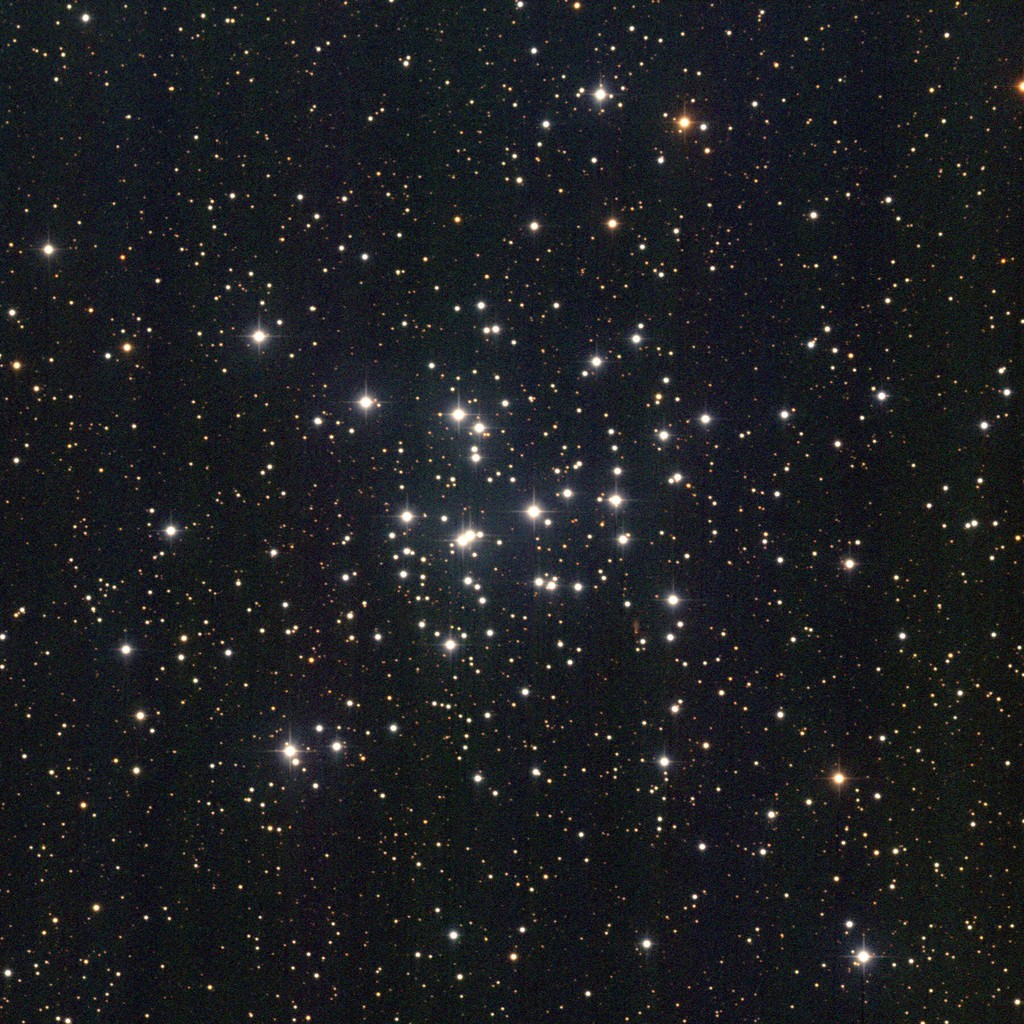
Messier 36 (NGC 1960) is one of three bright open star clusters that together make the constellation Auriga a showpiece of the winter sky, alongside its near-twins M37 and M38. All three lie at similar distances of roughly 4,000 light-years and are visible in the same binocular or wide-field telescope sweep, but NGC 1960 stands out for its youth: it contains no evolved red giant stars, meaning its most massive members have not yet had time to exhaust their hydrogen fuel. M36 may have been first recorded by Giovanni Battista Hodierna before 1654, and Charles Messier catalogued it in 1764.
NGC 1960 contains roughly 60 stars in a compact grouping about 14 light-years across, dominated by hot blue-white B-type stars whose combined light makes the cluster shine at apparent magnitude 6.0 — just at the edge of naked-eye visibility. The cluster's youth, probably no more than 25 million years old, explains the absence of the golden and reddish giants that mark the slightly older M37 and M38 nearby. The three Auriga clusters form a visually harmonious group that demonstrates different stages of open cluster evolution: youthful M36 still blazing with hot blue stars, middle-aged M38 beginning to show evolved members, and the oldest, richest M37 with red giant stars sprinkled among its 200+ members.
A small telescope at low power readily resolves M36 into 30 or 40 bright stars; a binocular sweep taking in M36, M37, and M38 in a single field is one of the more rewarding winter observing experiences. This color composite was made from CCD images taken in January 1997 at the Kitt Peak National Observatory 0.9-meter telescope.
Navigate from Elnath toward Auriga. In Auriga — forms a triangle with M37 and M38; sweep the area between Elnath and the centre of Auriga.
| Star | Bayer | Mag | Spectral Type | Distance | Meaning |
|---|---|---|---|---|---|
| Capella | α Aur | 0.08 | M1 · Yellow giant binary | 43 ly | Latin for 'The Little She-Goat' — the sixth brightest star in the sky, actually a pair of yellow giant stars orbiting each other. |
| Alnath | θ Aur | 1.65 | B7 · Blue-white giant | 134 ly | Arabic Al-Nath, 'The Butting One' — shared with Taurus, marking the tip of the Bull's horn and the foot of Auriga's charioteer. |
| Alnath | θ Aur | 1.65 | B7 · Blue-white giant | 134 ly | Arabic Al-Nath, 'The Butting One' — marks the tip of Taurus's northern horn. It is also shared with Auriga as its foot. |
| Menkalinan | β Aur | 1.90 | A2 · Yellow giant binary | 82 ly | Arabic Mankib dhī al-'Inān, 'Shoulder of the Rein-Holder' — marks Auriga the Charioteer's shoulder. An eclipsing binary pair. |
| Hassaleh | ι Aur | 2.69 | K3 · Yellow supergiant | 870 ly | Arabic Al-Hasalah, possibly 'The Tortoise' — marks the foot of Auriga the Charioteer, a luminous yellow supergiant. |