NOIRLab/ NSF /AURA
| Type | Open Cluster | Constellation | Aur |
|---|---|---|---|
| Magnitude | 6.2 | Size | 24.0′ |
| Distance | 4,400 light-years | Best Month | January |
| Visibility | Northern | Difficulty | Easy (level 2/4) |
| Min. Aperture | binoculars | RA / Dec | 05h 52m 22.8s · +32° 32' 60" |
| Discovered by | Giovanni Batista Hodierna, 1654 | ||
NOIRLab/ NSF /AURA
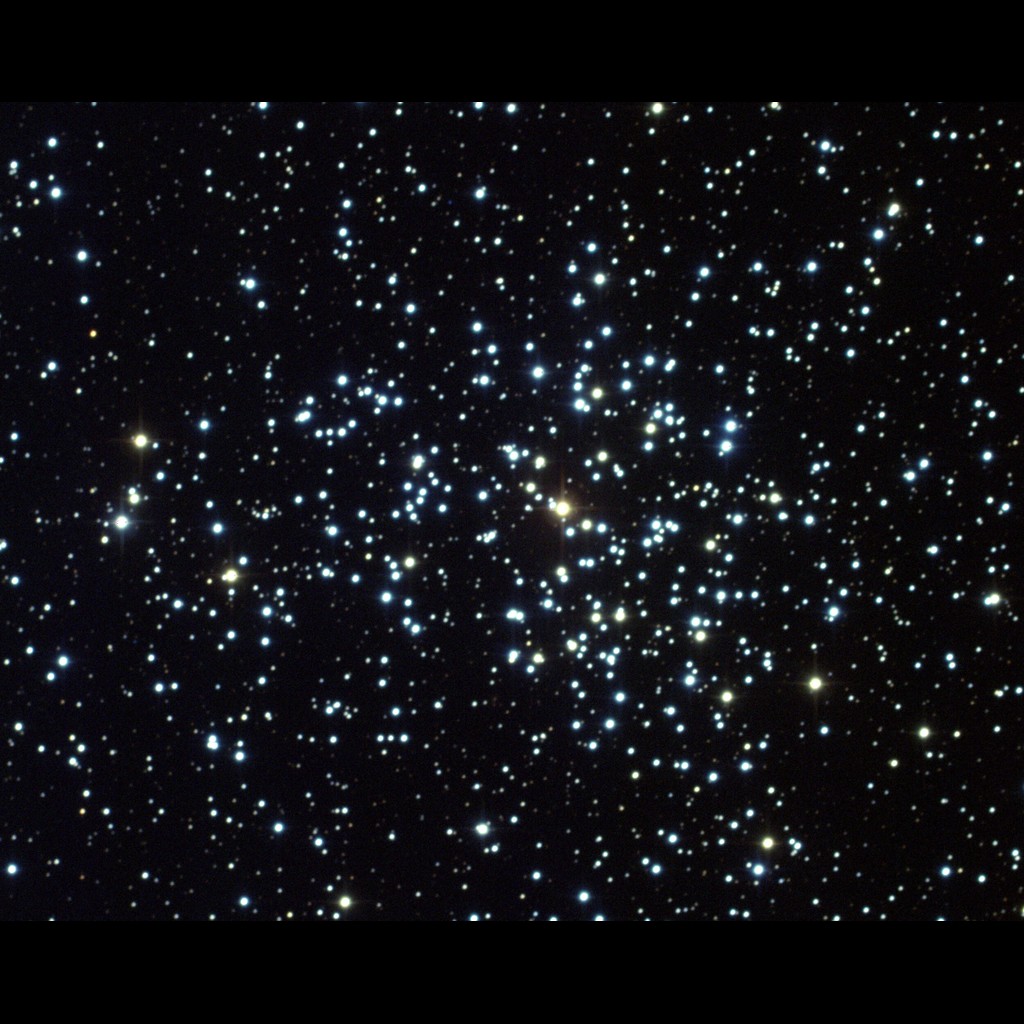
Messier 37 (NGC 2099) is the richest, brightest, and most impressive of the three Auriga open clusters, sitting alongside M36 and M38 in the winter constellation Auriga. It lies approximately 4,600 light-years away, spans about 27 light-years, and contains around 200 confirmed stellar members — twice the membership of its neighbors. M37 may have been recorded by Giovanni Battista Hodierna before 1654; Charles Messier catalogued it in 1764. At apparent magnitude 5.6, it is a naked-eye object from a dark site, and through any telescope it is the most spectacular of the three clusters by a considerable margin.
NGC 2099 is estimated to be around 300–350 million years old — significantly more evolved than M36 — and its age shows in its stellar population. Scattered among the blue-white majority are numerous red and orange giant stars, bright evolved members that have exhausted their core hydrogen and expanded enormously. These warm-colored stars stand out vividly in color images against the cooler blue-white cluster background, making M37 particularly beautiful photographically. The cluster's rich, compact appearance is enhanced by a relatively concentrated central region surrounded by a more diffuse halo of fainter members.
Through binoculars M37 appears as the brightest and most condensed of the three Auriga clusters; a small telescope at low power delivers a stunning, fully resolved view of stars of many colors scattered across the field, with the rich reddish giants immediately catching the eye. This color composite was made from CCD images taken in December 1994 at the Kitt Peak National Observatory 0.9-meter telescope.
Navigate from Elnath toward Auriga. The easternmost of the three Auriga clusters — slightly east of M36 and M38.
| Star | Bayer | Mag | Spectral Type | Distance | Meaning |
|---|---|---|---|---|---|
| Alnath | θ Aur | 1.65 | B7 · Blue-white giant | 134 ly | Arabic Al-Nath, 'The Butting One' — shared with Taurus, marking the tip of the Bull's horn and the foot of Auriga's charioteer. |
| Alnath | θ Aur | 1.65 | B7 · Blue-white giant | 134 ly | Arabic Al-Nath, 'The Butting One' — marks the tip of Taurus's northern horn. It is also shared with Auriga as its foot. |
| Menkalinan | β Aur | 1.90 | A2 · Yellow giant binary | 82 ly | Arabic Mankib dhī al-'Inān, 'Shoulder of the Rein-Holder' — marks Auriga the Charioteer's shoulder. An eclipsing binary pair. |
| Hassaleh | ι Aur | 2.69 | K3 · Yellow supergiant | 870 ly | Arabic Al-Hasalah, possibly 'The Tortoise' — marks the foot of Auriga the Charioteer, a luminous yellow supergiant. |