NOIRLab/ NSF /AURA
| Type | Open Cluster | Constellation | Aur |
|---|---|---|---|
| Magnitude | 7.4 | Size | 21.0′ |
| Distance | 4,200 light-years | Best Month | January |
| Visibility | Northern | Difficulty | Easy (level 2/4) |
| Min. Aperture | binoculars | RA / Dec | 05h 28m 40.8s · +35° 49' 48" |
| Discovered by | Giovanni Batista Hodierna, 1654 | ||
NOIRLab/ NSF /AURA
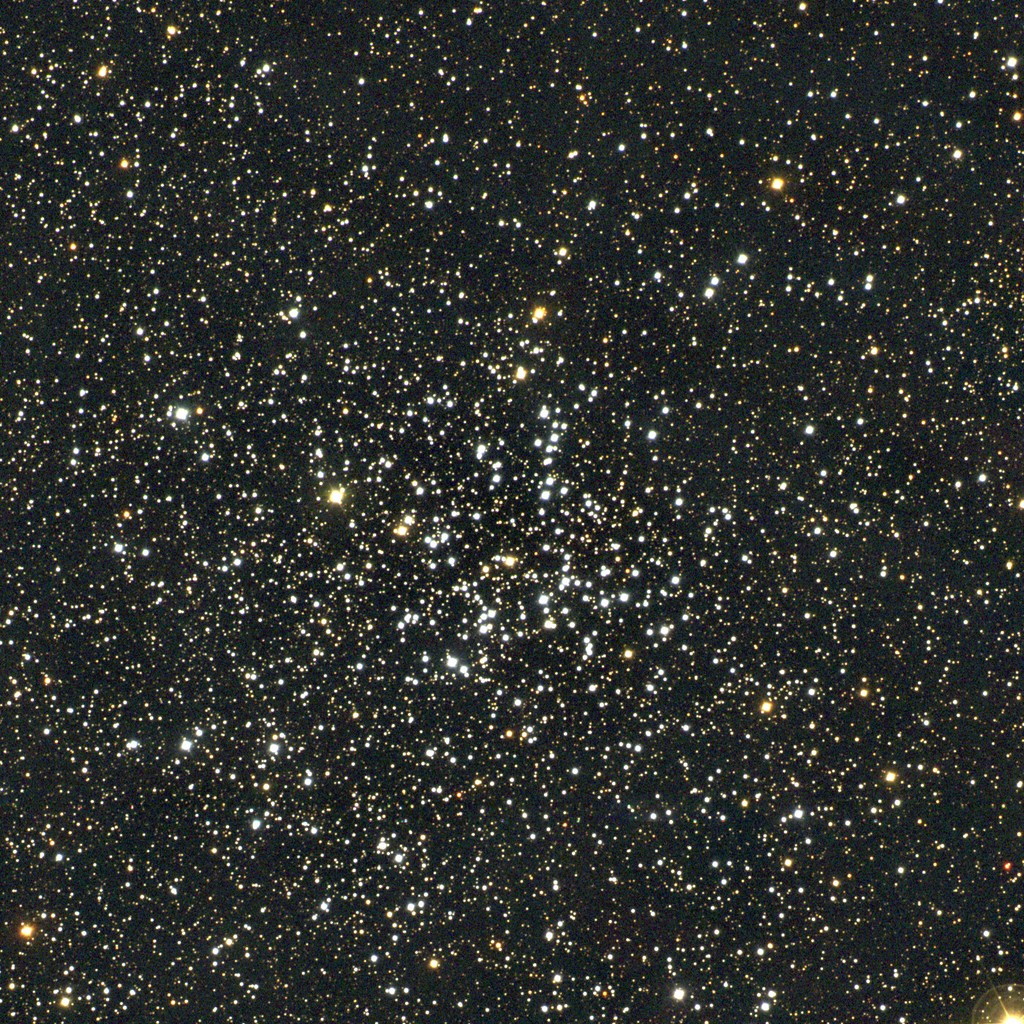
Messier 38 (NGC 1912) is the largest in apparent size of the three bright open star clusters in Auriga, though in stellar richness and brilliance it falls between its neighbors M36 and M37. It lies somewhat over 4,000 light-years away and may have been first recorded by Giovanni Battista Hodierna before 1654; it was independently catalogued by Charles Messier in 1764. NGC 1912 is of intermediate age — roughly 200 million years old — old enough that several of its most massive stars have evolved into yellow and reddish giants, yet young enough to retain plenty of hot blue-white members. A fanciful asterism is visible to patient observers: the brightest stars trace an oblique cross, or the Greek letter pi, across the face of the cluster.
NGC 1912 contains some 100 confirmed members spread across about 20 light-years and presents a somewhat scattered, chain-like appearance at the telescope compared with the more concentrated M37. The presence of evolved yellow supergiants alongside blue-white stars shows M38 at a middle stage of open cluster evolution. A small compact cluster, NGC 1907, lies just 36 arcminutes to the south in the same field — much richer and more distant, an old cluster of perhaps 1.3 billion years offering a striking contrast to M38's relative youth.
In binoculars M38 appears as the largest but faintest of the three Auriga clusters; a small telescope reveals the loose, slightly cruciform pattern of brighter stars. This approximately true-color image was assembled from twelve BVR exposures taken in January 1997 at the Burrell Schmidt telescope of Case Western Reserve University's Warner and Swasey Observatory on Kitt Peak.
Navigate from Elnath toward Auriga. The westernmost of the three Auriga clusters — sweeping east leads to M36 then M37.
| Star | Bayer | Mag | Spectral Type | Distance | Meaning |
|---|---|---|---|---|---|
| Capella | α Aur | 0.08 | M1 · Yellow giant binary | 43 ly | Latin for 'The Little She-Goat' — the sixth brightest star in the sky, actually a pair of yellow giant stars orbiting each other. |
| Alnath | θ Aur | 1.65 | B7 · Blue-white giant | 134 ly | Arabic Al-Nath, 'The Butting One' — shared with Taurus, marking the tip of the Bull's horn and the foot of Auriga's charioteer. |
| Alnath | θ Aur | 1.65 | B7 · Blue-white giant | 134 ly | Arabic Al-Nath, 'The Butting One' — marks the tip of Taurus's northern horn. It is also shared with Auriga as its foot. |
| Menkalinan | β Aur | 1.90 | A2 · Yellow giant binary | 82 ly | Arabic Mankib dhī al-'Inān, 'Shoulder of the Rein-Holder' — marks Auriga the Charioteer's shoulder. An eclipsing binary pair. |
| Hassaleh | ι Aur | 2.69 | K3 · Yellow supergiant | 870 ly | Arabic Al-Hasalah, possibly 'The Tortoise' — marks the foot of Auriga the Charioteer, a luminous yellow supergiant. |