WIYN/KPNO/NOIRLab/ NSF /AURA/H. Schweiker
| Type | Open Cluster | Constellation | Cyg |
|---|---|---|---|
| Magnitude | 4.6 | Size | 32.0′ |
| Distance | 825 light-years | Best Month | September |
| Visibility | Northern | Difficulty | Easiest (level 1/4) |
| Min. Aperture | naked eye | RA / Dec | 21h 31m 48.0s · +48° 25' 48" |
| Discovered by | Charles Messier, 1764 | ||
WIYN/KPNO/NOIRLab/ NSF /AURA/H. Schweiker
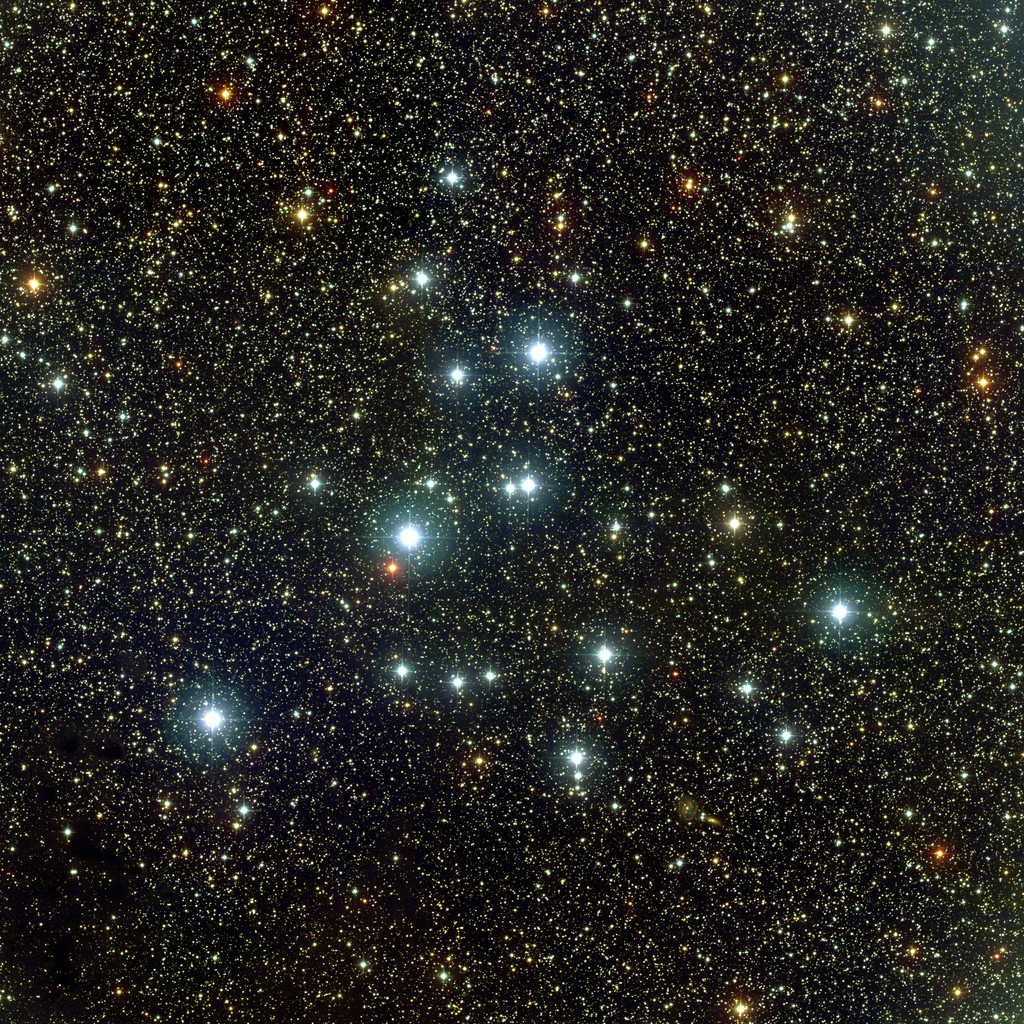
Messier 39 (NGC 7092) is a large, loose open star cluster in the constellation Cygnus, lying only about 800 light-years from Earth — making it one of the closest open clusters in Messier's catalog. It was possibly observed by Aristotle around 325 BC as a "comet-like cloudiness," though this attribution is uncertain; Charles Messier catalogued it independently in 1764. NGC 7092 is a sparse cluster, containing around 30 members spread across an enormous apparent area of sky — roughly a degree in diameter, twice the width of the full Moon — making it a challenging object for moderate-sized telescopes with narrow fields but a splendid sight in binoculars.
NGC 7092 is estimated to be between 200 and 300 million years old, old enough that several of its original blue stars have evolved away, but still young enough to be dominated by A-type and hot F-type stars. The cluster's sparse, widely scattered nature is partly a result of its relative old age but also reflects its original looseness: it was never a tightly bound system. Set against the rich Cygnus Milky Way, it can be difficult to distinguish cleanly from the background star field at higher magnifications, but at low power it stands out as a clearly overdense grouping in an already rich region of sky.
Binoculars show M39 as a large, obvious scattering of bright stars near the naked-eye star 61 Cygni; it is among the best binocular clusters in the autumn sky. This image is a mosaic of 33 dithered BVR frames taken with the Mosaic camera at the WIYN 0.9-meter telescope on Kitt Peak on the night of September 15, 2003; multiple small positional offsets between frames filled in the gaps between the camera's eight separate CCD detectors.
From Deneb: From Deneb, sweep 9° east-northeast into eastern Cygnus.
| Star | Bayer | Mag | Spectral Type | Distance | Meaning |
|---|---|---|---|---|---|
| Deneb | α Cyg | 1.25 | A2 · Blue-white supergiant | 2600 ly | Arabic Dhanab al-Dajājah, 'Tail of the Hen' — the tail of Cygnus the Swan and one of the three stars of the Summer Triangle. |
| Sadr | γ Cyg | 2.23 | F8 · Yellow-white supergiant | 1800 ly | Arabic Al-Sadr, 'The Breast' — marks the center of Cygnus the Swan, where the Northern Cross intersects. Surrounded by the North America Nebula. |