NOIRLab/ NSF /AURA
| Type | Open Cluster | Constellation | UMa |
|---|---|---|---|
| Magnitude | 8.4 | Size | 0.8′ |
| Distance | 510 light-years | Best Month | April |
| Visibility | Northern | Difficulty | Moderate (level 3/4) |
| Min. Aperture | 3in | RA / Dec | 12h 22m 22.8s · +58° 04' 48" |
| Discovered by | Charles Messier, 1764 | ||
NOIRLab/ NSF /AURA
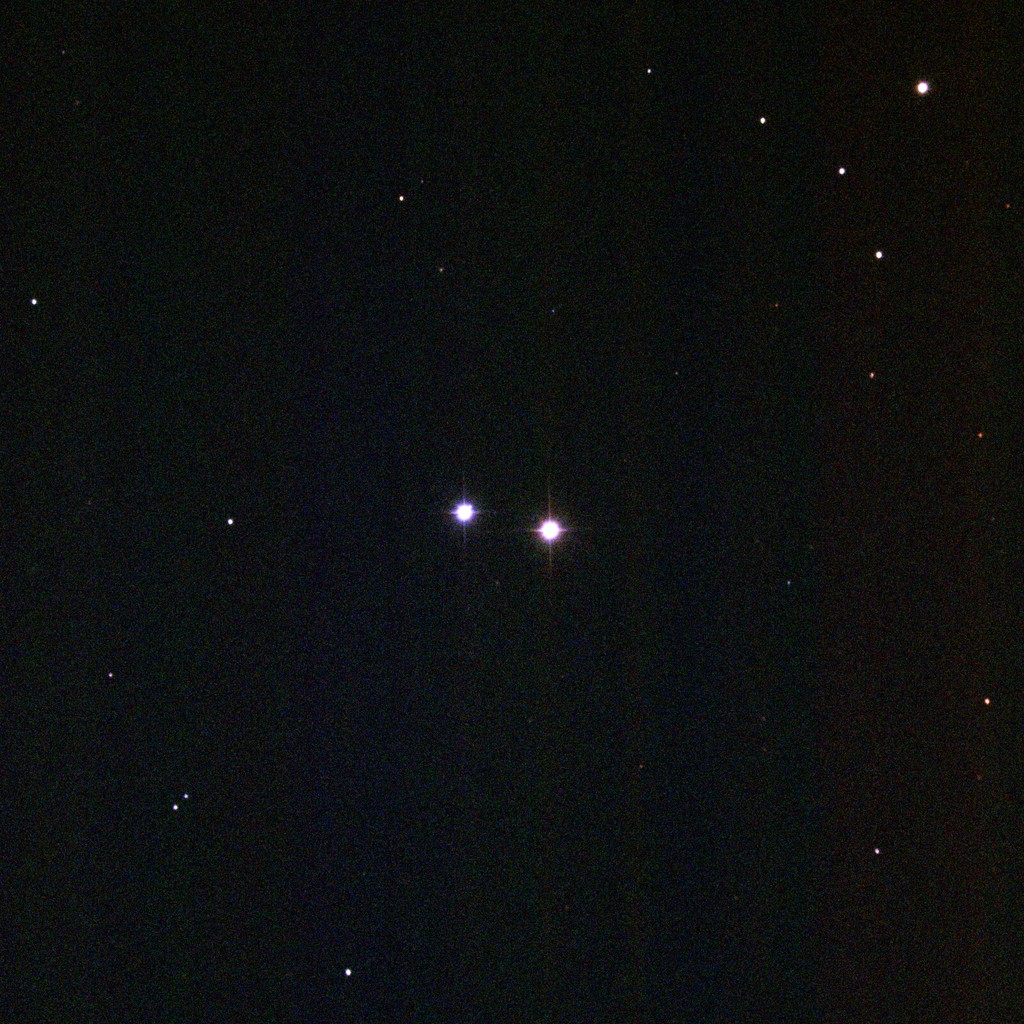
Messier 40 (Winnecke 4) is the most unusual object in Charles Messier's catalog — not a nebula, cluster, or galaxy, but a pair of faint stars. Messier entered it on October 24, 1764, while searching for a nebula that Johannes Hevelius had reported in the constellation Ursa Major. Finding no nebula at the indicated position, Messier recorded the two faint stars he did find, noting that Hevelius must have been mistaken. The pair was later independently catalogued in 1863 by A. Winnecke of the Pulkovo Observatory, giving it the designation Winnecke 4. The inclusion of M40 in the catalog is sometimes cited as evidence that Messier's method, while enormously valuable, was not perfectly systematic — he was primarily interested in avoiding false-positive comet identifications rather than in classifying all types of celestial objects.
The two stars that make up Winnecke 4 are a wide visual double — separated by about 50 arc-seconds on the sky. Modern measurements suggest they lie at different distances, approximately 500 and 900 light-years respectively, and are not physically bound to each other: the apparent pairing is a line-of-sight coincidence rather than a true gravitational binary system. Each star is a modestly luminous dwarf, both close to solar luminosity, without any of the striking visual qualities of Messier's showpiece nebulae. Neither star has spectroscopic companions or other notable properties.
In a small telescope Winnecke 4 appears simply as two faint stars close together, easily missed without knowing what to look for. This image was made at the Kitt Peak National Observatory 0.9-meter telescope in February 1996.
From Dubhe: From Dubhe (Alpha Ursae Majoris), move 2° northeast — near the star 70 Ursae Majoris.
| Star | Bayer | Mag | Spectral Type | Distance | Meaning |
|---|---|---|---|---|---|
| Alioth | — | 1.76 | A0 · White giant | 83 ly | Arabic origin uncertain, possibly from 'fat tail of a sheep.' The brightest star in Ursa Major and the handle of the Big Dipper. |
| Dubhe | α UMa | 1.81 | F7 · Orange giant | 124 ly | Arabic Zahr al-Dubb al-Akbar, 'Back of the Greater Bear' — one of the two pointer stars that lead to Polaris, the North Star. |
| Alkaid | η UMa | 1.85 | B3 · Blue-white main sequence | 101 ly | Arabic Al-Qa'id, 'The Leader of the Daughters of the Bier' — the tip of the Big Dipper's handle, representing the chief mourner in an Arabic funeral procession. |
| Mizar | ζ UMa | 2.23 | A2 · White binary | 83 ly | Arabic Al-Marāq, 'The Groin' — the middle star of the Big Dipper's handle. The first double star discovered through a telescope (1617). |
| Merak | δ UMa | 2.34 | A1 · Blue-white main sequence | 79 ly | Arabic Al-Maraqq, 'The Loins of the Bear' — one of the two pointer stars of the Big Dipper that guide observers to Polaris. |
| Phad | γ UMa | 2.41 | A0 · White main sequence | 84 ly | Arabic Al-Fakhdhah, 'The Thigh of the Bear' — marks the hip of Ursa Major, one of the four bowl stars of the Big Dipper. |
| Megrez | β UMa | 3.32 | A3 · White main sequence | 81 ly | Arabic Al-Maghriz, 'Root of the Bear's Tail' — the faintest of the seven Big Dipper stars, where the handle meets the bowl. |
| Thuban | λ Dra | 3.67 | A0 · White giant | 303 ly | Arabic Al-Thubbān, 'The Dragon' — served as the North Pole Star around 2700 BCE during the age of the Egyptian pyramid builders. |