NOIRLab/ NSF /AURA
| Type | Open Cluster | Constellation | CMa |
|---|---|---|---|
| Magnitude | 4.5 | Size | 38.0′ |
| Distance | 2,300 light-years | Best Month | February |
| Visibility | Global | Difficulty | Easiest (level 1/4) |
| Min. Aperture | naked eye | RA / Dec | 06h 46m 58.8s · -20° 46' 12" |
| Discovered by | Giovanni Batista Hodierna, 1654 | ||
NOIRLab/ NSF /AURA
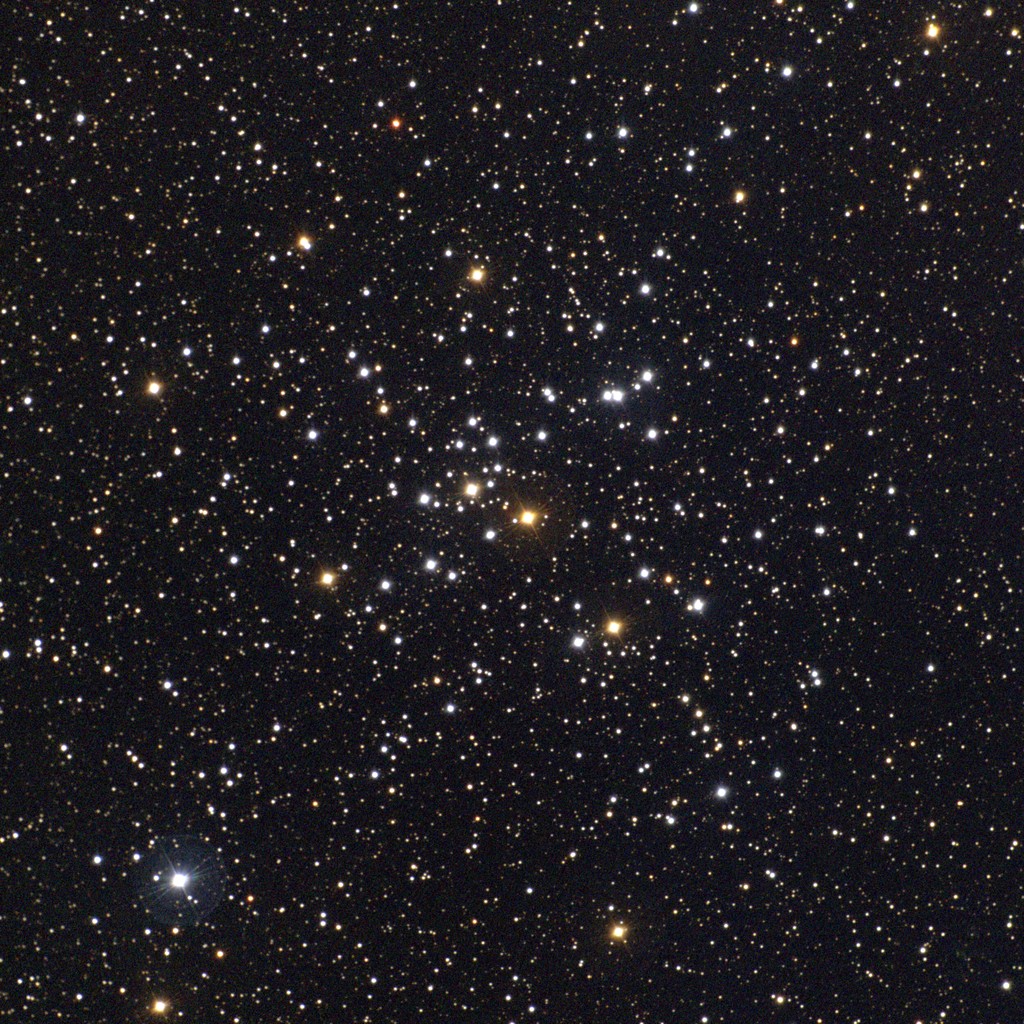
Messier 41 (NGC 2287) is a bright open star cluster in the constellation Canis Major, lying approximately 2,300 light-years from Earth and spanning about 25 light-years across. It may have been noted by Aristotle as early as 325 BC as a patch of light near Sirius; it was later recorded by Giovanni Battista Hodierna before 1654, and Charles Messier catalogued it in 1764. On a clear night NGC 2287 is a naked-eye object, appearing as a small cloudy patch just 4 degrees south of brilliant Sirius — the brightest star in the sky. The cluster contains around 100 stars and is estimated to be about 200 million years old.
NGC 2287's age is written in its stellar population. The cluster is old enough that several of its most massive original members have evolved into red giants — the orange-tinted stars that stand out immediately in color images and at the telescope. The presence of these luminous evolved stars alongside the remaining blue-white members gives M41 a color contrast that makes it particularly beautiful through a moderate telescope. A bright blue giant star in the southeast corner of the field is a foreground object, not a cluster member; its vivid blue-white color contrasts with the warm orange giants within NGC 2287 itself.
A naked-eye glow visible even from suburban skies under good transparency, M41 in binoculars resolves into dozens of stars; a small telescope at low power shows a richly populated field with the warm orange giants catching the eye among the brighter members. This approximately true-color image was assembled from eleven BVR exposures taken in September 1997 at the Burrell Schmidt telescope of Case Western Reserve University's Warner and Swasey Observatory on Kitt Peak.
Navigate from Alhena toward Canis Major. Just 4° south of Sirius (Alpha Canis Majoris) — the brightest star in the sky makes an unmistakable guide.
| Star | Bayer | Mag | Spectral Type | Distance | Meaning |
|---|---|---|---|---|---|
| Sirius | α CMa | -1.44 | A0 · Blue-white main sequence | 8.6 ly | Greek for 'Glowing' or 'Scorching' — the brightest star in the night sky. The ancient Egyptians timed the Nile flood by its heliacal rising. |
| Adhara | ε CMa | 1.50 | B2 · Blue-white supergiant | 430 ly | Arabic for 'Virgins' — part of a group of stars once seen as a constellation of maidens guarding the sky. |
| Wezen | η CMa | 1.83 | F8 · Yellow-white supergiant | 1600 ly | Arabic Al-Wazn, 'The Weight' — a yellow-white supergiant so massive that it barely moves across the sky, giving rise to its name. |
| Mirzam | β CMa | 1.98 | B1 · Blue-white giant | 500 ly | Arabic Al-Mirzam, 'The Announcer' — rises just before Sirius, heralding the arrival of the brightest star in the sky. |
| Saiph | κ Ori | 2.07 | B0 · Blue supergiant | 650 ly | Arabic Saif al-Jauzā, 'Sword of the Giant' — Orion's right foot, though nearly as luminous as Rigel, it appears dimmer due to its extreme distance. |
| Aludra | — | 2.45 | B5 · Blue supergiant | 3190 ly | Arabic Al-'Adhārā, 'The Virgins' — one of a group of stars in Canis Major representing maidens. An enormous blue supergiant. |
| Arneb | α Lep | 2.58 | F0 · Yellow-white supergiant | 2200 ly | Arabic Al-Arnab, 'The Hare' — named for the constellation itself, the brightest star in Lepus the Hare crouching beneath Orion. |