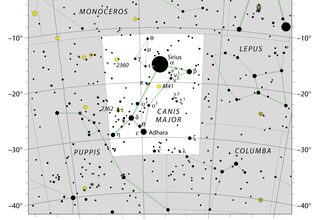
 IAU Chart
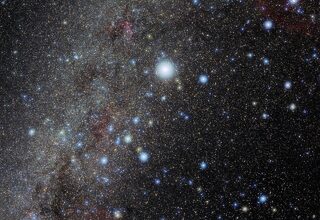 NOIRLab Images
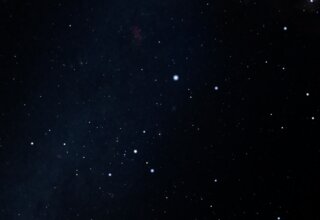 Stellarium Images
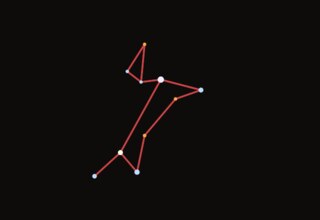 Stars and Sticks
| Abbreviation | CMa |
|---|---|
| Meaning | Greater Dog |
| Pronunciation Guide is based on “Pronouncing Astronomical Names,” published in 1943 by the American Astronomical Society. | CANE-iss MAY-jer |
| Genitive The genitive is the Latin possessive form used in star names. For example, Alpha Orionis means “the Alpha of Orion.” | KAY-nis muh-JOR-is |
| Best Month | February |
| Visibility | Global |
| Origin | AncientThese figures are rooted in the classical Greek and Mesopotamian traditions cataloged by Ptolemy in the 2nd century AD. |
| Author | PtolemyPtolemy, a 2nd-century Greco-Egyptian astronomer, cataloged the 48 classical constellations in his landmark work, the Almagest. These form the core of the 88 modern constellations recognized today. |
| Type | constellation |
| Difficulty | Easiest |
| Description | The larger of Orion's two hunting dogs bounds faithfully at his master's heels across the winter sky. The constellation is dominated by Sirius — the 'Dog Star' and the brightest star in the entire night sky at magnitude -1.46, just 8.6 light-years from Earth. The ancient Egyptians tracked Sirius meticulously because its heliacal rising heralded the annual flooding of the Nile and the start of their new year. The Romans called the hot summer days 'dies caniculares' — dog days — because they fell when Sirius rose with the Sun. Sirius is actually a binary system; its companion, Sirius B, is a white dwarf — the first white dwarf ever identified, discovered in 1862. |
Click a thumbnail to view full-size. Plain and Annotated versions available on the image page.
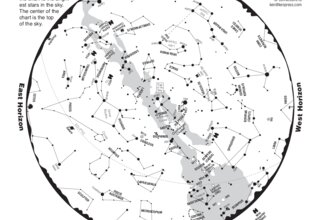
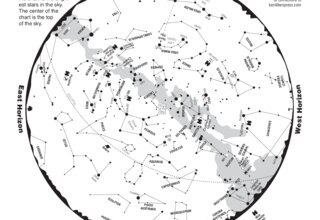
Monthly sky charts courtesy of What's Out Tonight? — Copyright ©2026 Ken Graun. Star charts are optimized for mid-latitudes of the Northern Hemisphere. Click a chart to view or download the PDF. For guidance on using the chart, or to purchase a planisphere and astronomy books, visit kenpress.com.
Images: NOIRLab/NSF/AURA/E. Slawik · IAU and Sky & Telescope · Stellarium — Full credits →