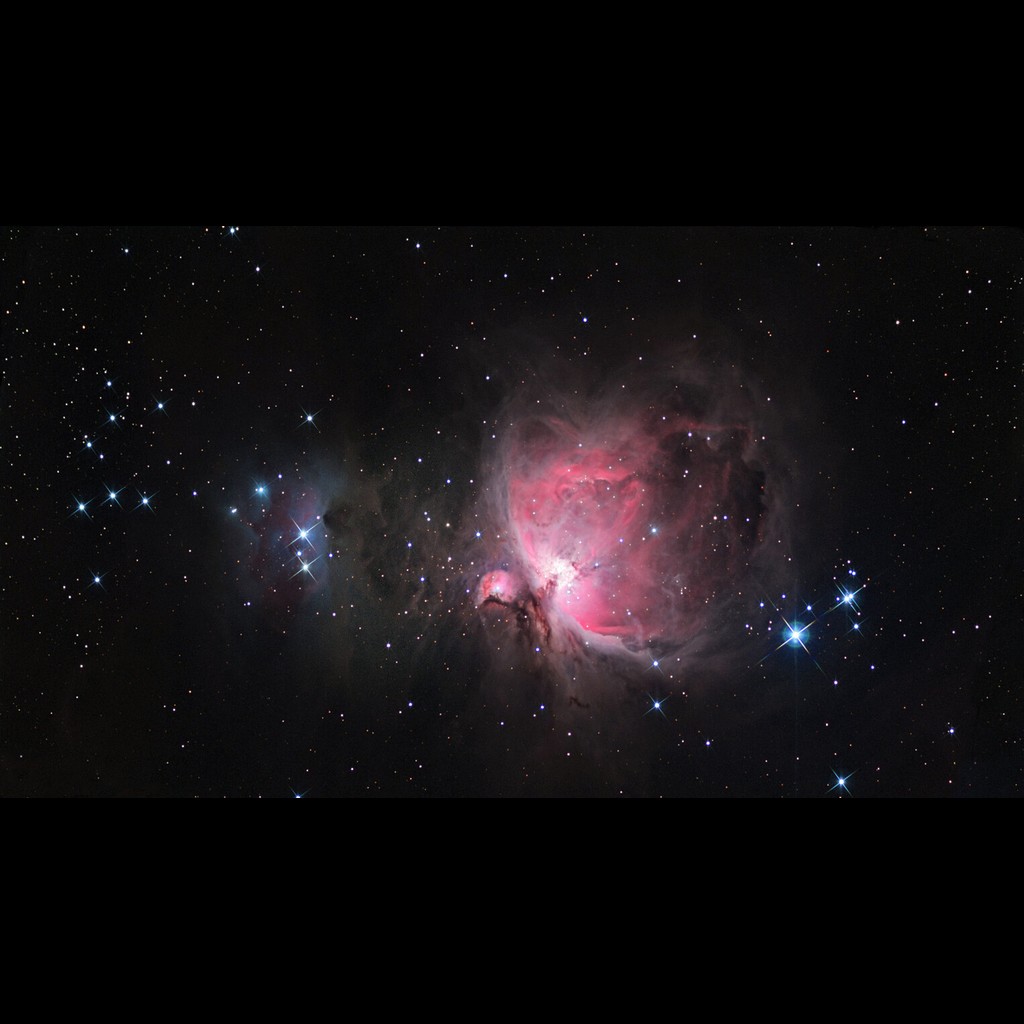
KPNO/NOIRLab/NSF/AURA/Ryan Steinberg and Family/Adam Block
| Type | Emission Nebula | Constellation | Ori |
|---|---|---|---|
| Magnitude | 4.0 | Size | 65.0′ |
| Distance | 1,344 light-years | Best Month | January |
| Visibility | Global | Difficulty | Easiest (level 1/4) |
| Min. Aperture | naked eye | RA / Dec | 05h 35m 16.8s · -05° 23' 24" |
| Discovered by | Nicolas-Claude Fabri de Peiresc, 1610 | ||
KPNO/NOIRLab/NSF/AURA/Ryan Steinberg and Family/Adam Block
Messier 42 (NGC 1976), the Great Orion Nebula, is the closest and most studied star-forming region in the sky, lying approximately 1,600 light-years away in the Sword of Orion — the short vertical line of stars hanging below Orion's three-star Belt. Astronomical records of the Orion Nebula reach back centuries, though credit for its first systematic telescopic description is usually given to Nicolas-Claude Fabri de Peiresc in 1610; it was later memorably described by William Herschel as "the chaotic material of future suns." Galileo, remarkably, pointed his telescope at the same region and catalogued the stars but missed the nebula entirely. Charles Messier added NGC 1976 to his list in 1769.
The Orion Nebula is not merely a glowing cloud but an active stellar nursery: it contains enough raw material to form roughly 10,000 stars the mass of the Sun. Embedded within the brightest central region are the four hot young stars of the Trapezium (Theta1 Orionis), a tight grouping that provides the ultraviolet energy to ionize the surrounding hydrogen gas and make the nebula glow. Long-exposure images reveal a turbulent landscape of glowing filaments, dark lanes, and dense globules called proplyds — protoplanetary disks silhouetted against the bright nebula — where individual solar systems may be forming today. The nebula's bright central region spans roughly six light-years and is merely the visible face of a vast molecular cloud that extends through much of Orion.
On any clear night M42 is visible to the naked eye, and binoculars reveal a glowing smear of light immediately — it is the easiest nebula in the sky. This image was taken as part of the Advanced Observing Program (AOP) at the Kitt Peak Visitor Center in 2014.
From Alnilam: The middle star of Orion's sword — the fuzzy 'star' is M42. Unmissable on any clear night.
| Star | Bayer | Mag | Spectral Type | Distance | Meaning |
|---|---|---|---|---|---|
| Sirius | α CMa | -1.44 | A0 · Blue-white main sequence | 8.6 ly | Greek for 'Glowing' or 'Scorching' — the brightest star in the night sky. The ancient Egyptians timed the Nile flood by its heliacal rising. |
| Rigel | β Ori | 0.18 | B8 · Blue-white supergiant | 860 ly | Arabic Rijl Jauzā al-Yusrā, 'Left Leg of the Central One' — the left foot of Orion, a blue supergiant among the most luminous stars known. |
| Betelgeuse | α Ori | 0.45 | M2 · Red supergiant | 700 ly | Arabic Ibt al-Jauzā, 'Armpit of the Central One' — the right shoulder of Orion, a red supergiant expected to explode as a supernova. |
| Bellatrix | γ Ori | 1.64 | B2 · Blue-white giant | 250 ly | Latin for 'Female Warrior' — the left shoulder of Orion. Known in Arabic as Al-Najid, 'The Conqueror.' |
| Alnilam | ε Ori | 1.69 | B0 · Blue-white supergiant | 2000 ly | Arabic Al-Nilam, 'String of Pearls' — the central and brightest of Orion's three belt stars, one of the most luminous stars known. |
| Alnitak | β Tau | 1.74 | O9 · Blue supergiant | 1260 ly | Arabic Al-Nitāq, 'The Girdle' — the easternmost of Orion's three belt stars, near the famous Horsehead Nebula. |
| Saiph | κ Ori | 2.07 | B0 · Blue supergiant | 650 ly | Arabic Saif al-Jauzā, 'Sword of the Giant' — Orion's right foot, though nearly as luminous as Rigel, it appears dimmer due to its extreme distance. |
| Mintaka | — | 2.25 | O9 · Blue-white giant | 900 ly | Arabic Al-Mintaqa, 'The Belt' or 'The Girdle' — the westernmost of Orion's three belt stars, almost exactly on the celestial equator. |
| Arneb | α Lep | 2.58 | F0 · Yellow-white supergiant | 2200 ly | Arabic Al-Arnab, 'The Hare' — named for the constellation itself, the brightest star in Lepus the Hare crouching beneath Orion. |
| Cursa | — | 2.78 | A3 · Blue-white main sequence | 89 ly | Arabic Al-Kursī, 'The Footstool' of Orion — sits at the top of Eridanus just below Orion's feet, the starting point of the river. |