N.A.Sharp/NOIRLab/ NSF /AURA
| Type | Emission Nebula | Constellation | Ori |
|---|---|---|---|
| Magnitude | 9.0 | Size | 20.0′ |
| Distance | 1,344 light-years | Best Month | January |
| Visibility | Global | Difficulty | Easy (level 2/4) |
| Min. Aperture | binoculars | RA / Dec | 05h 35m 31.2s · -05° 16' 12" |
| Discovered by | Jean-Jacques Dortous de Mairan, 1731 | ||
N.A.Sharp/NOIRLab/ NSF /AURA
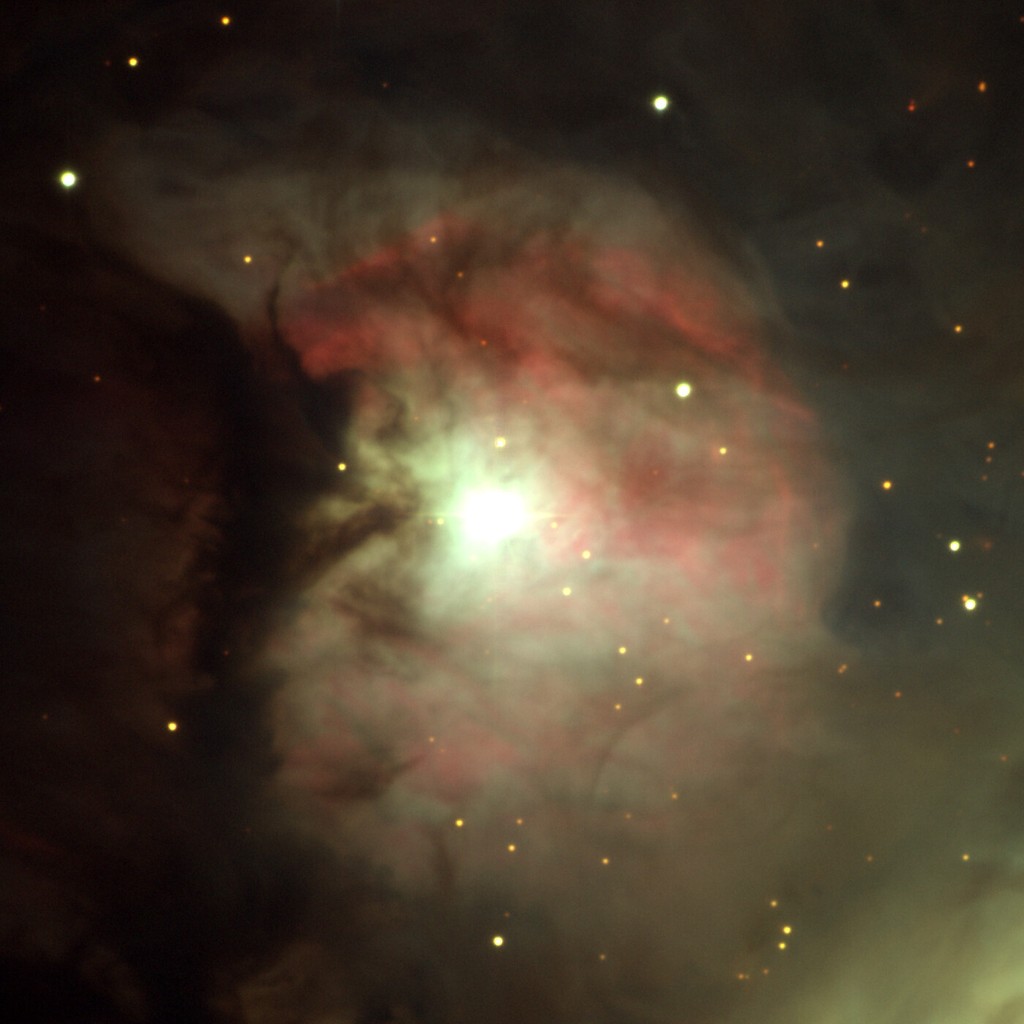
Messier 43 (NGC 1982), sometimes called de Mairan's Nebula, is physically part of the great Orion Nebula complex but is listed separately in Messier's catalog because a prominent dark lane of interstellar dust divides it from the main body of M42. It was first described by Jean-Jacques Dortous de Mairan in 1731 and was noted separately by Charles Messier when he catalogued M42 in 1769. In reality, NGC 1982 and the Orion Nebula are part of the same vast star-forming molecular cloud, lying at the same distance of about 1,600 light-years in the constellation Orion — the dark lane between them is simply a foreground ribbon of cold dust that blocks our view of the connecting nebulosity behind it.
At the heart of NGC 1982 sits NU Orionis (HD 37061), a young irregular variable star that powers the small but distinct nebular region around it. NU Ori is a massive, newly formed star whose intense ultraviolet radiation ionizes the surrounding gas, creating a compact but beautiful glowing nebula. The star has a characteristically elongated appearance in deep images, believed to result from a disk of dusty material surrounding it — a relic of the star's recent formation still accreting or dissipating. Though far smaller and less spectacular than M42, M43 is a genuine emission nebula in its own right, with interesting structure visible in moderate apertures.
In a small telescope M43 appears as a small, comma-shaped or round glow just north of the bright core of M42, separated from it by the noticeable dark lane; larger apertures reveal the central variable star and the patchy, layered structure of the nebula around it. This image was taken with the WIYN 0.9-meter telescope on Kitt Peak on the night of December 20, 2002.
From Alnilam: Immediately north of M42 in the same field — separated by a dark dust lane.
| Star | Bayer | Mag | Spectral Type | Distance | Meaning |
|---|---|---|---|---|---|
| Sirius | α CMa | -1.44 | A0 · Blue-white main sequence | 8.6 ly | Greek for 'Glowing' or 'Scorching' — the brightest star in the night sky. The ancient Egyptians timed the Nile flood by its heliacal rising. |
| Rigel | β Ori | 0.18 | B8 · Blue-white supergiant | 860 ly | Arabic Rijl Jauzā al-Yusrā, 'Left Leg of the Central One' — the left foot of Orion, a blue supergiant among the most luminous stars known. |
| Betelgeuse | α Ori | 0.45 | M2 · Red supergiant | 700 ly | Arabic Ibt al-Jauzā, 'Armpit of the Central One' — the right shoulder of Orion, a red supergiant expected to explode as a supernova. |
| Bellatrix | γ Ori | 1.64 | B2 · Blue-white giant | 250 ly | Latin for 'Female Warrior' — the left shoulder of Orion. Known in Arabic as Al-Najid, 'The Conqueror.' |
| Alnilam | ε Ori | 1.69 | B0 · Blue-white supergiant | 2000 ly | Arabic Al-Nilam, 'String of Pearls' — the central and brightest of Orion's three belt stars, one of the most luminous stars known. |
| Alnitak | β Tau | 1.74 | O9 · Blue supergiant | 1260 ly | Arabic Al-Nitāq, 'The Girdle' — the easternmost of Orion's three belt stars, near the famous Horsehead Nebula. |
| Saiph | κ Ori | 2.07 | B0 · Blue supergiant | 650 ly | Arabic Saif al-Jauzā, 'Sword of the Giant' — Orion's right foot, though nearly as luminous as Rigel, it appears dimmer due to its extreme distance. |
| Mintaka | — | 2.25 | O9 · Blue-white giant | 900 ly | Arabic Al-Mintaqa, 'The Belt' or 'The Girdle' — the westernmost of Orion's three belt stars, almost exactly on the celestial equator. |
| Arneb | α Lep | 2.58 | F0 · Yellow-white supergiant | 2200 ly | Arabic Al-Arnab, 'The Hare' — named for the constellation itself, the brightest star in Lepus the Hare crouching beneath Orion. |
| Cursa | — | 2.78 | A3 · Blue-white main sequence | 89 ly | Arabic Al-Kursī, 'The Footstool' of Orion — sits at the top of Eridanus just below Orion's feet, the starting point of the river. |