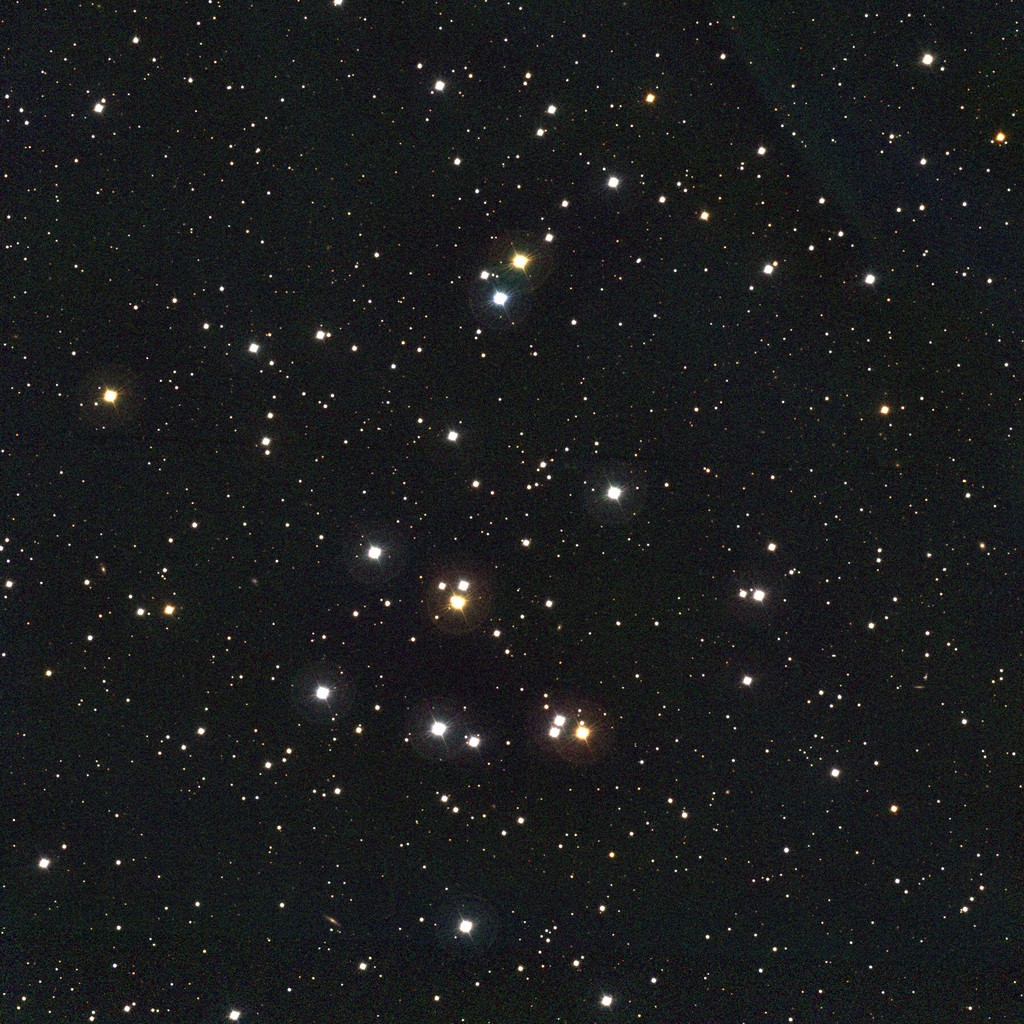
NOIRLab/ NSF /AURA
| Type | Open Cluster | Constellation | Cnc |
|---|---|---|---|
| Magnitude | 3.7 | Size | 95.0′ |
| Distance | 577 light-years | Best Month | March |
| Visibility | Northern | Difficulty | Easiest (level 1/4) |
| Min. Aperture | naked eye | RA / Dec | 08h 40m 01.2s · +19° 58' 48" |
| Discovered by | Prehistoric, -200 | ||
NOIRLab/ NSF /AURA
Messier 44 (NGC 2632), the Beehive Cluster — also known by its ancient name Praesepe, Latin for "the Manger" — is one of the nearest open star clusters to Earth, lying approximately 600 light-years away in the constellation Cancer. It has been known since antiquity and appears to have been noted by astronomers for at least 2,000 years; both Aratus and Hipparchus mentioned it. Galileo trained his newly built telescope on the Beehive in 1609, resolving what the naked eye sees as a fuzzy cloud into about 40 individual stars — one of the earliest demonstrations of the telescope's power to reveal structure invisible to the unaided eye. Charles Messier catalogued it in 1769.
NGC 2632 spans more than 1.5 degrees on the sky — roughly three times the width of the full Moon — and contains approximately 1,000 stars, with about 350 confirmed gravitational members. It is estimated to be between 600 and 750 million years old and shares a common origin, age, and motion through space with the Hyades cluster in Taurus, suggesting both clusters were born from the same primordial molecular cloud long since dispersed. M44's membership includes a mix of red giants, yellow sun-like stars, and white dwarfs alongside the brighter blue-white main-sequence stars visible in binoculars. Recent surveys have identified several exoplanets orbiting Beehive member stars.
From a dark site, M44 is visible to the naked eye as a faint hazy patch; binoculars reveal dozens of stars immediately, and the cluster is best viewed at the lowest possible magnification to appreciate its full extent. This approximately true-color image was assembled from fifteen BVR exposures taken in January 1997 at the Burrell Schmidt telescope of Case Western Reserve University's Warner and Swasey Observatory on Kitt Peak.
From Pollux: Midway between Pollux (Gemini) and Regulus (Leo) — the fuzzy naked-eye patch in Cancer is unmistakable on a dark night.
| Star | Bayer | Mag | Spectral Type | Distance | Meaning |
|---|---|---|---|---|---|
| Pollux | β Gem | 1.16 | K0 · Orange giant | 34 ly | Named for the immortal twin of Greek myth, son of Zeus. The brightest star in Gemini has a confirmed planet — Pollux b — orbiting it. |
| Ras Elased Australis | ε Leo | 2.97 | G0 · Orange giant | 247 ly | Arabic Ra's al-Asad al-Janūbī, 'Southern Head of the Lion' — marks the lion's mane, one of the sickle stars that form Leo's head. |