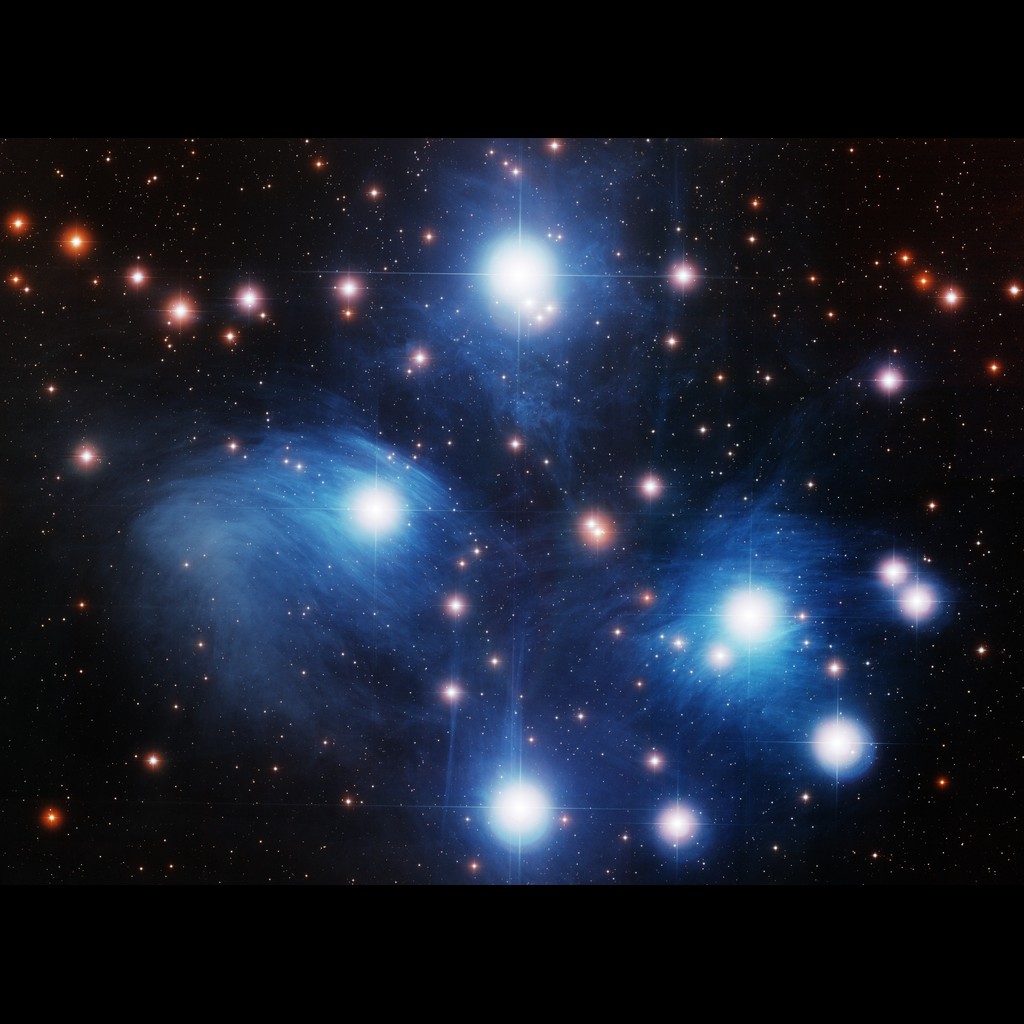
NOIRLab/NSF/AURA/T.A. Rector (University of Alaska Anchorage), R. Cool (University of Arizona) and WIYN
| Type | Open Cluster | Constellation | Tau |
|---|---|---|---|
| Magnitude | 1.6 | Size | 110.0′ |
| Distance | 444 light-years | Best Month | December |
| Visibility | Global | Difficulty | Easiest (level 1/4) |
| Min. Aperture | naked eye | RA / Dec | 03h 47m 31.2s · +24° 06' 00" |
| Discovered by | Prehistoric, -100000 | ||
NOIRLab/NSF/AURA/T.A. Rector (University of Alaska Anchorage), R. Cool (University of Arizona) and WIYN
The Pleiades (no NGC number; sometimes referred to as Melotte 22) are the most famous star cluster in the sky — a compact, luminous gathering of hot young stars in the constellation Taurus, lying approximately 440 light-years from Earth. Known since prehistory on every inhabited continent, the Pleiades appear in the oldest written records including Homer, Hesiod, and the Bible. In Japan the cluster is called Subaru, and its stylized image is the emblem of the Subaru automobile company. Charles Messier added the Pleiades to his list in 1769 — though the omission of an NGC number reflects the fact that Dreyer's New General Catalogue, compiled a century later, focused on objects less obvious than a naked-eye cluster.
The Pleiades contain several hundred stars, of which the roughly dozen brightest are hot, luminous B-type stars — the "Seven Sisters" of mythology plus several fainter siblings. The cluster is very young by astronomical standards, at most 100–125 million years old, and its massive blue-white members burn brilliantly against the sky. One of the cluster's most striking features, visible in photographs but invisible to the eye at the telescope, is the gossamer blue reflection nebulosity that wraps around the brightest stars: dusty interstellar material — part of a molecular cloud the cluster is passing through — scattering the short-wavelength blue light of the hot stars. This nebulosity is not physically associated with the cluster itself but happens to lie along the same line of sight.
The Pleiades is one of the few objects where binoculars outperform a telescope: the cluster spans several degrees and a wide field is essential to appreciate it fully. This image was made with the Mosaic wide-field camera on the WIYN 0.9-meter telescope on Kitt Peak using B, V, and I filters; north is to the right and east is up.
Navigate from Alcyone toward Taurus. The Pleiades are unmistakable — the most obvious star cluster in the entire sky.
| Star | Bayer | Mag | Spectral Type | Distance | Meaning |
|---|---|---|---|---|---|
| Aldebaran | α Tau | 0.87 | K5 · Red giant | 65 ly | Arabic Al-Dabarān, 'The Follower' — it follows the Pleiades star cluster across the sky. The fiery eye of Taurus the Bull. |
| Hassaleh | ι Aur | 2.69 | K3 · Yellow supergiant | 870 ly | Arabic Al-Hasalah, possibly 'The Tortoise' — marks the foot of Auriga the Charioteer, a luminous yellow supergiant. |