N.A.Sharp/NOIRLab/ NSF /AURA
| Type | Open Cluster | Constellation | Pup |
|---|---|---|---|
| Magnitude | 6.0 | Size | 27.0′ |
| Distance | 5,400 light-years | Best Month | February |
| Visibility | Global | Difficulty | Easy (level 2/4) |
| Min. Aperture | binoculars | RA / Dec | 07h 41m 49.2s · -14° 49' 12" |
| Discovered by | Charles Messier, 1771 | ||
N.A.Sharp/NOIRLab/ NSF /AURA
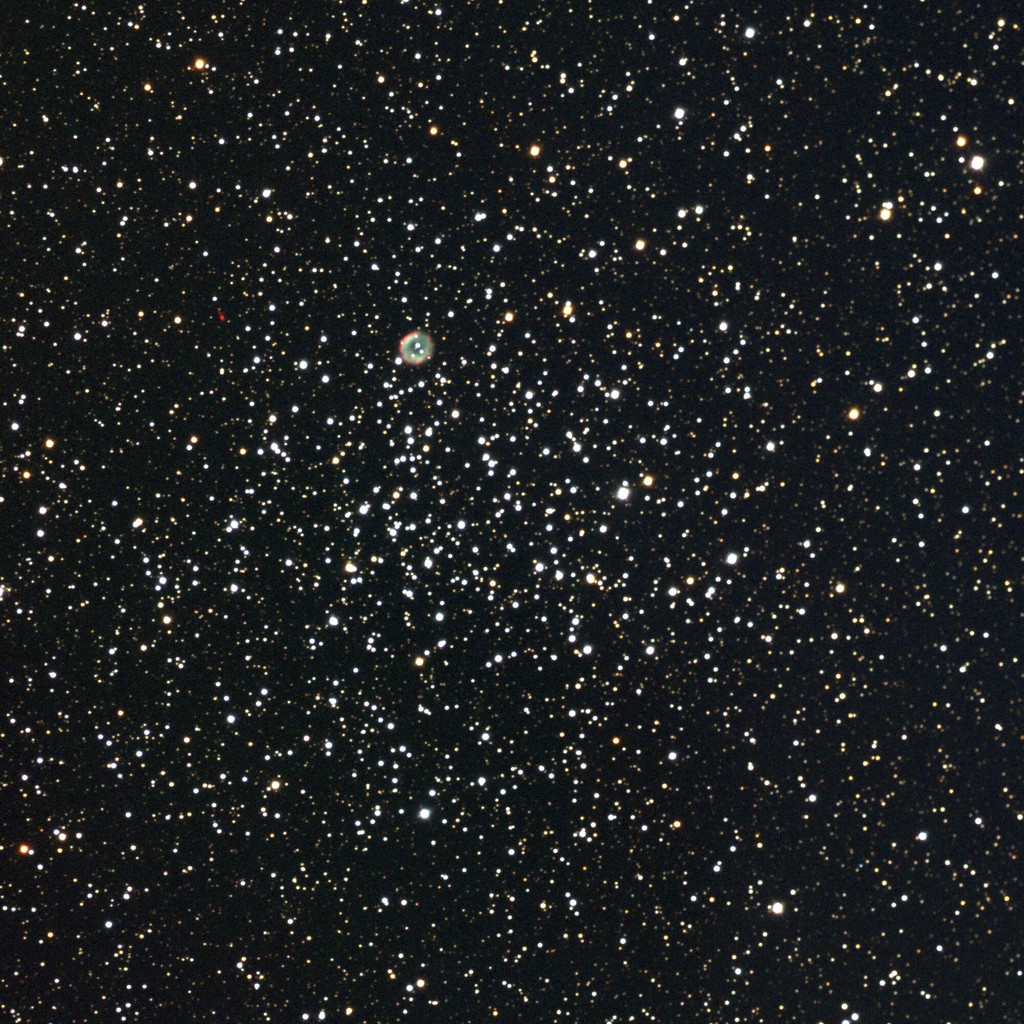
Messier 46 (NGC 2437) is a rich open star cluster in the constellation Puppis, approximately 5,400 light-years away and spanning about 30 light-years. Charles Messier discovered it on February 19, 1771. NGC 2437 contains over 150 conspicuous stars with a total population perhaps exceeding 500, all roughly 300 million years old — one of the richer old open clusters in the Messier catalog. What makes M46 particularly remarkable, however, is what appears to be a planetary nebula visible on its northern edge: the round, ghostly disk of NGC 2438, the glowing shell of gas expelled by a dying star.
Despite appearances, NGC 2438 is almost certainly a foreground object unrelated to M46. Its radial velocity is significantly different from the cluster's, and distance estimates place it at roughly half the distance to NGC 2437 — the two simply happen to overlap along our line of sight. A second unusual object also lurks in this field: a strikingly red smudge to the east known as OH231.8+4.2, a bipolar protoplanetary nebula — material being violently ejected by a star partway through its death throes. Even closer to us than NGC 2438, it shows twin expanding lobes of emission and reflection nebulosity ejected from a central star on the asymptotic giant branch. The coincidence of three independent objects — an old open cluster, a foreground planetary nebula, and a protoplanetary nebula — in the same small patch of sky is remarkable.
In a telescope M46 appears as a rich, uniform spray of stars of similar brightness; NGC 2438 appears as a faint, round haze floating within the cluster field, clearly non-stellar. This approximately true-color image was assembled from eleven BVR exposures taken in September 1997 at the Burrell Schmidt telescope of Case Western Reserve University's Warner and Swasey Observatory on Kitt Peak.
Navigate from Alhena toward Puppis. In Puppis, about 1.5° east of M47 — the two form a fine pair in binoculars.
| Star | Bayer | Mag | Spectral Type | Distance | Meaning |
|---|---|---|---|---|---|
| Sirius | α CMa | -1.44 | A0 · Blue-white main sequence | 8.6 ly | Greek for 'Glowing' or 'Scorching' — the brightest star in the night sky. The ancient Egyptians timed the Nile flood by its heliacal rising. |
| Wezen | η CMa | 1.83 | F8 · Yellow-white supergiant | 1600 ly | Arabic Al-Wazn, 'The Weight' — a yellow-white supergiant so massive that it barely moves across the sky, giving rise to its name. |