NOIRLab/ NSF /AURA
| Type | Open Cluster | Constellation | Pup |
|---|---|---|---|
| Magnitude | 4.4 | Size | 30.0′ |
| Distance | 1,600 light-years | Best Month | February |
| Visibility | Global | Difficulty | Easiest (level 1/4) |
| Min. Aperture | naked eye | RA / Dec | 07h 36m 36.0s · -14° 28' 48" |
| Discovered by | Giovanni Batista Hodierna, 1654 | ||
NOIRLab/ NSF /AURA
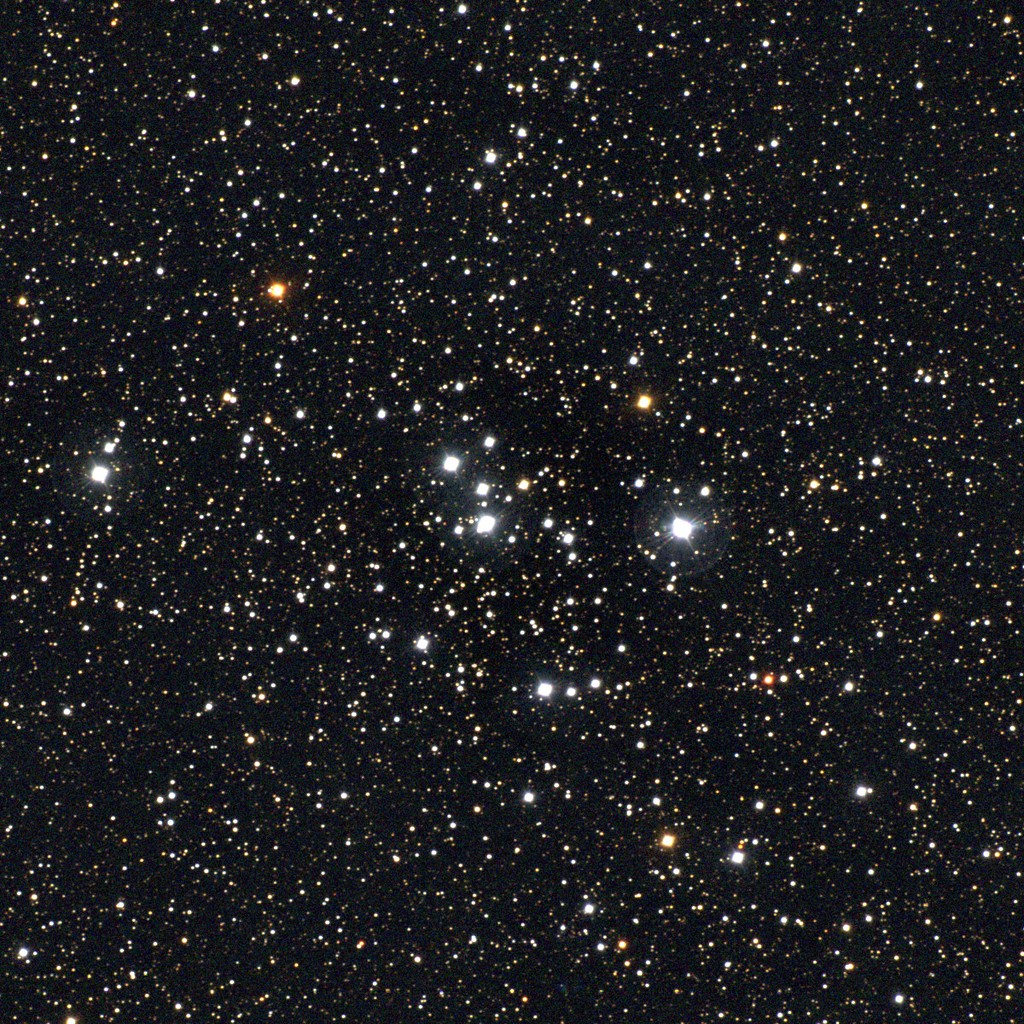
Messier 47 (NGC 2422) is a bright, coarse open star cluster in the constellation Puppis, lying approximately 1,600 light-years from Earth and spanning about 14 light-years — comparable in apparent size to the full Moon. It was observed by several astronomers before Charles Messier independently catalogued it in 1771. NGC 2422 is a young cluster, estimated at no more than 78 million years old, and its roughly 50 brightest members are dominated by brilliant blue-white B-type stars with a scattered handful of evolved orange giants. On dark, transparent nights it is just visible to the naked eye as a dim fuzzy spot, and in binoculars it resolves into a bold, well-scattered gathering of stars.
NGC 2422 shares its patch of sky with the nearby but very different M46 (NGC 2437), lying just 1.3 degrees to the east. The two clusters make a rewarding side-by-side binocular comparison: M47 is younger, coarser, and brighter — a dozen brilliant stars standing out in a loose grouping — while M46 is older, richer, more uniform, and noticeably more densely populated with hundreds of fainter members. Together they demonstrate the diversity of open clusters that can exist in the same region of the galaxy. The Puppis region of the Milky Way is rich with star-forming material, and both clusters formed within the same broad spiral arm structure.
From a dark site M47 is a naked-eye object; binoculars immediately resolve its bright members into a scattered grouping, and a small telescope at low power delivers a beautiful wide-field view of M47 and M46 side by side. This approximately true-color image was assembled from fifteen BVR exposures taken in January 1997 at the Burrell Schmidt telescope of Case Western Reserve University's Warner and Swasey Observatory on Kitt Peak.
Navigate from Alhena toward Puppis. In Puppis, about 1.5° west of M46 — both visible in the same binocular field.
| Star | Bayer | Mag | Spectral Type | Distance | Meaning |
|---|---|---|---|---|---|
| Sirius | α CMa | -1.44 | A0 · Blue-white main sequence | 8.6 ly | Greek for 'Glowing' or 'Scorching' — the brightest star in the night sky. The ancient Egyptians timed the Nile flood by its heliacal rising. |
| Wezen | η CMa | 1.83 | F8 · Yellow-white supergiant | 1600 ly | Arabic Al-Wazn, 'The Weight' — a yellow-white supergiant so massive that it barely moves across the sky, giving rise to its name. |
| Mirzam | β CMa | 1.98 | B1 · Blue-white giant | 500 ly | Arabic Al-Mirzam, 'The Announcer' — rises just before Sirius, heralding the arrival of the brightest star in the sky. |