NOIRLab/ NSF /AURA
| Type | Open Cluster | Constellation | Hya |
|---|---|---|---|
| Magnitude | 5.5 | Size | 54.0′ |
| Distance | 1,500 light-years | Best Month | March |
| Visibility | Global | Difficulty | Easiest (level 1/4) |
| Min. Aperture | naked eye | RA / Dec | 08h 13m 55.2s · -05° 47' 60" |
| Discovered by | Charles Messier, 1771 | ||
NOIRLab/ NSF /AURA
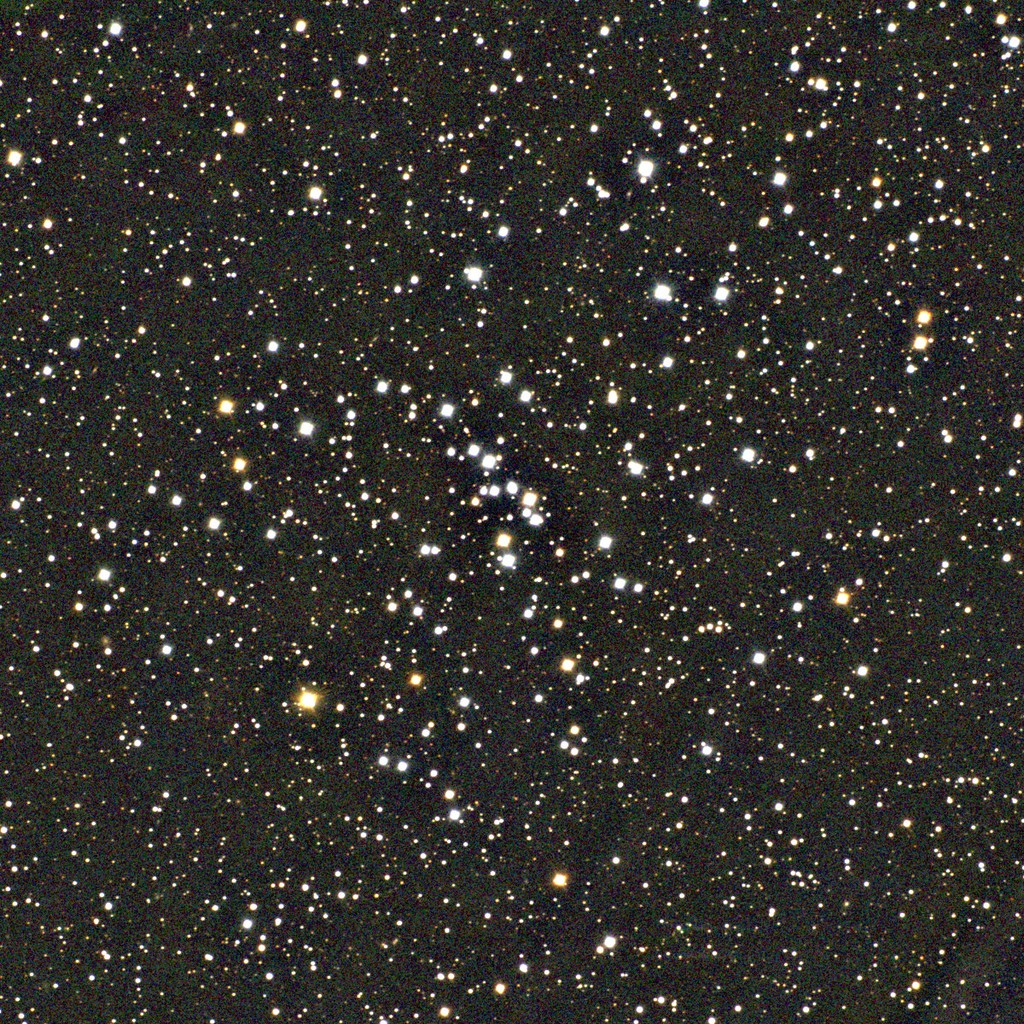
Messier 48 (NGC 2548) is a large open star cluster in the constellation Hydra, approximately 1,500 light-years from Earth and containing close to 100 stars spread across a broad area of sky. Charles Messier catalogued it on February 19, 1771, but recorded its position with a five-degree error — an unusual lapse that caused the cluster to be "lost" and unidentified for nearly two centuries. It was not until the 1950s that the American astronomer Oswald Thomas convincingly matched Messier's description to NGC 2548, making M48 perhaps the most famous of Messier's positional errors and the last of the catalog's "missing" objects to be resolved. The cluster is just visible to the naked eye from a dark site despite its modest surface brightness.
NGC 2548 is estimated to be around 300 million years old — a middle-aged open cluster — with a stellar population that shows several evolved yellow and orange giants mixed among the more numerous blue-white main-sequence members. This mix of stellar types gives the cluster a pleasant color range at the telescope. Like many open clusters of similar age, M48 is gradually losing stars to gravitational interactions with the surrounding Milky Way environment, and it is no longer as tightly bound as it was in its youth. At its distance and angular extent, the cluster covers a region of sky nearly twice the size of the full Moon.
Binoculars reveal M48 as a large, softly glowing swarm of stars in a relatively sparse area of sky; a small telescope at low power resolves the full membership into a scattered, graceful grouping. This approximately true-color image was assembled from twelve BVR exposures taken in January 1997 at the Burrell Schmidt telescope of Case Western Reserve University's Warner and Swasey Observatory on Kitt Peak.
Navigate from Alhena toward Hydra. In northern Hydra, southeast of the Cancer-Hydra border.
| Star | Bayer | Mag | Spectral Type | Distance | Meaning |
|---|---|---|---|---|---|
| Procyon | β CMi | 0.40 | F5 · Yellow-white main sequence | 11 ly | Greek for 'Before the Dog' — it rises just before Sirius, the Dog Star. One of the three vertices of the Winter Triangle. |