NOIRLab/ NSF /AURA
| Type | Galaxy | Constellation | Vir |
|---|---|---|---|
| Magnitude | 8.4 | Size | 10.2′ |
| Distance | 56.0 million light-years | Best Month | May |
| Visibility | Global | Difficulty | Easy (level 2/4) |
| Min. Aperture | binoculars | RA / Dec | 12h 29m 49.2s · +08° 00' 00" |
| Discovered by | Charles Messier, 1771 | ||
NOIRLab/ NSF /AURA
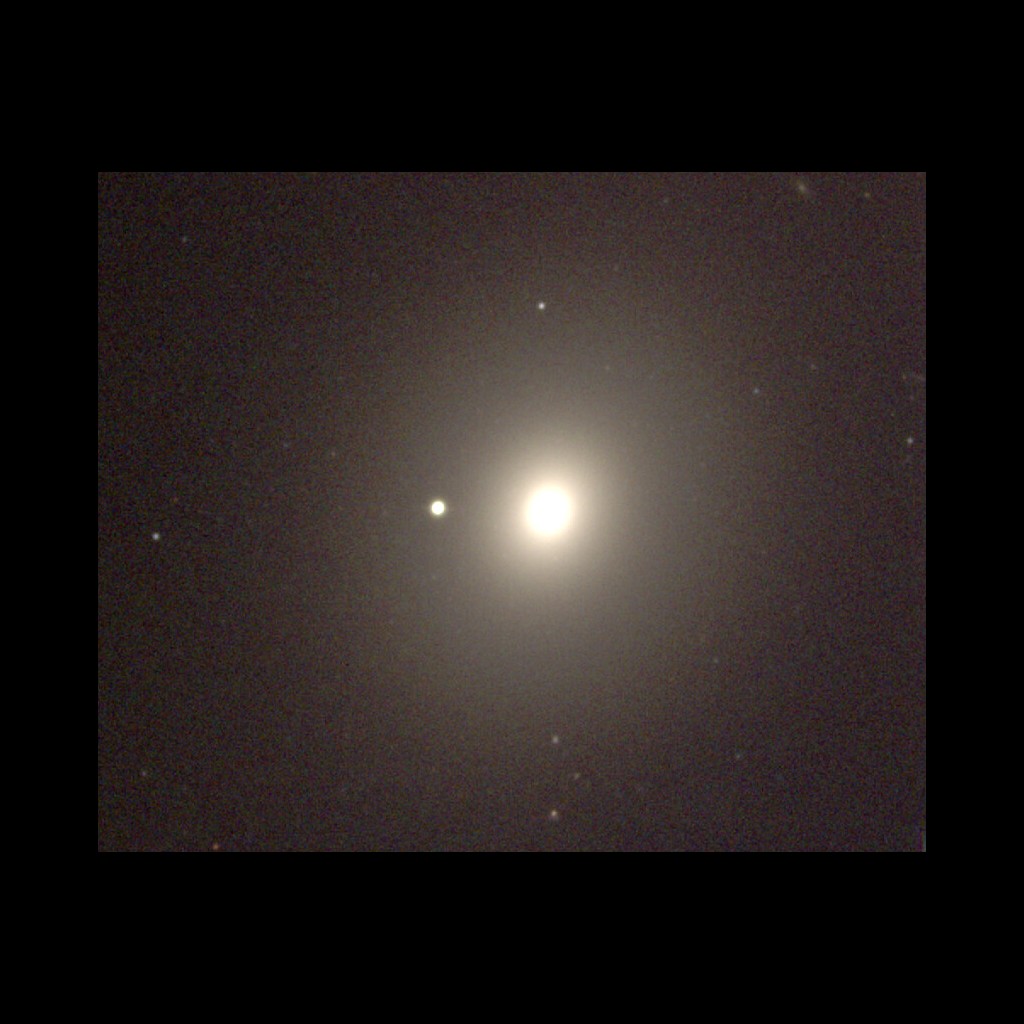
Messier 49 (NGC 4472) is a giant elliptical galaxy in the constellation Virgo, approximately 55 million light-years away, and is the brightest member of the vast Virgo Cluster of galaxies. It was discovered by Charles Messier on February 19, 1771 — making it the first Virgo Cluster galaxy to be recorded and the first extragalactic object discovered by Messier himself. NGC 4472 is classified as type E4, meaning it appears moderately flattened. Like most giant ellipticals, it has a smooth, featureless appearance: no spiral arms, no dust lanes, no visible star-forming regions — just a symmetrical, softly glowing sphere of old stars that fades gradually into the surrounding sky.
NGC 4472 is an enormous system. It contains an estimated trillion stars, has a luminosity roughly ten times that of our Milky Way, and spans nearly 160,000 light-years — one of the most massive galaxies in our cosmological neighborhood. Buried at its center is one of the most massive supermassive black holes known, with a mass of around 6 to 10 billion solar masses. The galaxy's smooth stellar population consists almost entirely of ancient red and yellow stars, with very little gas or dust remaining to fuel new star formation — a characteristic of giant ellipticals that have consumed most of their raw material in early, intense episodes of star formation billions of years ago. M49 is surrounded by a rich system of about 5,900 globular clusters.
In binoculars M49 appears as a small, star-like glow; a small telescope shows an oval smudge with a brighter central nucleus. This image was taken in December 1996 at the Kitt Peak National Observatory 0.9-meter telescope.
From Spica: In Virgo, south of the main Virgo Cluster concentration — look 12° north-northwest of Spica.
| Star | Bayer | Mag | Spectral Type | Distance | Meaning |
|---|---|---|---|---|---|
| Spica | α Vir | 0.98 | B1 · Blue-white binary | 250 ly | Latin for 'Ear of Grain' — Virgo holds a sheaf of wheat. One of the four Royal Stars of antiquity, used by Hipparchus to discover the precession of the equinoxes. |
| Denebola | — | 2.14 | A3 · White main sequence | 36 ly | Arabic Dhanab al-Asad, 'Tail of the Lion' — marks the lion's tail. One of the few stars where infrared excess suggests a debris disk. |
| Porrima | — | 2.74 | F0 · Yellow-white binary | 38 ly | Named for Porrima, Roman goddess of prophecy. One of the finest equal double stars in the sky — twin yellow-white stars orbiting each other. |
| Vindemiatrix | — | 2.85 | G8 · Yellow giant | 102 ly | Latin for 'The Grape Gatherer' — its heliacal rising in ancient times signaled the grape harvest season in the Mediterranean. |