NOIRLab/ NSF /AURA
| Type | Open Cluster | Constellation | Mon |
|---|---|---|---|
| Magnitude | 5.9 | Size | 16.0′ |
| Distance | 3,200 light-years | Best Month | February |
| Visibility | Global | Difficulty | Easy (level 2/4) |
| Min. Aperture | binoculars | RA / Dec | 07h 02m 49.2s · -08° 20' 60" |
| Discovered by | Giovanni Domenico Cassini, 1711 | ||
NOIRLab/ NSF /AURA
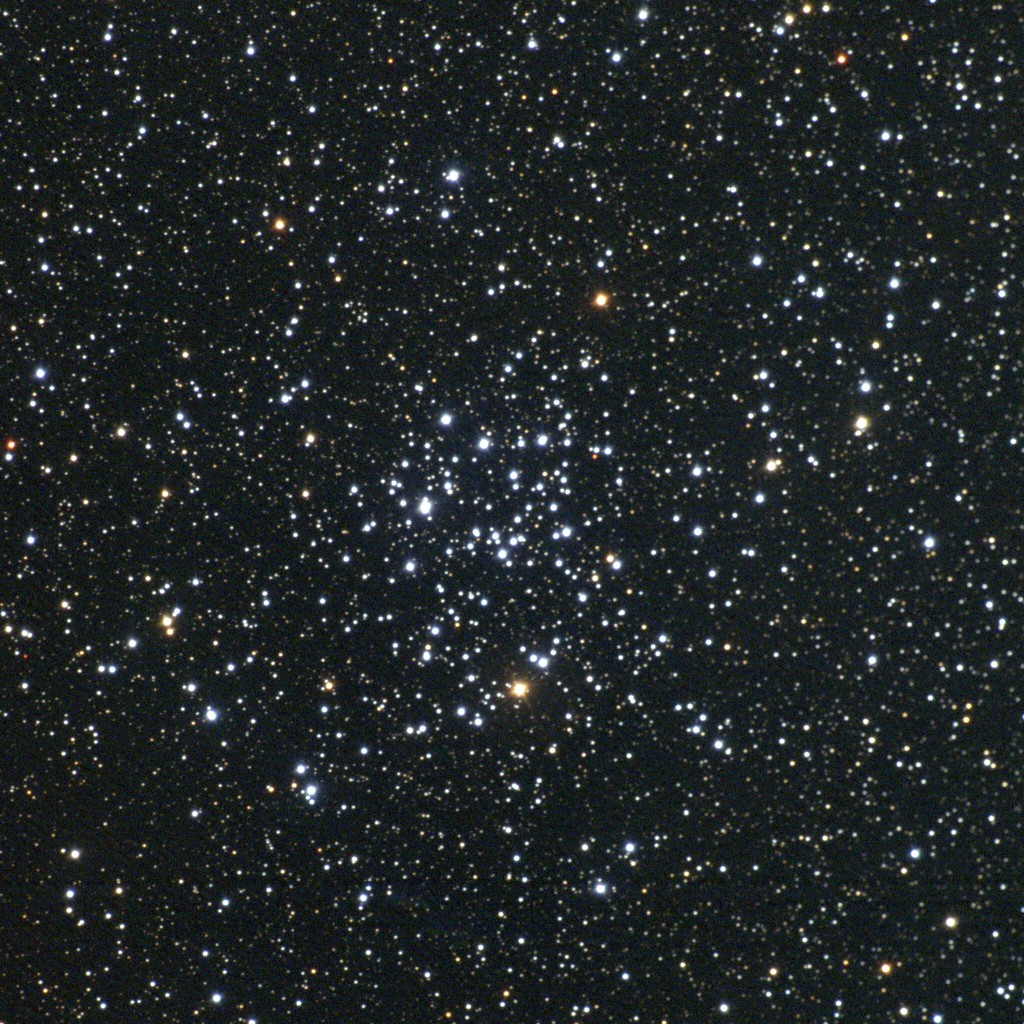
Messier 50 (NGC 2323) is an open star cluster in the constellation Monoceros (the Unicorn), located approximately 3,000 light-years from Earth and spanning about 20 light-years across. It was possibly first discovered by Giovanni Cassini around 1711, making it one of a handful of Messier objects with pre-Messier records; Charles Messier catalogued it independently on April 5, 1772. NGC 2323 contains some 200 stars and is estimated to be between 78 and 100 million years old — a relatively young cluster in which the hottest original members have barely begun to evolve off the main sequence. More fanciful observers have described its overall star pattern as heart-shaped.
NGC 2323 lies in a region of the Milky Way between Sirius and the three stars of Orion's Belt, placing it in a rich swath of the winter sky. Its stellar population is dominated by hot blue-white stars, reflecting its youth, with a scattered handful of brighter orange giants that have already evolved off the main sequence. The cluster is moderately concentrated, with a slightly denser core fading into a more diffuse outer region. A bright, reddish-orange star near the center of the cluster — a K-type giant — provides a striking color contrast against the blue-white majority.
In binoculars M50 appears as a moderate-brightness condensation in the rich winter Milky Way; a small telescope resolves it into a compact, attractive gathering of roughly 50 brighter stars over a granular background of fainter members. This approximately true-color image was assembled from twelve BVR exposures taken in September 1997 at the Burrell Schmidt telescope of Case Western Reserve University's Warner and Swasey Observatory on Kitt Peak.
Navigate from Alhena toward Monoceros. In Monoceros, between Sirius and Procyon.
| Star | Bayer | Mag | Spectral Type | Distance | Meaning |
|---|---|---|---|---|---|
| Sirius | α CMa | -1.44 | A0 · Blue-white main sequence | 8.6 ly | Greek for 'Glowing' or 'Scorching' — the brightest star in the night sky. The ancient Egyptians timed the Nile flood by its heliacal rising. |
| Mirzam | β CMa | 1.98 | B1 · Blue-white giant | 500 ly | Arabic Al-Mirzam, 'The Announcer' — rises just before Sirius, heralding the arrival of the brightest star in the sky. |