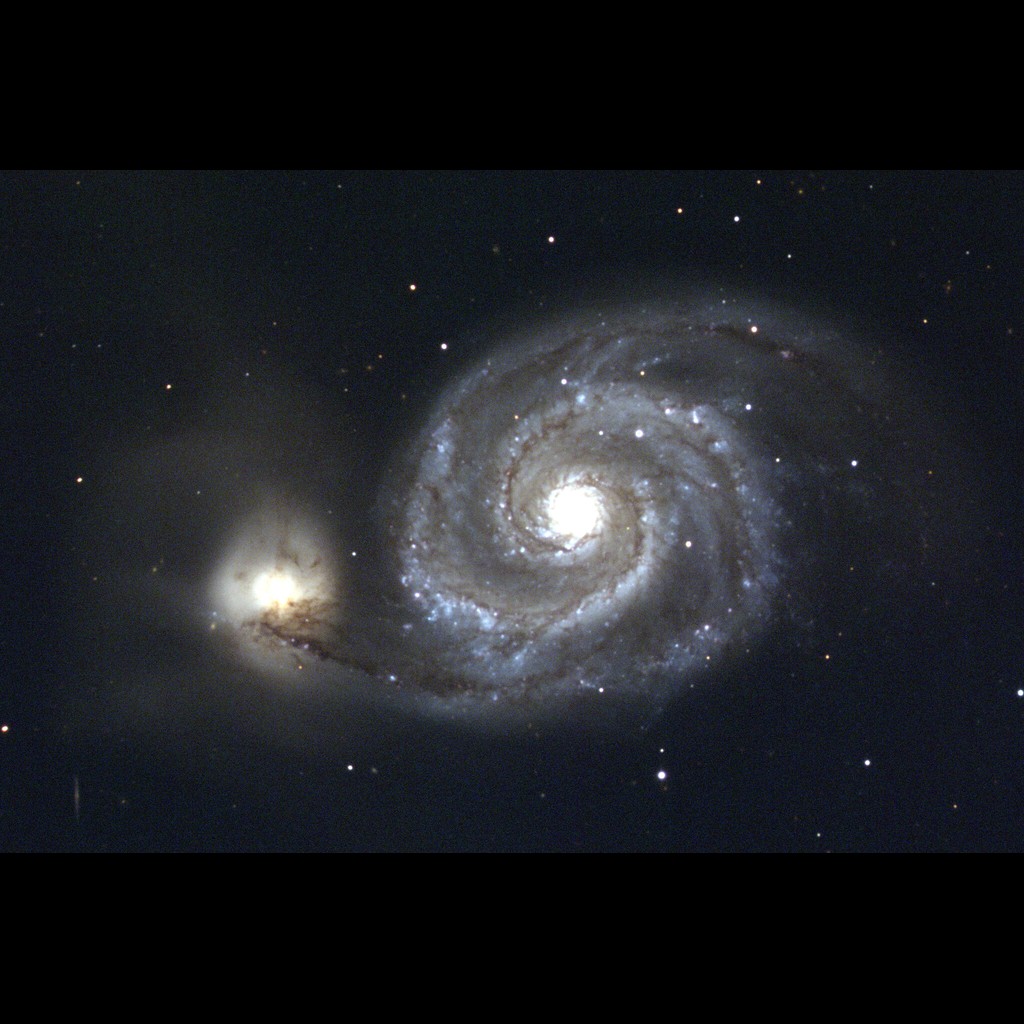
Todd Boroson/NOIRLab/NSF/AURA/
| Type | Galaxy | Constellation | CVn |
|---|---|---|---|
| Magnitude | 8.4 | Size | 11.2′ |
| Distance | 23.0 million light-years | Best Month | May |
| Visibility | Northern | Difficulty | Easy (level 2/4) |
| Min. Aperture | binoculars | RA / Dec | 13h 29m 52.8s · +47° 12' 00" |
| Discovered by | Charles Messier, 1773 | ||
Todd Boroson/NOIRLab/NSF/AURA/
Messier 51 comprises two interacting galaxies in the constellation Canes Venatici: the grand spiral NGC 5194, popularly known as the Whirlpool Galaxy, and its smaller companion NGC 5195. Charles Messier discovered the main galaxy on October 13, 1773, and Pierre Méchain noted the companion in 1781. At approximately 31 million light-years away and spanning over 65,000 light-years, NGC 5194 is a relatively nearby and luminous spiral. In 1845, the Third Earl of Rosse, observing with his great 72-inch reflecting telescope in Ireland, became the first person to detect spiral structure in a "nebula" — and M51 was the galaxy that revealed it, making Messier 51 one of the most historically significant objects in all of astronomy.
The spiral arms of NGC 5194 are among the most perfectly defined of any galaxy we can observe, and their extraordinary symmetry is likely sustained by the gravitational tidal pull of NGC 5195, whose close passage is thought to generate the density waves that compress gas and trigger star formation along the arms. The result is a galaxy ablaze with hot young O and B stars, star-forming regions, and luminous nebulae — making M51 considerably brighter than our own Milky Way despite being less massive. NGC 5195 passes behind one of NGC 5194's dust-filled arms, giving it a distinctly reddish cast where the arm's dust intervenes. The core of NGC 5194 harbors a bright ultraviolet source and one of the most compact, luminous radio sources known.
In binoculars M51 appears as a faint double smudge of light on a dark night; a 100 mm telescope shows the two galaxies clearly, and larger apertures begin to trace spiral structure in the main galaxy. This image was made by combining three CCD frames taken in red, green, and blue filters at the Kitt Peak National Observatory 0.9-meter telescope in 1991.
From Alkaid: From Alkaid (the end of the Big Dipper's handle), move 3.5° southwest — M51 sits just off the tip of the handle.
| Star | Bayer | Mag | Spectral Type | Distance | Meaning |
|---|---|---|---|---|---|
| Alioth | — | 1.76 | A0 · White giant | 83 ly | Arabic origin uncertain, possibly from 'fat tail of a sheep.' The brightest star in Ursa Major and the handle of the Big Dipper. |
| Alkaid | η UMa | 1.85 | B3 · Blue-white main sequence | 101 ly | Arabic Al-Qa'id, 'The Leader of the Daughters of the Bier' — the tip of the Big Dipper's handle, representing the chief mourner in an Arabic funeral procession. |
| Mizar | ζ UMa | 2.23 | A2 · White binary | 83 ly | Arabic Al-Marāq, 'The Groin' — the middle star of the Big Dipper's handle. The first double star discovered through a telescope (1617). |
| Phad | γ UMa | 2.41 | A0 · White main sequence | 84 ly | Arabic Al-Fakhdhah, 'The Thigh of the Bear' — marks the hip of Ursa Major, one of the four bowl stars of the Big Dipper. |
| Cor Caroli | — | 2.89 | A0 · White main sequence | 110 ly | Latin for 'Heart of Charles' — named to honor King Charles II of England. The brightest star in Canes Venatici. |
| Megrez | β UMa | 3.32 | A3 · White main sequence | 81 ly | Arabic Al-Maghriz, 'Root of the Bear's Tail' — the faintest of the seven Big Dipper stars, where the handle meets the bowl. |