NOIRLab/ NSF /AURA
| Type | Open Cluster | Constellation | Cas |
|---|---|---|---|
| Magnitude | 7.3 | Size | 13.0′ |
| Distance | 5,000 light-years | Best Month | October |
| Visibility | Northern | Difficulty | Easy (level 2/4) |
| Min. Aperture | binoculars | RA / Dec | 23h 24m 28.8s · +61° 34' 48" |
| Discovered by | Charles Messier, 1774 | ||
NOIRLab/ NSF /AURA
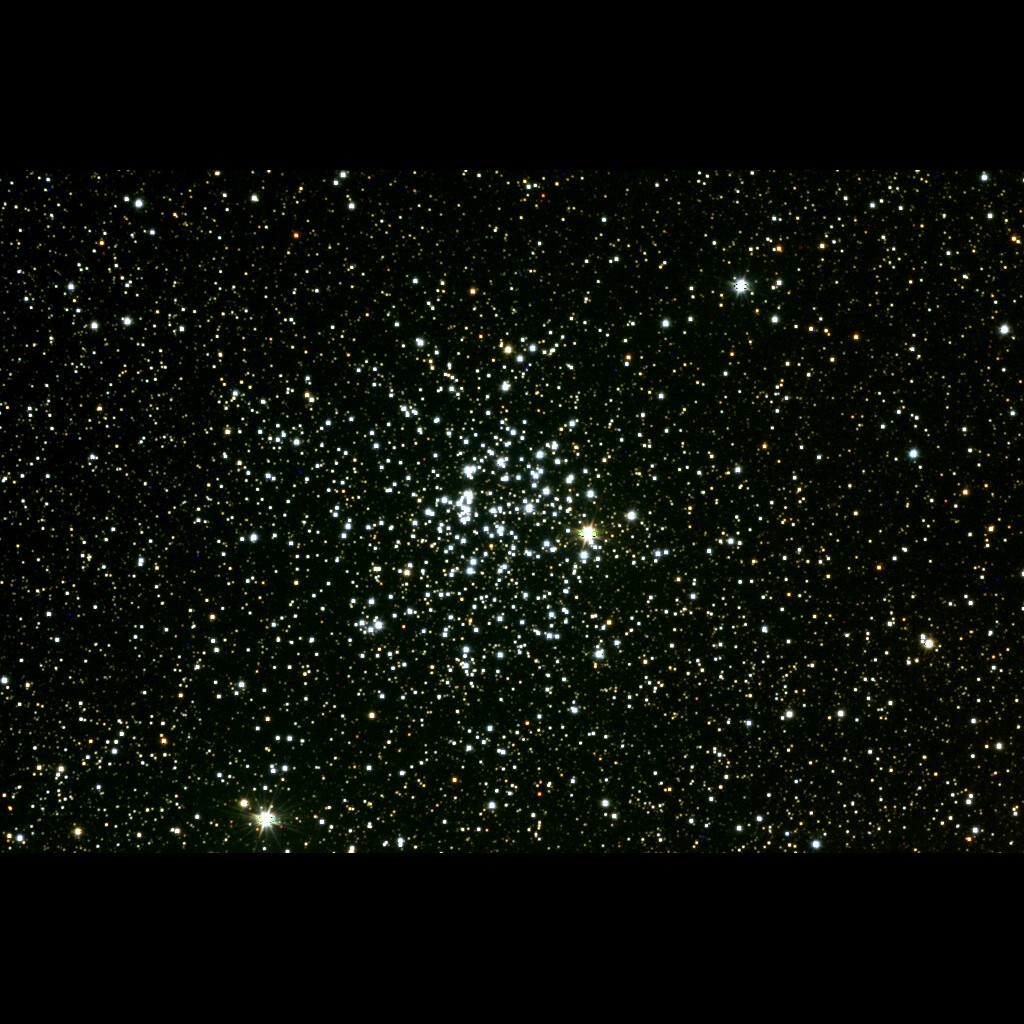
Messier 52 (NGC 7654) is a rich, compact open star cluster in the constellation Cassiopeia, lying approximately 7,000 light-years from Earth. Charles Messier discovered it on September 7, 1774, describing it as a "cluster of very small stars mixed with nebulosity." NGC 7654 contains some 190 confirmed members in a region about 19 light-years across, making it one of the richer northern open clusters. It is estimated to be between 35 and 100 million years old — young enough to retain several hot blue stars, yet mature enough to show a few evolved orange giants among its membership.
NGC 7654 is a well-concentrated cluster with a noticeably denser core surrounded by a more diffuse outer halo of fainter members. A conspicuous reddish-orange star is visible slightly right of center in this image — it is a foreground object, not a genuine cluster member, but its warm color provides a pleasing visual contrast to the bluer cluster stars behind it. The nearby Bubble Nebula (NGC 7635), a spectacular emission nebula produced by a massive Wolf-Rayet star, lies approximately half a degree to the southwest of M52 and can sometimes be captured in the same wide-field image, making the Cassiopeia region doubly rewarding.
Through binoculars M52 appears as a compressed, slightly nebulous glow; a small telescope at moderate power resolves several dozen stars with a distinctly brighter center, and the lone orange foreground star stands out immediately. This color image was assembled from red, green, and blue CCD exposures taken at the Burrell Schmidt telescope of Case Western Reserve University's Warner and Swasey Observatory on Kitt Peak.
From Caph: From Caph (Beta Cassiopeiae), sweep 6° east-southeast — near the Bubble Nebula (C11).
| Star | Bayer | Mag | Spectral Type | Distance | Meaning |
|---|---|---|---|---|---|
| Cih | α Cas | 2.15 | B0 · Blue-white supergiant | 550 ly | Chinese name meaning 'The Whip' — the middle star of Cassiopeia's W, marking the queen's waist. A luminous blue variable. |
| Shedir | γ Cas | 2.24 | K0 · Orange giant | 229 ly | Arabic Al-Sadr, 'The Breast' — marks the heart of Cassiopeia the Queen on her throne. A slowly varying orange giant. |
| Caph | β Cas | 2.28 | F2 · White giant | 54 ly | Arabic Al-Kaff, 'The Hand' or 'The Palm' — marks the tip of the W-shape of Cassiopeia. A pulsating variable star. |
| Alderamin | α Cep | 2.45 | A7 · White subgiant | 49 ly | Arabic Al-Dhirā' al-Yamīn, 'The Right Arm' of Cepheus. Due to precession, it will become the North Star around 7500 CE. |
| Ruchbah | δ Cas | 2.66 | A5 · White giant binary | 99 ly | Arabic Al-Rukbah, 'The Knee' of Cassiopeia — one of the W-shaped stars of the queen, an eclipsing binary that dips in brightness periodically. |