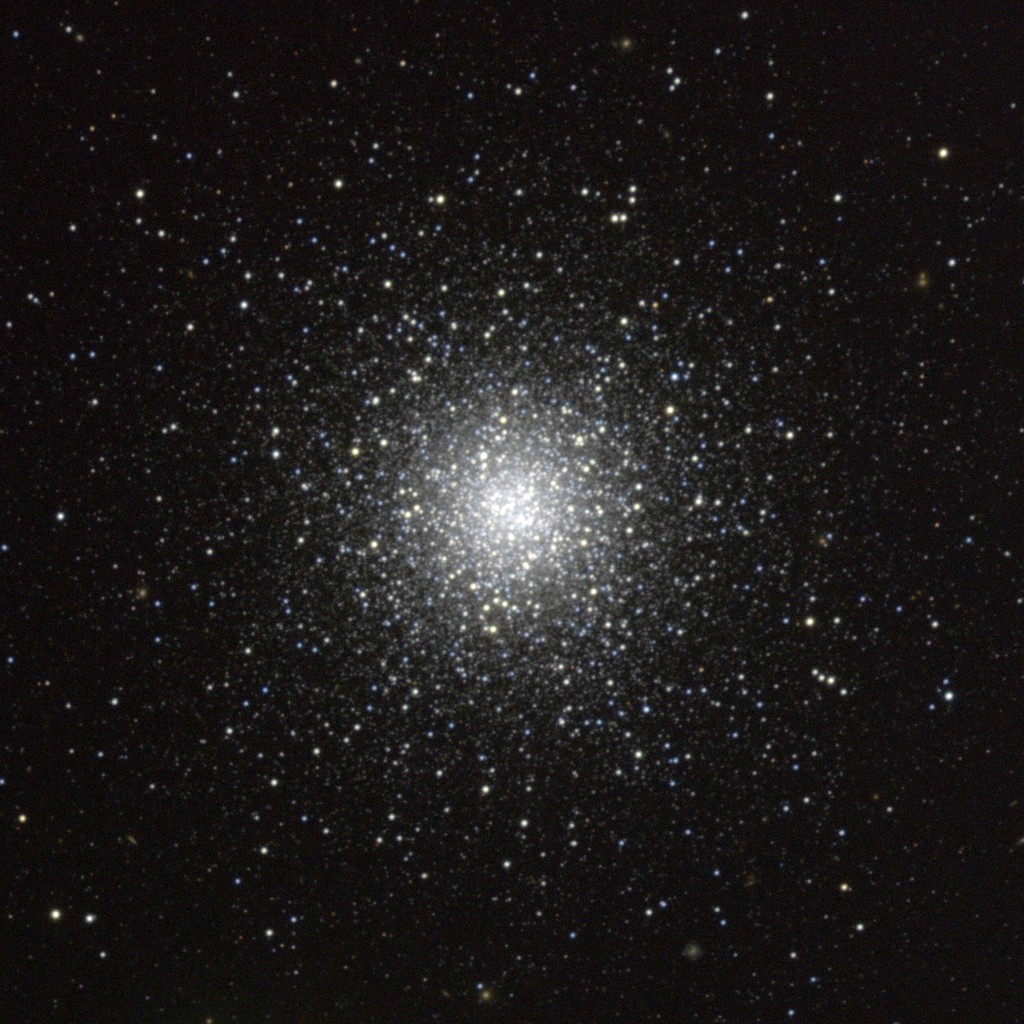
REU Program/NOIRLab/ NSF /AURA
| Type | Globular Cluster | Constellation | Com |
|---|---|---|---|
| Magnitude | 7.6 | Size | 12.6′ |
| Distance | 58,000 light-years | Best Month | May |
| Visibility | Northern | Difficulty | Moderate (level 3/4) |
| Min. Aperture | 3in | RA / Dec | 13h 12m 54.0s · +18° 10' 12" |
| Discovered by | Johann Elert Bode, 1775 | ||
REU Program/NOIRLab/ NSF /AURA
Messier 53 (NGC 5024) is a large, rich globular cluster in the constellation Coma Berenices, remarkable for its extreme distance: roughly 60,000 light-years from Earth and approximately 60,000 light-years from the galactic center as well — placing it among the most remote globular clusters in Messier's catalog. It was discovered by Johann Elert Bode in 1775 and independently catalogued by Charles Messier on February 26, 1777. NGC 5024 contains several hundred thousand stars spread across about 220 light-years, with a well-defined concentrated core that makes it a conspicuous object even at its great distance.
Because NGC 5024 lies so far from the galactic center — almost as far from the center as it is from us — it spends much of its orbit in the distant halo of the Milky Way, relatively free from the tidal forces that can disrupt clusters closer to the core. It is an ancient system, estimated at around 12.7 billion years old, and its stellar population is correspondingly metal-poor: its stars were forged early in the Universe from primordial hydrogen and helium with relatively little of the heavier elements that later stellar generations produced. NGC 5024 is one of only a few Messier globulars that can be compared directly with an even more remote neighbor: NGC 5053, a much sparser globular cluster, lies just a degree to the southeast.
A small telescope shows M53 as a bright, round glow with a noticeably brighter nucleus; 150 mm aperture begins to resolve stars at the edges. This image was assembled from exposures taken at the Kitt Peak National Observatory 0.9-meter telescope in July 1997 and again in May 1998, as part of the Research Experiences for Undergraduates (REU) program supported by the National Science Foundation.
From Arcturus: In Coma Berenices, near the bright star Alpha Comae Berenices.
| Star | Bayer | Mag | Spectral Type | Distance | Meaning |
|---|---|---|---|---|---|
| Arcturus | α Boo | -0.05 | K2 · Orange giant | 37 ly | Greek Arktouros, 'Guardian of the Bear' — it follows Ursa Major across the sky. The brightest star in the northern hemisphere. |
| Mufrid | β Boo | 2.68 | G0 · Yellow subgiant | 37 ly | Arabic Al-Mufrid, 'The Solitary Star of the Lancer' — close companion to brilliant Arcturus in the sky, though not physically related. |
| Vindemiatrix | — | 2.85 | G8 · Yellow giant | 102 ly | Latin for 'The Grape Gatherer' — its heliacal rising in ancient times signaled the grape harvest season in the Mediterranean. |