REU Program/NOIRLab/ NSF /AURA
| Type | Globular Cluster | Constellation | Sgr |
|---|---|---|---|
| Magnitude | 7.7 | Size | 9.1′ |
| Distance | 87,400 light-years | Best Month | August |
| Visibility | Global | Difficulty | Moderate (level 3/4) |
| Min. Aperture | 3in | RA / Dec | 18h 55m 04.8s · -30° 28' 48" |
| Discovered by | Charles Messier, 1778 | ||
REU Program/NOIRLab/ NSF /AURA
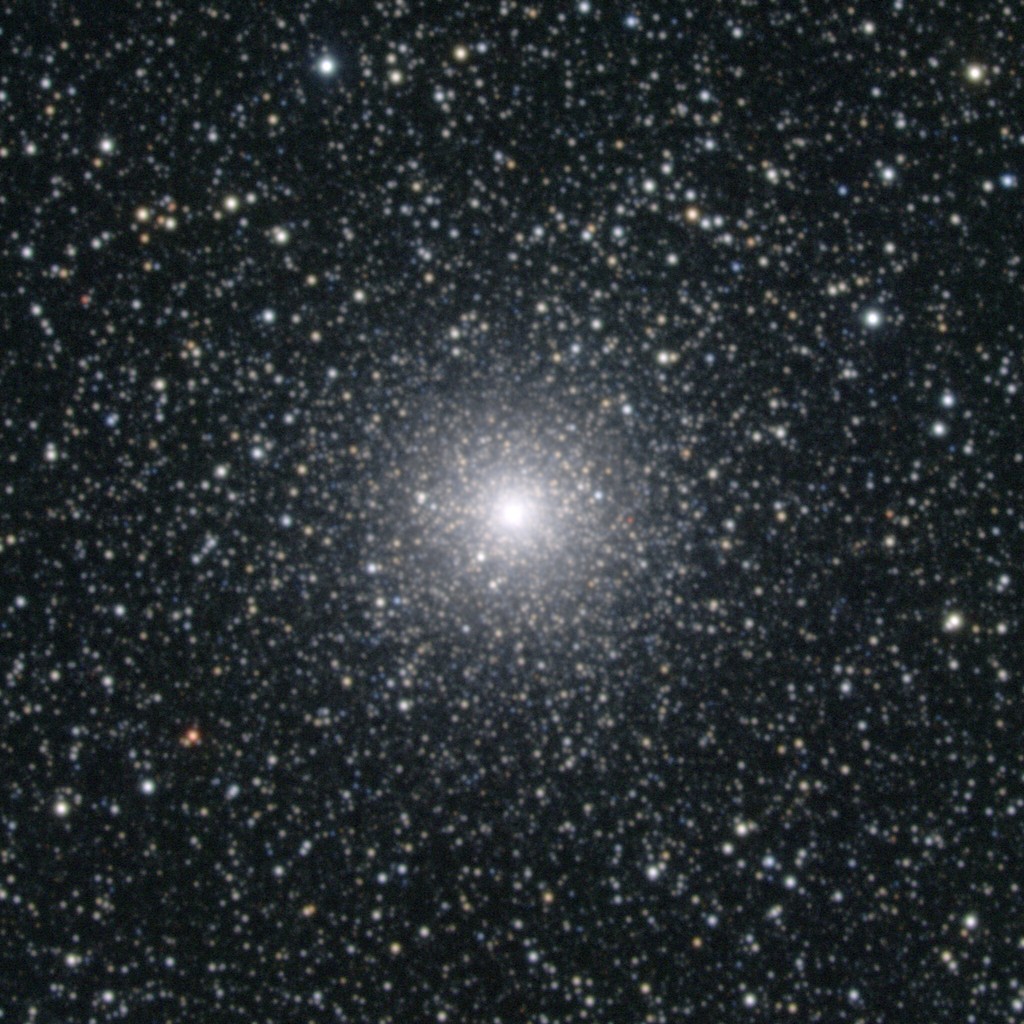
Messier 54 (NGC 6715) is a luminous, compact globular cluster in the constellation Sagittarius — and one of the most remarkable objects in Messier's catalog, because it is not a member of our own Milky Way. Charles Messier discovered it on July 24, 1778, and for over two centuries it was assumed to be a remote Milky Way globular at about 60,000 light-years. In 1994, however, the discovery of the Sagittarius Dwarf Elliptical Galaxy revealed that NGC 6715 lies at the core of this small satellite galaxy being cannibalized by the Milky Way — at a true distance of approximately 87,000 light-years. M54 is thus the first extragalactic globular cluster to be identified, and a fascinating relic of the ongoing tidal disruption of a dwarf galaxy.
NGC 6715 is a dense, concentrated cluster with a bright but unresolved core. It contains millions of stars in an extremely compact volume — more like the nucleus of a small galaxy than a typical Milky Way globular — and its extraordinary central density makes it difficult to resolve even with large telescopes. The Sagittarius Dwarf Elliptical Galaxy, of which M54 marks the center, has already been largely disrupted by the Milky Way's gravity: its stars are being strewn into long tidal streams that wrap around our galaxy like scarves, some of which have been traced across much of the sky.
A small telescope shows M54 as a bright, compact, star-like nucleus with a very slight haze; its extreme distance makes individual star resolution nearly impossible without very large apertures. This composite image was made at the Kitt Peak National Observatory 0.9-meter telescope in July 1998 during the Research Experiences for Undergraduates (REU) program supported by the National Science Foundation.
Navigate from Vega toward Sagittarius. In deep southern Sagittarius near the star Zeta Sagittarii.
| Star | Bayer | Mag | Spectral Type | Distance | Meaning |
|---|---|---|---|---|---|
| Shaula | — | 1.62 | B1 · Blue-white subgiant | 700 ly | Arabic Al-Shawlā', 'The Raised Tail' — the stinger of Scorpius, one of the brightest stars in the southern sky and a navigation star. |
| Kaus Australis | ε Sgr | 1.79 | B9 · Blue-white giant | 143 ly | Hybrid Arabic-Latin, 'Southern Bow' — the brightest star in Sagittarius, at the base of the Archer's bow. Part of the Teapot asterism. |
| Nunki | ζ Sgr | 2.05 | B2 · Blue-white main sequence | 228 ly | Babylonian origin — one of the oldest known star names, from the Babylonian star catalogue. Associated with the sacred city of Eridu. |
| Kaus Meridionalis | δ Sgr | 2.72 | K3 · Orange giant | 306 ly | Hybrid Arabic-Latin, 'Middle of the Bow' — the central bow star of Sagittarius, part of the famous Teapot asterism. |
| Kaus Borealis | — | 2.82 | K1 · Orange giant | 78 ly | Hybrid Arabic-Latin, 'Northern Bow' — marks the top of the Archer's bow in Sagittarius. Part of the Teapot asterism. |
| Nash | — | 2.98 | K0 · Orange giant | 97 ly | Arabic Al-Nasl, 'The Arrowhead' or 'The Point' — marks the tip of the Archer's arrow aimed at the heart of Scorpius. |