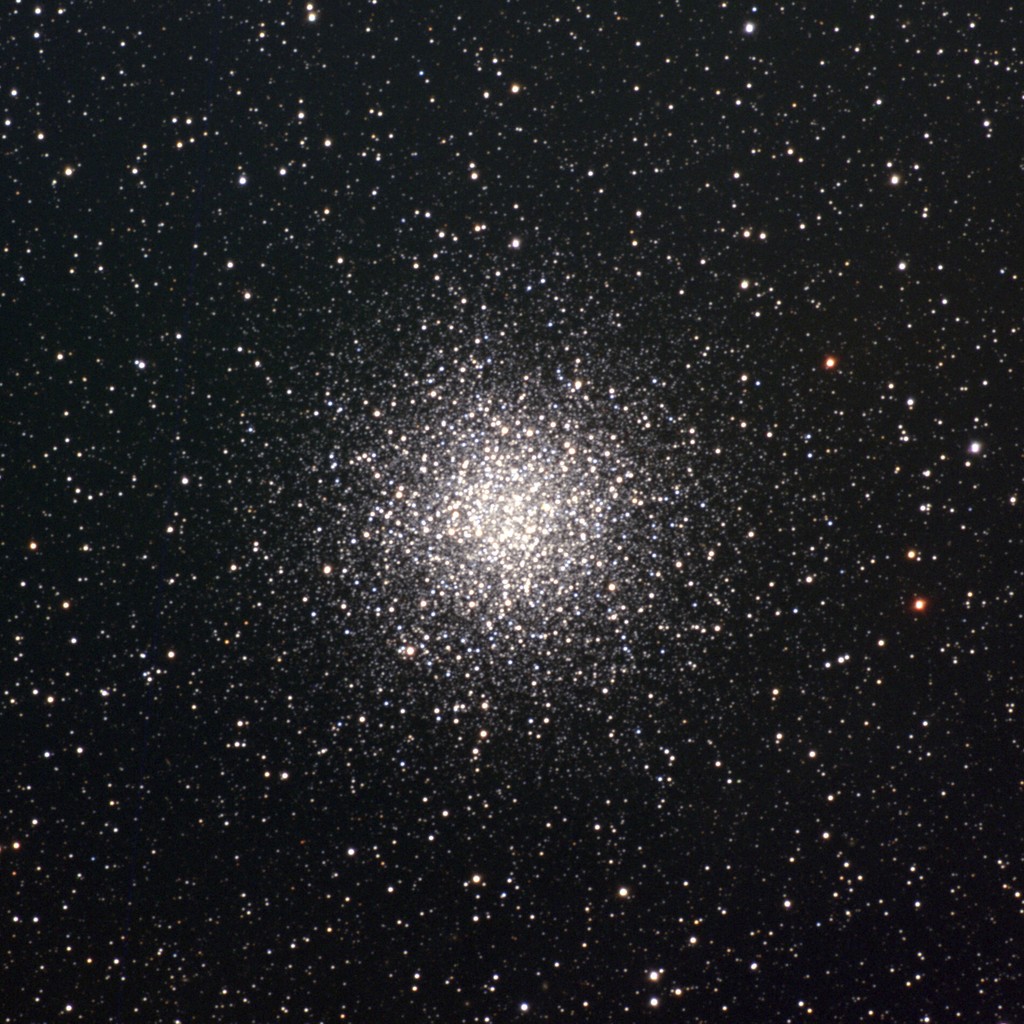
Hillary Mathis, REU Program/NOIRLab/ NSF /AURA
| Type | Globular Cluster | Constellation | Sgr |
|---|---|---|---|
| Magnitude | 7.0 | Size | 19.0′ |
| Distance | 17,600 light-years | Best Month | August |
| Visibility | Global | Difficulty | Easy (level 2/4) |
| Min. Aperture | binoculars | RA / Dec | 19h 40m 01.2s · -30° 58' 12" |
| Discovered by | Nicolas Louis de Lacaille, 1752 | ||
Hillary Mathis, REU Program/NOIRLab/ NSF /AURA
Messier 55 (NGC 6809) is a large, nearby globular cluster in the constellation Sagittarius, lying approximately 18,000 light-years from Earth and spanning about 100 light-years — one of the physically largest globular clusters in Messier's catalog. It was first recorded by Nicolas Louis de Lacaille in 1752 from the Cape of Good Hope; Charles Messier repeatedly attempted to observe it from Paris but found it too low in the southern sky, only finally cataloguing it on July 24, 1778. Despite its large angular size — covering roughly two-thirds the diameter of the full Moon — M55 is a notoriously difficult object for northern observers because it never climbs high above the southern horizon from mid-northern latitudes.
NGC 6809 is one of the most loosely structured globular clusters known, with a very low central concentration and a gradual, nearly uniform distribution of stars from center to edge — so sparse that it barely resembles the tight, condensed systems typical of Messier's other globulars. This loose structure likely reflects the cluster's relatively uncrowded history: it has spent much of its existence far from the galactic center, spared the tidal disruption and dynamical evolution that compresses more centrally located clusters. Despite its diffuse appearance, M55 is an ancient system, estimated at about 12.3 billion years old, with a metal-poor stellar population typical of the earliest generations of stars.
From southern latitudes M55 is a showpiece, easily visible to the naked eye and beautiful in binoculars; from the northern hemisphere it requires a clear southern horizon and exceptional atmospheric transparency. This image was made in June 1996 at the Burrell Schmidt telescope of Case Western Reserve University's Warner and Swasey Observatory on Kitt Peak, as part of the Research Experiences for Undergraduates (REU) program supported by the National Science Foundation.
Navigate from Vega toward Sagittarius. Deep in southern Sagittarius — low from northern latitudes, best from the tropics southward.
| Star | Bayer | Mag | Spectral Type | Distance | Meaning |
|---|---|---|---|---|---|
| Kaus Australis | ε Sgr | 1.79 | B9 · Blue-white giant | 143 ly | Hybrid Arabic-Latin, 'Southern Bow' — the brightest star in Sagittarius, at the base of the Archer's bow. Part of the Teapot asterism. |
| Nunki | ζ Sgr | 2.05 | B2 · Blue-white main sequence | 228 ly | Babylonian origin — one of the oldest known star names, from the Babylonian star catalogue. Associated with the sacred city of Eridu. |
| Kaus Meridionalis | δ Sgr | 2.72 | K3 · Orange giant | 306 ly | Hybrid Arabic-Latin, 'Middle of the Bow' — the central bow star of Sagittarius, part of the famous Teapot asterism. |
| Kaus Borealis | — | 2.82 | K1 · Orange giant | 78 ly | Hybrid Arabic-Latin, 'Northern Bow' — marks the top of the Archer's bow in Sagittarius. Part of the Teapot asterism. |