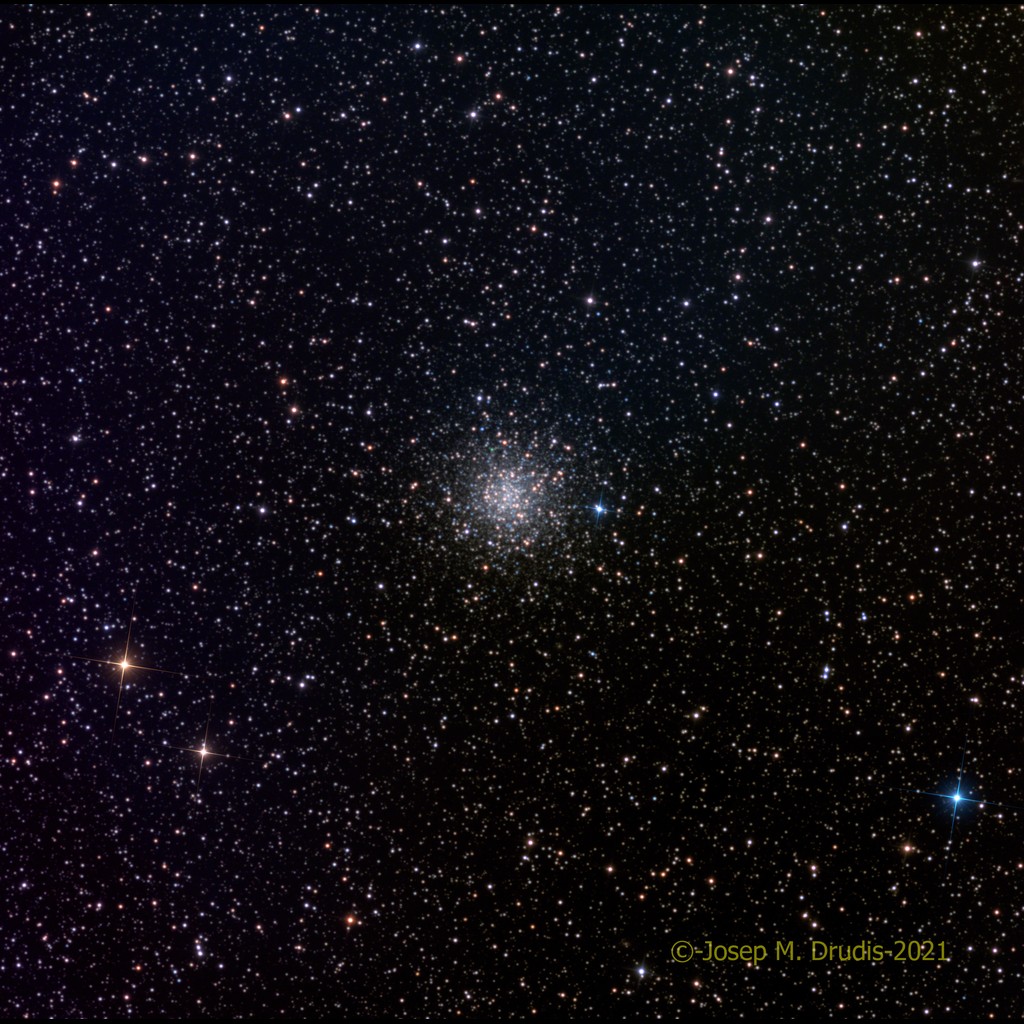
Copyright 2021 - Josep M. Drudis
| Type | Globular Cluster | Constellation | Lyr |
|---|---|---|---|
| Magnitude | 8.3 | Size | 7.1′ |
| Distance | 32,900 light-years | Best Month | August |
| Visibility | Northern | Difficulty | Moderate (level 3/4) |
| Min. Aperture | 3in | RA / Dec | 19h 16m 37.2s · +30° 10' 48" |
| Discovered by | Charles Messier, 1779 | ||
Copyright 2021 - Josep M. Drudis
Messier 56 (NGC 6779) is a globular cluster in the constellation Lyra, located approximately 33,000 light-years from Earth, not far in the sky from the famous Ring Nebula (M57). Charles Messier discovered it on January 19, 1779. NGC 6779 shines at apparent magnitude 8.3 and contains around 80,000 stars with a combined mass of roughly 230,000 solar masses. Though less famous than Lyra's other Messier object, M56 is a respectable globular for small telescopes and rewards a comparison with M57 in the same binocular or wide-field eyepiece sweep.
NGC 6779 is notable for two peculiarities that distinguish it from most Milky Way globular clusters. First, it is suspected to be a captured object: one leading theory holds that M56 is the remnant of a small dwarf galaxy or giant globular cluster that was absorbed by the Milky Way in the distant past — the same origin proposed for Omega Centauri (NGC 5139), the largest globular in the sky. This possible extragalactic heritage may explain the second curiosity: M56 follows a retrograde orbit around the galactic center, moving in the opposite direction from most Milky Way globulars. Retrograde orbits are a signature of objects accreted from satellite galaxies, which approach from random directions rather than sharing the systematic rotation of the Milky Way disk.
In binoculars M56 is a faint, round haze; a small telescope at moderate power shows a slightly concentrated glow with a marginally brighter center, and a 200 mm aperture begins to resolve stars at the edges.
From Vega: Roughly midway between Vega (Lyra) and Albireo (Beta Cygni).
| Star | Bayer | Mag | Spectral Type | Distance | Meaning |
|---|---|---|---|---|---|
| Vega | α Lyr | 0.03 | A0 · Blue-white main sequence | 25 ly | Arabic Wāqi', 'The Swooping Eagle' — the fifth brightest star and anchor of the Summer Triangle. Will become the North Star around 13,727 CE. |
| Sadr | γ Cyg | 2.23 | F8 · Yellow-white supergiant | 1800 ly | Arabic Al-Sadr, 'The Breast' — marks the center of Cygnus the Swan, where the Northern Cross intersects. Surrounded by the North America Nebula. |
| Albireo | β Cyg | 3.05 | K3 · Orange giant + blue companion | 430 ly | Origin uncertain, possibly corrupted Latin or Arabic. Famous as one of the most beautiful double stars in the sky — gold and blue. |
| Sheliak | γ Lyr | 3.52 | A8 · Blue-white eclipsing binary | 960 ly | Arabic Al-Sheliak, 'The Tortoise' or 'The Lyre' — an eclipsing binary in Lyra that was one of the first variable stars discovered, in 1784. |