N.A.Sharp, REU program/NOIRLab/ NSF /AURA
| Type | Planetary Nebula | Constellation | Lyr |
|---|---|---|---|
| Magnitude | 8.8 | Size | 1.4′ |
| Distance | 2,300 light-years | Best Month | August |
| Visibility | Northern | Difficulty | Easy (level 2/4) |
| Min. Aperture | binoculars | RA / Dec | 18h 53m 34.8s · +33° 01' 48" |
| Discovered by | Antoine Darquier de Pellepoix, 1779 | ||
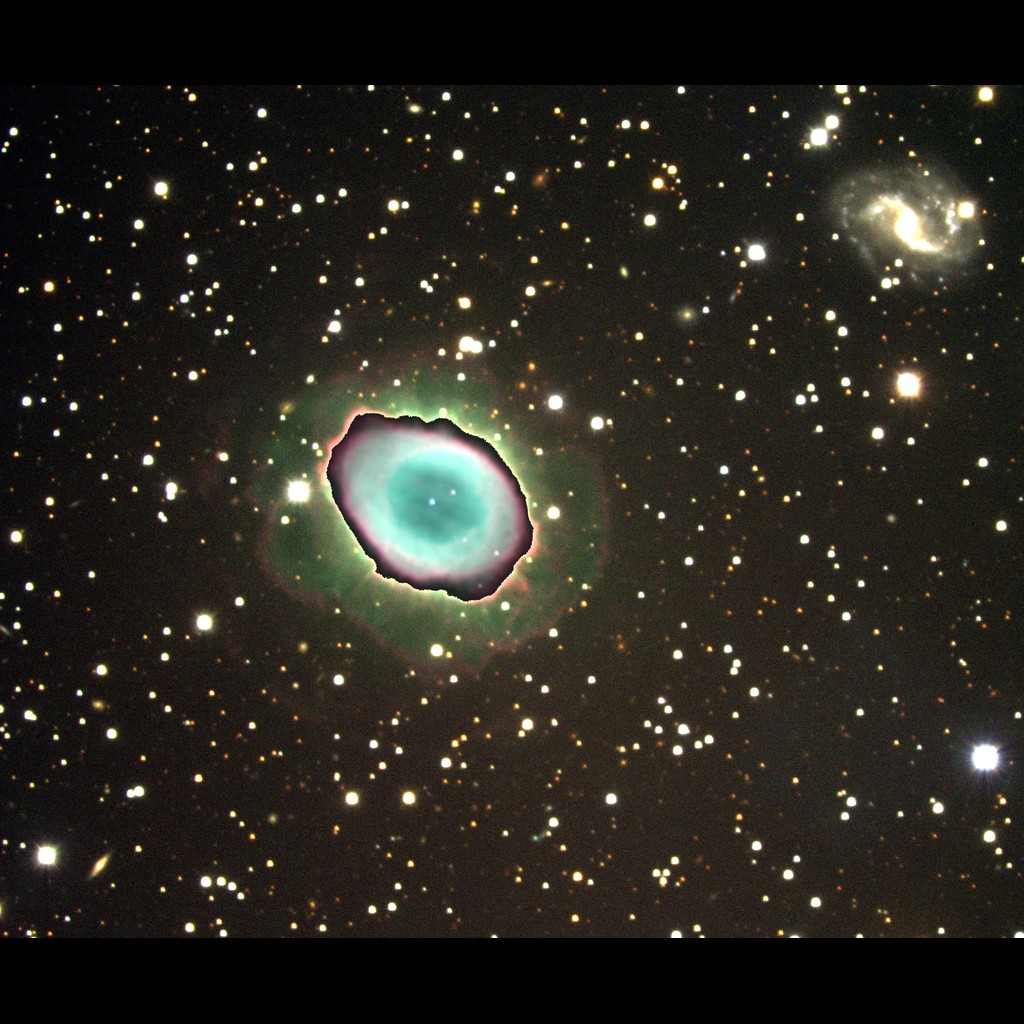
N.A.Sharp, REU program/NOIRLab/ NSF /AURA
Messier 57 (NGC 6720), the Ring Nebula, is one of the most recognizable and frequently observed objects in the summer sky — a tiny, luminous smoke ring floating in the constellation Lyra between the two stars Sulafat and Sheliak. It was discovered independently by Antoine Darquier de Pellepoix and Charles Messier in January 1779, the same month Messier also found M56 in the same constellation. The Ring Nebula is a planetary nebula: the glowing shell of gas cast off by a dying Sun-like star as it consumed the last of its nuclear fuel and collapsed into a white dwarf — the tiny, intensely hot stellar remnant visible at the geometric center of the ring. The nebula lies approximately 2,300 light-years away.
NGC 6720 is more complex than its simple ring suggests. The familiar bright annulus is merely the inner, densest part of a layered structure: an outer, much fainter envelope of gas extends well beyond the visible ring, as this deep image reveals. The colors of the nebula track the physical conditions as gas expands and cools: the innermost region around the white dwarf glows blue-green from oxygen emission; the familiar ring shines red from hydrogen and nitrogen; and the outermost faint halo fades to lower-excitation species. A small faint background galaxy, IC 1296, can be seen to the upper right — normally invisible in shorter exposures but captured here in this deep image.
The Ring Nebula is a telescopic showpiece visible in any instrument, appearing as a distinctly non-stellar, oval smoke ring even in small telescopes; 200 mm aperture shows the annular structure clearly. This image was made at the Kitt Peak National Observatory 2.1-meter telescope during the year 2000 Research Experiences for Undergraduates (REU) program; a "double exposure" technique was used to show both the detailed outer structure and the normally saturated inner regions simultaneously.
From Vega: Between Sheliak (Beta Lyrae) and Sulafat (Gamma Lyrae) — roughly halfway between the two southern stars of the Lyra parallelogram.
| Star | Bayer | Mag | Spectral Type | Distance | Meaning |
|---|---|---|---|---|---|
| Vega | α Lyr | 0.03 | A0 · Blue-white main sequence | 25 ly | Arabic Wāqi', 'The Swooping Eagle' — the fifth brightest star and anchor of the Summer Triangle. Will become the North Star around 13,727 CE. |
| Sadr | γ Cyg | 2.23 | F8 · Yellow-white supergiant | 1800 ly | Arabic Al-Sadr, 'The Breast' — marks the center of Cygnus the Swan, where the Northern Cross intersects. Surrounded by the North America Nebula. |
| Albireo | β Cyg | 3.05 | K3 · Orange giant + blue companion | 430 ly | Origin uncertain, possibly corrupted Latin or Arabic. Famous as one of the most beautiful double stars in the sky — gold and blue. |
| Sheliak | γ Lyr | 3.52 | A8 · Blue-white eclipsing binary | 960 ly | Arabic Al-Sheliak, 'The Tortoise' or 'The Lyre' — an eclipsing binary in Lyra that was one of the first variable stars discovered, in 1784. |