NOIRLab/ NSF /AURA/
| Type | Galaxy | Constellation | Vir |
|---|---|---|---|
| Magnitude | 9.7 | Size | 5.9′ |
| Distance | 62.0 million light-years | Best Month | May |
| Visibility | Global | Difficulty | Moderate (level 3/4) |
| Min. Aperture | 3in | RA / Dec | 12h 37m 48.0s · +11° 49' 12" |
| Discovered by | Charles Messier, 1779 | ||
NOIRLab/ NSF /AURA/
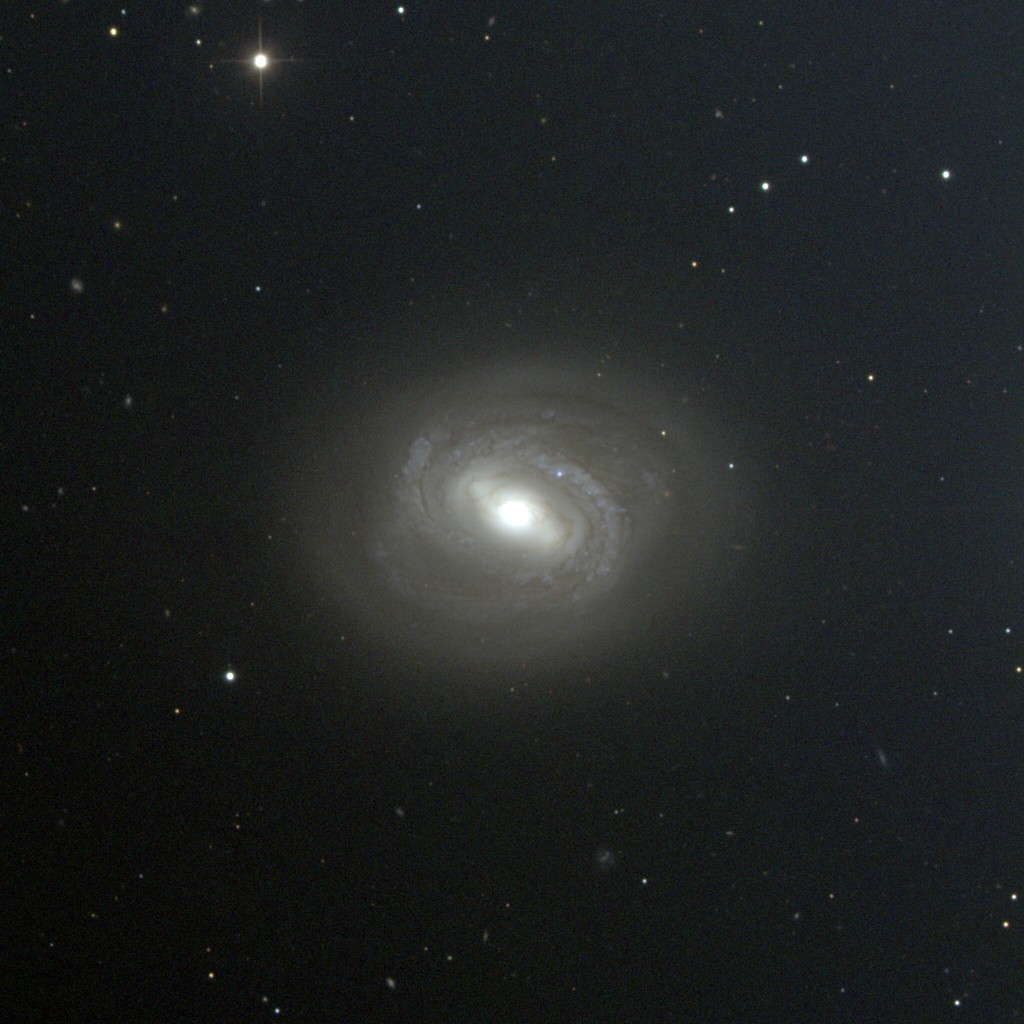
Messier 58 (NGC 4579) is a barred spiral galaxy in the constellation Virgo, approximately 60 million light-years away as a member of the vast Virgo Cluster of galaxies — the dominant cluster in our Local Supercluster. It was discovered by Charles Messier on April 15, 1779, and is one of the brightest galaxies in the Virgo Cluster, shining at apparent magnitude 9.7. NGC 4579 is classified as type SBc, indicating a weakly barred spiral, though the bar is not prominent and some classifications place it intermediate between a barred and normal spiral. At this distance, it is one of the first galaxies for which astronomers derived a reliable recession velocity, helping establish the expanding nature of the Universe.
NGC 4579 shows hints of spiral structure in deep images, though from our moderately inclined viewing angle the arms are not as dramatically displayed as in a face-on spiral. Its nucleus contains a low-luminosity active galactic nucleus — an accreting supermassive black hole that contributes a slightly non-stellar component to the core brightness. The Virgo Cluster, of which M58 is a conspicuous member, contains over 1,300 confirmed galaxies within a region roughly 8 million light-years across; sixteen other Messier objects are also members, including M49, M59, M60, M84, M85, M86, M87, M88, M89, M90, M91, M98, M99, M100, and M61.
In a small telescope M58 appears as a faint, oval glow with a slightly brighter nucleus; larger apertures hint at elongation and a brighter center. This CCD composite was made in April 1998 at the Kitt Peak National Observatory 0.9-meter telescope.
Navigate from Spica toward Virgo. In the heart of the Virgo Galaxy Cluster — best found by sweeping from Denebola or Vindemiatrix.
| Star | Bayer | Mag | Spectral Type | Distance | Meaning |
|---|---|---|---|---|---|
| Denebola | — | 2.14 | A3 · White main sequence | 36 ly | Arabic Dhanab al-Asad, 'Tail of the Lion' — marks the lion's tail. One of the few stars where infrared excess suggests a debris disk. |
| Vindemiatrix | — | 2.85 | G8 · Yellow giant | 102 ly | Latin for 'The Grape Gatherer' — its heliacal rising in ancient times signaled the grape harvest season in the Mediterranean. |